Monday, May 16, 2016

No Bells - part two. Focus

I ran across an article: School Bells Interfere With Learning but unfortunately it has some points backwards. It misinterprets much of the what and why of bells and classes. Let me explain.
"... because we partition students into neat packages called subjects, they are implicitly taught that learning is something we do in compartments."
Actually, this is called focus (or uni-tasking) and we aren't partitioning the students at all. We're separating the subjects for three reasons: so the students can concentrate on one thing at a time, so that the most competent teachers for each subject can teach them and so the students don't have to have the exact same schedule of learning - each is able to specialize in his or her own way.

It's a NEW IDEA called differentiating.

Since students aren't going through the day in lockstep with all of their classmates, we must keep to a schedule so that everyone's time and preparation can be utilized most effectively.
If you try and introduce a little bit of another subject in your subject, students object, saying "This isn't English, Mr. Wees. Teach us Mathematics." (I've actually had students tell me that). Where in the real world is learning sectioned off like this?
Frankly, everywhere. Learning is always focused on one topic. When was the last time you attended a college class called "College Algebra and British Lit as used in Cobol programming?" Teaching at the elementary grades is cross-curricular by nature. The higher you rise, the more likely you're going to specialize. Not only is each student's course mix different but the levels are, too. One freshman may take Honors Algebra2, Spanish 3 and H.English but the other takes CP English, CPAlgebra1 and Spanish1.

Then, there's competence. I can teach Physics and any level of math, but I'd be fooling myself if I thought I could do Biology, History or Latin. I hate it when some other teachers try to teach math because they invariably screw up and I'm sure the English teachers would complain about my writing style. Even within a certification area, teachers have strengths and weaknesses. Some teachers are great with Geometry and others aren't.  Calculus is beyond many and some don't have the patience for pre-algebra or consumer math.
"Mathematics do English (and other languages) when they explain their discoveries to other people. Biologists use geography to decide where to start their research. All of what we learn is interconnected, and more of these connections need to made obvious to the students. This is not easy to do in a school with nine 45 minute separate blocks."
Ignoring the grammatical weirdness, this is the crux of his problem. Just because we are dealing with a vast interconnected world doesn't mean that the best way to learn is by studying the whole thing all at once. The connections cannot be made clear to students until the students understand the two (or more) things that are being connected.

There is also a huge difference between "learn" and "use." I use English to explain my thoughts on math but that doesn't mean I can teach English and it doesn't mean that mixing math and English will improve the learning of either. (Educational pundits went to school but that doesn't mean they know how to fix it, either, but I digress.)

The argument that connections can't be made in 45 minute blocks is precisely the reason many schools went to 90 blocks. Not that it helped anything.
"Maybe we should even rethink how we schedule kids, and consider other instructional models. There are schools where there are no bells, no classes like what you would see in a traditional school, just kids (and adults) learning."
I want a school with no classes.
Cliche alert! 

When will otherwise well-meaning people realize that the vast bulk of their students are not "natural students" who, "unlike themselves", have greater interest outside of the classroom than in?

There's a reason that these schools are few ... they don't work for most kids.

The "no bells, no classes" scenario ... there's also no learning. These schools are filled with the spoiled rotten children of money. In return for the kid's chance to pretend to learn, the schools pretend to give them an education, whitewashing over the fact that the kids have little interest in anything and school is below "nothing" on their lists.

The teachers think they're being "cutting edge" and "understanding" and the school is "so 21st century" that your head might burst from the fuzzy good feelings. I've seen this kind of school go straight into the tank. Fortunately for the kids, their parents have plenty of money because that education isn't cutting the mustard.

Those kids who can do the "unschooling" kind of thing are the ones who could pick up a "Perl for Dummies" book and teach themselves programming over the weekend. They also tend to have parents who take the place of the school.

Those aren't your kids. Or my students.

Work is Not the Enemy

Doesn’t it seem strange that we can have a shortage of skilled labor, a crumbling infrastructure, and 6% unemployment? How did we get into this fix? Are we lazy?

All around us, society has slowly redefined what it means to have a “good job.” The portrayals in Hollywood, and the messages from Madison Avenue have been unmistakable. “Work less and be happy!” For the last thirty years, we’ve been celebrating a different kind of work. We’ve been aspiring to other opportunities. We’ve stopped making things.

We’ve convinced ourselves that “good jobs” are the result of a four year degree. That’s bunk. Not all knowledge comes from college. Skill is back in demand. Steel toed boots are back in fashion. And Work is Not the Enemy.

(channeling Mike Rowe.)

Saturday, May 14, 2016

What's high school for?

In May of 2011, Seth Godin asked: What's high school for?

"Perhaps we could endeavor to teach our future the following:
  1. How to focus intently on a problem until it's solved.
  2. The benefit of postponing short-term satisfaction in exchange for long-term success.
  3. How to read critically.
  4. The power of being able to lead groups of peers without receiving clear delegated authority.
  5. An understanding of the extraordinary power of the scientific method, in just about any situation or endeavor.
  6. How to persuasively present ideas in multiple forms, especially in writing and before a group.
  7. Project management. Self-management and the management of ideas, projects and people.
  8. Personal finance. Understanding the truth about money and debt and leverage.
  9. An insatiable desire (and the ability) to learn more. Forever.
  10. Most of all, the self-reliance that comes from understanding that relentless hard work can be applied to solve problems worth solving.

Not a bad list, I suppose.  Goals, if you will. They're good goals, obviously, but if the Internet is any evidence, very little of this seems to be necessary to survive in America as an adult. To thrive is another matter.

You can make the case for each of these being necessary in the RealWorldtm, but how many am I responsible for and can they be taught? How many should a high school graduate be proficient at before setting off and can we as educators stop them if they haven't demonstrated each one?

The first one. "Focus intently".  Exactly how do I teach that except by setting consequences for not focusing intently enough, or for not solving a problem quickly enough? That seems wrong. Too many kids will quit under the pressure. We can talk "grit" all we want. We can add this into our ever-expanding list of "Transferable Skills" and demand proficiency. We can bluster and pontificate but the student who falls short through ADHD or a conflict with a teacher ...

Postponing short-term satisfaction for long-term gain is a laudable trait. Pretending to teach it and measure it is unworkable. This will be a "Yeah, check that box and move on" situation. I can see the rubric now:
Proficient with distinction: "Held off eating the marshmallow for thirty minutes before succumbing."
"Reading critically" is a phrase that sounds intelligent but falls short in practice. You cannot teach students how to read critically. You can tell them of tricks to reading but that stops being productive quickly. High school kids CAN read; what they need is the background knowledge and worldly experience to be able to tell which parts of that text are bullshit.  They need extensive science courses to refute the VERY compelling counter-arguments. It's difficult to counter anti-vaxxers, for example, if you don't understand biology, chemistry, and probability and statistics. It's difficult to convince them if you haven't got a good handle on psychology, too. Fools are so damned good at being fools.

Being able to "lead". I like that one. Expecting every teenager to lead, or even work collaboratively with peers, is a fool's mission though.  Few kids are competent at what they do - that's why they are learning. As I've said before, learning is not the time for collaboration. Working with already learned information is the time collaboration can happen. Beyond collaboration, leading, is not for every kid.

Understanding the scientific method is why we have them take science. Not my fault if Organized Religion seems to be actively fighting that every step of the way.

Understanding this leads to
understanding self-management.
Multiple-form presentation - definitely. First, though, the kid needs to know those various methods and know all the things he wants to talk about. That's why we teach them Foreign Languages, English, Science, History, Technology, Engineering, Arts, Mathematics (FLESH TEAMS).

Project management - how much of this should we leave until after the foundation work is done? Science Fair is a great example of this. Give them the background, then have them experiment. I'm totally for doing science fair -- I think the parents do a wonderful job with those boards.

The expectation of universal self-management is a pipe dream for teenagers. There's a reason they're not allowed to rent a car, smoke cigarettes, take a pill without supervision, ... the works. They're learning self-management. College kids don't even have it yet. Hell, many adults don't have it yet. How much of society do you expect me to solve here?

Ah, yes. Consumer skills. Personal finance. The "Truth" about money. Kids know how many things work - and don't care about the rest yet. They get the idea of "I earn money. I save money. I spend it on rebuilding that 1959 Studebaker." Whenever my admin talks about "Consumer Skills", it's usually a stupid reaction to "Kids can't write a check" or "Look at the College Debt Crisis -- We need to teach them how to avoid that!"  I'm here to tell you they aren't that stupid ... and nobody understands how to make a amortization schedule, not even the bankers. 

"Life-long learner." What a meaningless cliché. All that aside, how exactly does one tell if a student is a life-long learner if he's only just beginning his life? Is that diploma retractable? Do we call him up in 30 years and send a repo squad for it if he hasn't learned something in the last ten weeks?


"Most of all, the self-reliance that comes from understanding that relentless hard work can be applied to solve problems worth solving."  Bottom line, looking at every graduate I've shaken hands with as they walked back down the aisle,
If you give them a problem they NEED to solve, they'll be just fine.
I look at this list, and many like it, and I shudder when I think of the teachers who will be pushed into focusing on this at the expense of teaching content. You can't think critically without knowing something to think about. You can't teach many of these non-measurable skills (which doesn't make them unimportant) but unless you stop expecting teachers to measure the unmeasurable in order to provide accountability to those who have no idea what schools are supposed to do, you're only perpetuating the problems we face.


End of Rant. Thanks for reading.

I've got to get back to work.

Thursday, May 12, 2016

Ego of the Ignorant

Self-centered world-view ("I don't need it so neither do you.") coupled with ignorance of the many negative effects on those children who could have accomplished something.

It's the evil twin of "I don't DO math."

Having taught SATprep for many years, I can tell you that the English side of this test isn't very hard - and easier for adults than for teenagers who haven't had as much experience in literature nor the practice in writing. The math side does contain topics that are obscure if you aren't currently enrolled in Algebra II, so I can understand that part.

Tragic, really. What strikes me the most is that this was retweeted so much with comments like "You're my hero!" 

I call shenanigans.

Saturday, May 7, 2016

Open Mouth, Insert Foot

It's nearly time for graduation and you know what that means ... more bitching about grades and discipline and willful teenagers being allowed to walk with their class (or not). It's also time for everyone to comment on what the seniors are wearing beneath their robes. 

Did I say "seniors"? I meant "female seniors" because the boys wear a dark color and the girls wear white ... a white robe made of cheap satin and quite translucent. When a boy wears a black Batman t-shirt, no one can tell. If a girl wears anything other than a plain white t-shirt, the colors show right through. It's like that girl at the right wearing a blue striped shirt. If she dares to wear a colorful bra that shows around the straps of her halter top under the robe ... well, "That just won't do."

That's right, an all-covering robe isn't enough. If admin can see the bra strap or the pink Hello Kitty t-shirt through the cheap-ass fabric ... go change. Instead of simply ordering a better robe or letting the seniors choose which color to wear, admin decides to change tradition because of colored t-shirts.

"All seniors in the dark color."

By The Way, they forgot to mention this to the school board, community, parents, and until recently, the seniors themselves.

Now, I'm still okay with things at this point. Elegant solution to discrimination, clothing and dress code issues, blah, blah, blah. Those cheap white robes were terrible. If this had stopped there, I wouldn't be complaining, and neither would most everyone else.

White robes too clear = everyone go in dark color. Nobody would have given a damn.

See? Easy.
HOWEVER, when you are in a conservative and still very hide-bound and occasionally discriminatory school district, and are considering making a change to a long-time tradition such as the color of the graduation robes (decades-old tradition), the very last thing you should do as an admin is remark that it will also help you with the LBGT kids problem.

God dammit.

Now, instead of a simple sartorial decision, everyone starts looking around for someone to bitch at and about ... and so they did. Some blame the LGBT kids for forcing a change (they didn't); the old assholes are talking about how those damn LGBTs are so entitled (they aren't); how there's something wrong with them anyway; why can't they just accept the color we've chosen for them and be happy about it; we're not even comfortable with them in the ceremony anyway. Other seniors are adding to the pressure. You'd think the color white was more important than the diploma and we were still in the 1960s.


Sheesh.

When are we gonna learn?

Saturday, December 26, 2015

The New Math Wars

by James Tanton

Monday, December 21, 2015

Priorities

Just a quick question ...

With everything that goes on in a public school these days, why has actual teaching been shuffled so far down the list of priorities, behind:
  • Fire Drill/Police Dog Drug Search
  • Professional Development
  • Addressing Damage in the Bathrooms
  • Sports in all its forms (mostly afternoon disruptions, but we're coming up on skiing and snowboard season, and spring has golf ... 8am meets and competitions are the norm.
  • "Pardon the interruption for this announcement."
  • Service Organizations.
  • Class Fundraising going door-to-door.
  • Class Meetings 
  • Pep Rallies
  • Anti-Bad Things Assemblies
  • Teacher Education/School Visits/conferences/workshops
  • Principal doing Teacher Evaluations (Major disruption when he sits clicking his laptop)
  • Anything the Administration finds on their calendars.
  • Send the kids to the office if they're late ... to get a pass and come back to class.
  • Talk to the kid in trouble, set up a detention ... for missing class.
  • Meeting with the State College Scholarship rep who tells them they need to be sure they're attending class. Said meeting happens during class.
  • Anti-Drug counselor pulls them to have them sit in her comfy chair and eat cookies.
  • Volunteer Fire Department Rescue calls.
  • Field Trips for non-academic things.
  • Family vacations and appointments.
  • Illnesses that mysteriously occur on test days.
  • Inservice. Inservice. Inservice. Inservice. Inservice. Inservice. Inservice. Inservice. Inservice. Inservice. Inservice. Inservice. Inservice. Inservice. Inservice. Inservice. Inservice. Inservice.
"Give them the assignment so they can make up the work. We'll be out all week."

"This is the only time we could schedule 'Bodybuilders Against Drugs' and I didn't want to let the opportunity pass by."

"I think everyone in the department should attend this workshop."

You might point out that teacher education and workshops and school visits are intended to improve the overall teaching and improve the school. I worry that the professional development is explicitly expected to take a couple of years to come to full fruition ... and this is the only education these kids will get.

Sure, I can take the long view, but what of that senior?  What will replace this year for her if we continually mess with it? It's part of what lead to my previous rant about research.  I WANT to use the best ideas, but I don't care to spend a lot of time trying to winnow out the chaff and uncover the lone jewel of future glory at the expense of the students I already have.

I'm expressly NOT wishing for repetitive, boring, lock-step, soul-crushing monotony. This isn't a prison and can't be run like one. That's not what this is about. It's about predictability and finding security in knowing what's coming and when, and that school, unlike many of their homes, is about habits of mind and habits of behavior and learning everything you can while it's still free.

You might think it silly, but knowing that "Every Friday is a quiz in History" is actually comforting to a majority of students. The worst thing in a high school is to change everything suddenly. When you call "everyone out to the courtyard for an impromptu dance to relieve stress", you frustrate everyone who was just about to get to work, you get the ADHD kids going on something new at the exact wrong time, and you raise the anxiety levels of everyone.

It's easy to sit in an office and look at a shiny new workshop proposal and find a blank day on the calendar to schedule it in isolation, but that's messing with the rhythm of the school. When there's no rhythm in a school, there's no soul and no quiet confidence.


When did teaching move so far down the list of priorities?

Sunday, December 20, 2015

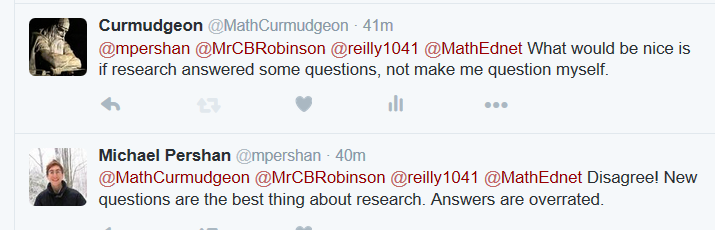
Hey Researchers!

Hey researchers. you know what would be cool?

How about if you settle some questions for us?  I've been in education a long time and I've heard what seems like infinite variations on the same questions, along with what seems like infinite new thoughts that came out of the blue.  Every time our principal or superintendent goes to a conference or a workshop, it seems they bring back a new idea, a new structure, a new way of doing things that "research has shown" to be the shiny new penny of educational thought.

When you look a little deeper, you find it was done on 65 elementary students in NYC ... and you're supposed to try and develop curricula for your 10th grade math classes that follows this brand spanking new paradigm.


Answers are NOT overrated. The whole point of research is to answer a question, either to prove or disprove it. Research that is only about finding something new is exploration, and while it does have it's purpose, it's not what we need in this country at this time in this industry.

We have lots of new ideas. I, for one, am sick of all of them. What we don't need is more new ideas to be trotted out, forced on the students and faculty, only to be replaced when the fashion statement of the month changes.

What we do need is to weed out the bad ideas, the bad policies, and the bad science that we already are following, used to follow and are considering going back to, or that we might consider in the future.

If you simply MUST develop new ideas and new ways of doing things, please in the name of anything you find holy, write the results down and save them for the next round of research on that topic.  

Researchers!  Instead of thinking of brand new things, how about you settle a few debates?

I know. It's boring.  You want to be "Fresh!" and "New!" and "Creative!" and here I'm asking you to determine the pros and cons of Semester Block vs 4x4 Block vs 40 min (8periods) vs 50 minutes (7periods).

That would be helpful.

Do a lot of research on it. Use a lot of schools and do it with HS students.  Settle the debate we're having at every goddamned school in the country and settle it so definitively that we can all tell our principals to go pound sand if they say something stupid. And make the research available so we can actually read it?

That would be helpful.

How about Proficiency-Based Grading and Graduation Requirements?  Do they work? If so, what did they look like when they did work and when they didn't? Is this just Standards Based Grading updated with a shiny new name for the new decade or is there really something good here?

How about getting into whether we should be taking statewide tests or home-grown final exams?

How about the use of technology in the early grades; in middle grades; in high school?

Don't tell me about your cutting edge research if it doesn't involve multiple grades and a full range of socio-economic levels encompassing thousands of students taking all the courses. (At least tell me what those grades are, in a font just as large as the headline.)

Don't tell me that research has shown that you shouldn't teach the subtraction algorithm ... unless you also tell me that the research was done exclusively on k-4th graders and was somewhat inconclusive.

Why not?  If you remember, I don't teach k-4 grades and my classes really should know the algorithm.

Hattie does this kind of thing all the time and my principals eat it up. Hattie puts out results with this really precise measurement that isn't very accurate. Why is nearly all of Hattie the stuff of nightmares for HS teachers?

Because our principals can't read. They see a big shiny number and say "We should do that, too."

They don't take the time to delve into the conditions of the research and merely assume that we should be changing RIGHT NOW so they can retain their jobs.

My district has gone to a half-day inservice every week to develop new initiatives .. and that's messing up the students something fierce.  We faculty, in the meantime, are going nowhere fast, wandering through tedious and worthless makework that the curriculum coordinator dreams up. Ill-defined terms, vague promises that "This will all make sense" and exercises that belong in a 6th grade classroom the day before Christmas break, all combine to make us want to tear our hair out.

Show me something that WORKED and let me build from that.  If it doesn't work, we need to have some way of reporting that back to the same researchers so others won't have to go through the same disruption and failure.

EVERY school that tries your new idea is now part of the research; all data should be kept. It never is ... in fact education is the only field where all of the research is case-control, the selection bias is ignored, the publication bias is widespread, and the results don't ever seem to matter ... all while the subjects of the research suffer through another set of changes and failures in the vague hope by the administrators that "Someday, we get it right." I'm here to tell you that "Someday" hasn't arrived yet.

My only consolation is that we're not experimenting on my kids.

"But it's backed by research!"

Yeah, show me. Prove it.

In the meantime, I've got to get back to work.

Sunday, December 13, 2015

Foolish Consistency

A discussion with a student at the end of a calculus class began with her saying "I feel that I didn't learn my fractions AT ALL in middle school and elementary school." It made me laugh a little because she was, in the same breath, saying how confident she felt about them now.

And we all know where the errors in calculus are ...

But, her next comment nestled in nicely with something that's been festering in my brain for a while. "My teacher last year had us use calculators way more than you do. He wanted decimal answers instead of √2, decimals instead of fractions. I think I like fractions better than decimals now." (I'm paraphrasing, here.)

Coincidentally, I had had a discussion with him the previous day about why I had given an online quiz on simplifying radical expressions like √300 = 10√3. He didn't see the point while I feel that it's a good thing for algebra 2 students to understand and certainly within their wheelhouse. It helps build the understandings that I feel are important.  Additionally, it's on the SAT, ACT, AP.

His point, equally valid, is that the RealWorldtm is increasingly going digital, demanding numerical answers and using computers to run simulations and solve problems. The diagonal of a square is going to be measured as 14.14 feet, not 10√2 feet.

In reply to my student, I said "We're different ... we focus on slightly different things and both are necessary.  Neither is a better teacher and neither has all the answers, but by having had both you can now apply either approach as appropriate and as suits you.  It would be terrible if you always had the same teacher for your entire career and never saw another point of view, another frame of reference."

Why do I mention this now?

Her comment had resonated with me because we're currently in the process of converting the grading system to Proficiency-Based Grading, and Carnegie Units to Proficiency-Based Graduation Requirements.

Transformations this extensive require long and elaborate discussions about how we measure, about what we measure, about how we justify our decisions to parents and colleges, and about how, whether, and when we teachers will measure.

Because our supervisory district administration aren't really teachers, and our curriculum coordinator used to teach elementary school and some MS social studies, everything must have a rubric or it isn't proper.  As well, everything we used to do was BAD and must be changed.

"We can't use the word 'Proficient' because it's not a growth word."
We're being asked, "Do we use a rubric?  Since your answer should be 'yes', which one of these four is the one you're all going to use?"

The fact that we spent nearly an hour discussing whether to use the word "proficient", "competent", or "skilled", and whether the top level would be modified with "highly", "advanced", or "with distinction" should give you a good idea of how divorced this all was from real students and real teaching. We never did finish that conversation, but we did begin to spend time arguing over whether the four levels should be considered five if there was a checkbox labelled "Not Enough Data to Measure" in addition to Highly 'word', 'word', Nearly 'word', Beginning 'word'.

The funny part is the explicit statement is that we will use the same rubric throughout the building, that every teacher, in every course, for every student, for every transferable skill (the non-content skills), will use the same rubric to determine proficiency.  If any measurement does not use the rubric, it isn't measured properly and cannot be defended as fair and consistent across the board.


This is foolish. A foolish consistency adored by little statesmen.

or, in this case, by administrators.

There are differences between students just as there are differences between teachers.  We cannot maintain absolute control over 18 year-old seniors in the same way we do 10 year-old elementary students. 8th-grade Algebra 1 needs a different approach than 11th-grade Informal Geometry. Some kids thrive on general questions that allow them to explore while others need more algorithmic approaches. We must allow some teachers to holistically judge an essay while others are focused on grammatical issues along with the content.

It wasn't that long ago we were all assured that it was right and proper to be adjusting our teaching to the "learning styles" of the students. Whatever happened to that?

Well, now we are to be consistent. Consistent in our teaching, consistent in our grading, consistent in our departments, consistent between departments, consistent across high schools in the SU.  Everyone consistent. Everyone using the same rubric ... as if a rubric were the only way and that rubric the only acceptable one.

Friends, the pendulum has swung towards "ROBOT", the French army is nowhere near Toledo, and the Inquisition is still safe from its enemies. I'm used to this quinquennial flip-flopping but I don't have to like it.

The Inquisition Administration has looked at teaching and decided that everyone needs to be consistent.  That's pure, unadulterated, bull.

The only consistency we should expect should be within a course ... but even that is muddied by IEPs, behavior plans, 504s, and other, very necessary, adjustments.

Here's the important point: Differences are GOOD.

Diversity in background is GOOD. Differences in approach are GOOD. Sure, you need to have a progression through the department that includes everything you've deemed important, but you also need to have individuals and their strengths.

Way back in the depths of time, when I was in high school, Mr. Corbin would just look at my essay and declare it a "B".  I thought him harsh until I looked at everyone else's in our little complaint session afterwards ... lo and behold, that "B" paper of mine was not as well written as John's "A" paper and was better than Peter's "C" paper.

When it came time to take English from Mr. Clark, we knew the rules changed.  Every grammatical error, no matter how insignificant, meant a full letter grade down.  One spelling mistake turned an "A" paper to a "B" paper.   To add to our teenaged angst, it was timed and, while we knew what day we'd be doing this, we didn't know the topic.  We would walk into the class on Wednesday, see the topic on the board, and then have 45 minutes to produce a page-and-a-half essay. (college-ruled, of course -- not of that wide-lined crap.)

Oh, how we bitched about that ...

... but we did learn to write. 

Was Mr. Clark a better teacher?  I would argue that he was because of his amazing command of the topic and the stories he could tell and the standards he set, but part of what made him good was the preparation we all got from Corbin and the fact that the two men were different. Corbin introduced us to American Lit. Clark introduced us to writers; Thoreau, and Frost, and Jacob Bronowski.  Corbin didn't mark down for minor grammatical mistakes; Clark did. We were students; we adapted. That's what you do.

"Yes, you can borrow this copy of Robert Frost's poetry, but make sure you give it back ... he and I wrote to each other by sending this book back and forth and making margin notes. I'm fond of it."
Trying to impose consistency on these two gentlemen would have been foolish and counter-productive.

Trying to impose a common rubric for AP Calculus and 7th-grade civics is foolish and counter-productive.

Trying to impose consistency even within our department is foolish and counter-productive. He's a math major; I'm an engineer; of course we look at things differently.

He uses the calculators more than I do; I ask for more mental math than he does. "Who's better?" misses the point that, over the course of four years, students get both.

"Who's better?" Why would you even ask that question?

In the long run, I suppose, it doesn't really matter what gets decided in these silly little meetings.  I intend to use the AP scoring style for AP calculus, a variation of it for Algebra 2 and Pre-Calculus and I will probably do many of the same things that I've been doing for years ... the successful things, at least. I don't think I'll ever stop changing subtly.

And that's the point.  When I find something good, an idea from another math teacher or even one of the curriculum people, I insert it into the folder. As it becomes relevant, I work it into the daily routine or the once-a-week, or whatever.

When it comes time to taking advice on how to teach high school math, though, I don't have much tolerance for people who have never taught anyone older than 12 and who couldn't describe a data set graphically if I did it for them ... and they're going to tell me the words I must use and the forms I must use and the rubric I will use to declare proficiency in standards that we haven't even decided upon yet?


Thanks for Reading.
I've got to get back to work.

Saturday, November 28, 2015

A Young Girl Learns Nothing.


I love the caption: "A young girl learns how to hold an airsoft gun during Youth Day at the NRA's annual meeting in Houston on May 5, 2013."

If anyone were paying attention, they would notice that the little girl is probably not learning anything; she's completely distracted by the things on the table.


Pretty much sums up the NRA and its vaunted training programs.

Friday, November 27, 2015

Wednesday, November 4, 2015

Incorrect Data isn't Useful

The other day I went to the Health Center for a followup checkup. I had been in previously and had gotten some anti-biotics for an insect bite that got infected. Simple, right? As part of the visit, the nurses are instructed to take routine weight and blood pressure measurements.

I know my blood pressure, so I was surprised that her diastolic reading was 20 points lower than it normally is. I remarked on that. Her reply was "Lower score is good, right?" in the tone of voice that conveyed clearly that I shouldn't be questioning her.

I'm thinking, "Sure ... unless it's a bad measurement." I get that BP is inexact, but it's a bit silly to refuse to re-measure it when the patient points it out. 20 points can make all the difference to the doctor's diagnosis of my overall health.

I decided that I would request the printout from the front desk as I left, the one with all of the day's numbers and decisions from the visit. I read the scale ... same weight as two weeks ago. On the printout, though, it was different ... she had obviously transposed digits when entering the data. In two weeks, I had "gained 23 pounds" and then lost it again in the 30 minutes it took to drive home. My blood pressure changed by 20 points, and that's a lot.

Bad data makes for inappropriate diagnosis.

Bad data makes for bad education policy, too.

The state of Vermont is "suffering" through the release of the first round of SBAC scores despite our scores being better than most other states (we're usually top 5).  "Results are much lower" and already my principal is bitching about it, despite declaring at the time, "We don't care what the scores are, we just want to get the process right." (I'm paraphrasing but that was the intent.)

I'm all for improvement, but I hate basing change on the back of bad data.  Our diagnosis is flawed because our data is flawed, and the prescription runs counter to other policies that the State has imposed.

First, the SBAC has measurement errors just like my nurse had.  Many students took that test knowing that scores would not be held against them, that there was absolutely no chance that anyone would see the scores in fewer than six months or act upon them to set courses for this year or college applications. Additionally, the test itself is drastically different in format (and it's all done through the Chromebook) ... a test completed entirely on-line.

There are no multiple choice questions and kids can have scratch paper, but they're not used to doing math that way. There's a lot of "drag the factors to the answer box" and write three paragraphs explaining why you know that this is a straight line .. and few can stretch out an explanation that far.

Second, and just as  important, the SBAC "passing scores" were decided upon after the fact, to make the percent-passing numbers match what the state had decided they should be ...

That's right. Before the kids even took the test, they told us that there would be a state-wide passing rate of 33% on the HS math test. Then they set the cut-score to match.

Third, add in the fact that we are a small school and we pride ourselves on being able to provide a more personalized education that your average public school, including having personalized learning plans that had quite a few students taking Algebra 2 as seniors. I'm sure you can see where this is going: many of our kids were taking a test heavily based on mathematics they hadn't seen yet.

This runs directly counter to another major initiative in the State of Vermont, the Personalized Learning Plan. Sometimes called "Personal Pathway to Graduation", the initiative requires schools to design different course pathways to graduation for each student as appropriate. This includes allowing schools to schedule certain kids into a faster progression for math and others into a more moderately paced path that might not even include algebra 2. It means that "pre-algebra, algebra 1, geometry, algebra 2" might be the most appropriate for a student.


Taking that approach and then complaining that they don't know algebra 2 by March of their junior year is silly.

It's the rhetorical equivalent of reading a graph that says that Pre-calculus students do better on the NAEP and then concluding that we must make sure every student takes Pre-calculus by the time state tests are given in the junior year
 ....

which a previous principal actually said.

So when the bright bulb in the room points out that we teachers should prepare the kids for college and careers, and should have prepared the kids better for this test, and "If you hold the kids to a higher standard, they'll rise to meet that standard," I will calmly channel Dick Cheney and say that "you go to war with the students you have, not the students you wish you had."

Finally, the teachers are not allowed to know what's on the test.  I don't want to teach to the test, but I'd like to know what is included.I'll give the same assessments I would already have planned, but I might change some questions to a similar format, for example.

Also, I'm not willing to just take their word for it that the test is appropriate. We can't check for bad questions that might have tripped up our students and we can't check that the answers they gave were correct or not. We have to take Pearson's word that the scorers actually knew what they were doing.  After reading Todd Farley's book, Making the Grades: My Misadventures in the Standardized Testing Industry and others with similar tales of the realities of corporate test making and scoring, I'm not particularly willing to do that.

The NY Regents is an example of a relatively open and transparent test-making system, but it has many errors. The NY teachers can catch these problems and get them fixed. If we look at Mr. Honner's long-running series reviewing the NY State Regents exams in mathematics, why should we expect that the SBAC tests will somehow be perfect if there is no chance for oversight?

The SBAC is a closed system with no accountability that scores the tests in strange ways, fails to take into account the realities of the students, will not allow anyone to analyze or even examine any of the questions (unlike the SAT which I can see in its entirely within a few weeks), spits out pre-determined results that do not reflect student abilities, and makes everyone wait an unconscionably long time for those results ... much too long for the school to do anything with them.

I can't use the scores because they aren't detailed enough, timely enough or accurate enough.

I guess I'll just teach math and ignore all that bluster.

Sunday, November 1, 2015

I guess we have to talk about cellphones again.

Actually, we need to talk about cops in school, euphemistically called School Resource Officers, as if they were a librarian or something.  This is a bit of a rant, in case you didn't realize.

This came across Facebook.
Sadly, there was a time when kids were taught to respect adults, in general. I work with some amazing teachers, but parents show open disrespect for teachers, so why should their kids be any different? todays parents are so over involved with their kid...
Total and utter bullshit.

"That time when kids were taught to respect their elders" and things were rosy and happy and nobody sassed an adult ... didn't exist except in the fevered dreams of people who think they weren't Royal Pains in the Ass themselves when they were teenagers.

"Back then" kids were just as disrespectful and just as stupid about it. The difference between then and now was that a teacher who made harsh and unreasonable demands could arbitrarily smack a kid - corporal punishment was pretty common - and there was nothing the kid could do. The teacher could be totally and completely wrong and all of society would just fall in line. After the teacher got done slapping or spanking, the parents would probably deal out more punishment when the kid got home, "No Respect for Authority."

After the Tinker decision and other lawsuits, schools began to realize that they didn't have complete and total control of their students and never did, that "students' rights didn't stop at the schoolhouse door", that the Constitution and (in the case under discussion here) specifically, the Fourth, Fifth and Eighth Amendments weren't just for adults.

Kids are citizens, too, and have all of those pesky constitutional rights. Smacking them around for looking at a text (the modern day equivalent of passing a note) is ridiculous. Expecting them to hand over a phone to a teacher who will search through it or not give it back until some unknown time ... is likewise unreasonable if you only do it to one student and only when you catch her and only if you're in a bad mood because your day wasn't going well. If you want to apply discipline, you have to be fair and equitable.

Teachers who do something creative, like having the students line up their phones on the "chalktray", have a much better record because it's done to everyone and becomes a habit. Kids can deal with that.

What they hate is the "I'm annoyed, therefore you are wrong and I'm taking your phone because reasons and if you question my AUTHORITAH, I will have you arrested."


Why does the teacher need to make this an issue? All accounts say the teacher asked her to put away the cellphone but she didn't do it fast enough (emphasis mine). How does this justify a harsh takedown by a cop, public arrest, jail and fines? Any teacher/admin/cop/adult who escalates this to the level in that video really needs to take a few psych courses, and do some serious introspective work ... is that student really threatening you that much? Is the student use of a cellphone anywhere near the disruption that the policeman caused?

Nowadays, schools try to slide past the Constitution by using weasel words and police phrasing and lingo to attempt to do this crap. We changed from "Inappropriate Language or Behavior" to "Assault", "Bullying" or "Harassment" ... or my favorite response to one boy shoving another at a locker, "ASSAULT and BATTERY, Third Degree."

The kid who recorded the incident was also arrested ... for "Causing a Distraction."
WTF, people?
Then, there's the kid who recorded the video on her cellphone: she was also arrested ... for "Causing a Distraction." So a cop in the room who takes a girl forcibly from her chair and throws her against a wall and handcuffs her -- that's not a distraction but a second kid with a phone is? I can assure you that my difficulty keeping the class on task would have a lot more to do with the cop than anything else.

We see this all the time as schools struggle to pretend they're Gods of All They Survey. A girl wears spandex leggings and the administrator calls it "a Safety Issue." It's not.

A kid wears a hat and we call it "Disrepect" and if the kid doesn't take it off instantly it becomes "Refusal To Follow Orders" or "Insubordination" or "Disruption". It's not.

A kid gives an Advil to another kid because of PMS, we call it "Illegal Drug Distribution" or invoke some "No Tolerance Drug Policy" as if that applied here. It doesn't.

South Carolina even has a law against disrupting school, a law that carries a punishment of 90 days in jail and a $1,000 fine if convicted.  "Disruption" used to be shooting spitballs and the punishment was a detention. Now it's a major criminal offense if you want to push it that far.

Police need to use specific, precise language that has been scrubbed of as much bias and humanity as possible because they are dealing with adults and a criminal justice system. If the police get involved, there are serious consequences if guilt is proven.

When the situation calls for jail time or extensive fines, we absolutely must call the police. This is not something untrained school personnel can handle. Anything you say can be used against you in court; you have the right to an attorney; you have the right to remain silent. The policemen can use DEADLY force if public safety is at stake.

The "School Resource Officer" is still a cop. Every interaction with a student is written up, recorded and reported. He is not a friend and he cannot ignore things.

The other 99.9% of the time, school discipline is not at that point and the cops should not be involved. Schools need to get out of the policeman's mindset, to remove that language from our speech and discipline policies.

We are not cops; we are dealing with children, actually and legally.

Passing notes in class, while rude and should be dealt with by school officials, is NOT a criminal offense. Cops should not be involved.

I don't want kids handing out Advil  - there are medical reasons. So I send them to the office/nurse to get some for free (where the nurse can say "That's enough for today" or "Is there something I need to know about that bruising all over your body? Know that I am required by law to call the state abuse hotline.") This kid in this case is nothing for a policeman to deal with. The abuser, yes.

"If all you've got is a cop ... everyone looks like a criminal" isn't quite accurate, really. He's required to treat every interaction as a possible criminal case; he has no choice. He is a policeman and he must follow rules.

"If a major incident occurs that needs the US Justice System, we'll call the cops"
became
"The SRO is there to deal with major incidents."

But that has become
"We pay him $90,000 dollars a year and he's not doing anything else right now,
so we'll send him to do this task we don't feel like doing."

and in some cases:
"The kid won't listen to us. SRO, you take care of it."

And that's how passing notes becomes a criminal offense. That's how refusing to hand over a phone can lead to forcible takedown, arrest, and jail time.

School administrations have increasingly becoming a cadre of self-important fools who have never taught a day in their lives and who have no idea what they're doing. 

A Professional relationship or a personal one?
Has the administration abdicated its responsibility to teach behavior and self-discipline to a policeman who must follow completely different and far stricter rules of interpersonal contact? I think so.

Here's a thought: If your SRO is expected to be a friendly guy, messing with kids and always has a smile ... do the kids know he is really a cop? Is the disrespect some claim as a reason for the arrest partly because kids have been calling him by his first name all this time?  Does he have a professional relationship with the students or a personal one?

A final point. Some reports claim the girl was recently orphaned. This is not true, but she was in foster care ... still a traumatic and depressing situation for a girl whose mother and grandmother are still alive. Think about what kind of home life that girl has lived. It doesn't excuse, but it does explain.

Thanks for reading. I've got to get back to work.

p.s.
Anyone who wants to claim that the cop is there to protect the students from a "Bad Guy With a Gun", please just shut the fuck up and crawl back into your hole ... you have no idea what you're talking about.