Monday, April 17, 2017
Charter Schools, Surprise!
Labels:
charter schools
In Spending Blind:
The Failure of Policy Planning in California Charter School Funding,
Gordon Lafer -- a University of Oregon prof who also works for
Oakland's The Public Interest -- finds "hundreds of millions of dollars
... spent each year without any meaningful strategy... on schools built
in neighborhoods that have no need for additional classroom space, and
which offer no improvement over the quality of education already
available in nearby public schools. In the worst cases, public
facilities funding has gone to schools that were found to have
discriminatory enrollment policies and others that have engaged in
unethical or corrupt practices."


Sunday, April 9, 2017
On Relevance
Labels:
Essays on Improving Schools
John Spencer has this on relevance.
Sometimes Math is just math. It isn't Real World. It has nothing to do with answering "When am I ever gonna have to use this?"
It's a topic we're exploring, and we can follow it a ways down this path.
Two roads may diverge in the yellow wood, but fortunately we can follow both. In most of high school mathematics, there's no need to choose only that which is "relevant".
In fact, that's probably the worst option available.
I despise the notion that urban, low-SES students have to analyze hip hop before they can "get into" poetry. It's not that I'm opposed to hip hop poetry (we do a few Def Jams poems and analyze the occasional rap song), but I disagree with the notion that poetry can only speak truth to coffee shop geeks or grad students in the literature department.Which is a great point. I would argue that it is either relevant or not; if you feel the need to "make it relevant," you will fail and the lesson will fall flat. Students do not need to be conned by relevance and will resist any imposed relevance.
Sometimes Math is just math. It isn't Real World. It has nothing to do with answering "When am I ever gonna have to use this?"
It's a topic we're exploring, and we can follow it a ways down this path.
Two roads may diverge in the yellow wood, but fortunately we can follow both. In most of high school mathematics, there's no need to choose only that which is "relevant".
In fact, that's probably the worst option available.
Tuesday, April 4, 2017
After a while you give up.
Labels:
PD Follies
ISS
Consider the following scenarios:
A conference at St. Michael's College in Burlington, Vermont. The speaker is Professor Robert Talbert (@RobertTalbert) and he is presenting his work with flipped learning to an audience of college professors and a few HS teachers. He speaks well, he is prepared, and he has given out material well in advance that he expects that everyone will have read, and questions that he expects everyone will have answered. Not surprisingly, everyone has. We discuss FL and his new book. We see what he has done with FL: what works well and why, and what doesn't and why. People work throughout the time, notes are taken, the food is lovely and the workshop is a success.
Or a Bio-Ethics conference at UVM Medical Center. Similarly, everything is straightforward, talks are given, information is presented, people listen and take notes. the food is lovely. The workshop is a success
A running theme throughout is the assumption of competence, treating everyone as if their time was valuable and that they were there because they wanted to be, that they wanted to hear what the speaker had to say.
Then, there's a conference geared towards high-school teachers.

Invariably, there's a bowl of candy. Your choice is used to sort you into groups. Most of the time, you need to stand up and hold hands with the next person and play "telephone" to demonstrate that ground-breaking idea that teenagers don't always listen attentively to your instructions.
There's a stack of post-it notes to stick to chart paper. Here's some colored markers. This presenter uses grade-school vocabulary and that sing-song voice one uses with 10 year-olds. That coordinator has 60 people crowd into a 20x20 foot space and then "Move to that side if you agree that that differentiation is a good thing, move to this side if you are wrong."
Did I mention that you have a Master's degree?
You'll be handed a paper copy of an article that was emailed out a few days before because "Not everyone is as advanced technologically as you" and couldn't be expected to have read anything ahead of time. I know, right? We can't expect anyone to know how to read something sent by E-Mail, apparently.
"Read this article and find the sentence that means the most to you."
The "scribe" will write it on the chart paper.
"Find the phrase that means the most to you."
The "scribe" will write it on the chart paper.
"Find the word that means the most to you."
The "scribe" will write it on the chart paper.
90 minutes later, you are done with a 3-page double-spaced article on the wonders of Common Core State Standards. You'd think we'd be further along in this process eight years after the introduction of CCSS, but no, we're examining a propaganda piece instead of developing course material to align with standards.
Did I mention that you have been teaching this material for 30-odd years?
Did I mention that the state of Vermont has decreed that all public school will be using the Common Core and that there's no particular reason to read about how wonderful it is?
I am not exaggerating. The whole thing would be demeaning and ridiculous but you get the feeling that the presenters aren't capable of anything more strenuous intellectually than 6th grade social studies -- your course work is gibberish to them.

"We're going to use the Gallery Walk protocol today."
"You have thirty-two minutes to discuss this topic in your groups of four. Person A will speak for 3 minutes with no interruptions. Following that, the table with remain quiet for 2 minutes to deeply consider what was said. Then persons B, C, and D will take 1 minute each to respond."
"There are easels around the room. Please take your Post-It note and attach it the the chart paper next to the statement that most closely matches your opinion."
You can resist only so much. After a while, you begin to go along with it all just to keep some progress happening. You know that if you ask a question, the gears in their heads will seize and jam and you'll never get anything done.
You dutifully watch the videos in the group, even though everyone is watching it starting at a different instant and the cacophony is making people twitch. The video could have been viewed on our own time, but I guess not. In Bizzarro World, it's better to have us all use the limited time we have together to not work together. Again, it's not informative; it's a college kid's project touting the glories of the work we're going to begin doing someday.
*HeadDesk*
Then, you'll write down what color the video was ... I chose "FUSCHIA" because it included lots of letters from the word I really wanted to use.
It becomes easier to let them ramble, to let them play their games of "Pass the ball of yarn back and forth and then it will represent the network of caring that we have here." You resign yourself to never getting anything actually finished during inservice. Proficiency-based grading isn't slated to be implemented for another three years because "some people can't even use Google Docs" and "I'm trying to teach the faculty how to fill in my template for learning" - you know we should be doing this more quickly but it's easier to just give up.
Let's call it: "Inservice Stockholm Syndrome."
Consider the following scenarios:
A conference at St. Michael's College in Burlington, Vermont. The speaker is Professor Robert Talbert (@RobertTalbert) and he is presenting his work with flipped learning to an audience of college professors and a few HS teachers. He speaks well, he is prepared, and he has given out material well in advance that he expects that everyone will have read, and questions that he expects everyone will have answered. Not surprisingly, everyone has. We discuss FL and his new book. We see what he has done with FL: what works well and why, and what doesn't and why. People work throughout the time, notes are taken, the food is lovely and the workshop is a success.
Or a Bio-Ethics conference at UVM Medical Center. Similarly, everything is straightforward, talks are given, information is presented, people listen and take notes. the food is lovely. The workshop is a success
A running theme throughout is the assumption of competence, treating everyone as if their time was valuable and that they were there because they wanted to be, that they wanted to hear what the speaker had to say.
Then, there's a conference geared towards high-school teachers.

Invariably, there's a bowl of candy. Your choice is used to sort you into groups. Most of the time, you need to stand up and hold hands with the next person and play "telephone" to demonstrate that ground-breaking idea that teenagers don't always listen attentively to your instructions.
There's a stack of post-it notes to stick to chart paper. Here's some colored markers. This presenter uses grade-school vocabulary and that sing-song voice one uses with 10 year-olds. That coordinator has 60 people crowd into a 20x20 foot space and then "Move to that side if you agree that that differentiation is a good thing, move to this side if you are wrong."
Did I mention that you have a Master's degree?
You'll be handed a paper copy of an article that was emailed out a few days before because "Not everyone is as advanced technologically as you" and couldn't be expected to have read anything ahead of time. I know, right? We can't expect anyone to know how to read something sent by E-Mail, apparently.
"Read this article and find the sentence that means the most to you."
The "scribe" will write it on the chart paper.
"Find the phrase that means the most to you."
The "scribe" will write it on the chart paper.
"Find the word that means the most to you."
The "scribe" will write it on the chart paper.
90 minutes later, you are done with a 3-page double-spaced article on the wonders of Common Core State Standards. You'd think we'd be further along in this process eight years after the introduction of CCSS, but no, we're examining a propaganda piece instead of developing course material to align with standards.
Did I mention that you have been teaching this material for 30-odd years?
Did I mention that the state of Vermont has decreed that all public school will be using the Common Core and that there's no particular reason to read about how wonderful it is?
I am not exaggerating. The whole thing would be demeaning and ridiculous but you get the feeling that the presenters aren't capable of anything more strenuous intellectually than 6th grade social studies -- your course work is gibberish to them.

"We're going to use the Gallery Walk protocol today."
"You have thirty-two minutes to discuss this topic in your groups of four. Person A will speak for 3 minutes with no interruptions. Following that, the table with remain quiet for 2 minutes to deeply consider what was said. Then persons B, C, and D will take 1 minute each to respond."
"There are easels around the room. Please take your Post-It note and attach it the the chart paper next to the statement that most closely matches your opinion."
You can resist only so much. After a while, you begin to go along with it all just to keep some progress happening. You know that if you ask a question, the gears in their heads will seize and jam and you'll never get anything done.
You dutifully watch the videos in the group, even though everyone is watching it starting at a different instant and the cacophony is making people twitch. The video could have been viewed on our own time, but I guess not. In Bizzarro World, it's better to have us all use the limited time we have together to not work together. Again, it's not informative; it's a college kid's project touting the glories of the work we're going to begin doing someday.
*HeadDesk*
Then, you'll write down what color the video was ... I chose "FUSCHIA" because it included lots of letters from the word I really wanted to use.
It becomes easier to let them ramble, to let them play their games of "Pass the ball of yarn back and forth and then it will represent the network of caring that we have here." You resign yourself to never getting anything actually finished during inservice. Proficiency-based grading isn't slated to be implemented for another three years because "some people can't even use Google Docs" and "I'm trying to teach the faculty how to fill in my template for learning" - you know we should be doing this more quickly but it's easier to just give up.
Let's call it: "Inservice Stockholm Syndrome."
Monday, April 3, 2017
Missing the Point
Twitter:Maybe because students "learn" from teachers and "practice" with other students?
If most students learn better one-on-one, why then don't we always break class into groups or make learning partners?
Thursday, March 30, 2017
Innate Skills
Labels:
Curriculum,
Innumeracy,
Math Reform
Every time we talk about "digital natives" and "Kids' innate skills with technology", we reinforce the idea that you've either got it or you don't, that if you are over thirty then you can't be good with tech, that if you're under thirty you don't need any training because you're simply imbued with an understanding of all silicon-based circuitry.
Fatuous self-indulgent hokum.
Let me state it for the record: There is no such thing as "Innate Skill" with technology. Kids have had more practice at playing games and chatting via FB, text, or IM, but nothing else. They are, on average, more comfortable holding a device but not better at using it for anything academic or work-related (unless that use includes playing games, or chatting via FB, text, or IM).
We are running counter to the ideas of lifelong learning, laying a downfield block on any need for a student to persist when faced with a computing obstacle. In fact, we are teaching them and they're learning.
We're teaching them to give up instantly.
We have had decades of computer games with puzzles and problems and every single one has a cheat code or "God mode" that is readily found on the Internet … meaning that every student has learned to try a problem for approximately 15 seconds and then Google the shortcut or cheat code.
But we still have to start with the simple problems.
College professors who shout from their Ivory Towers that "If you can Google the answer, you need to ask a better question" are foolish. Those who advocate for direct plagiarism in all things under the premise that "Research skills are important in the modern world" are delusional and flat-out wrong.
The simple and the intermediate questions are already answered somewhere, but we can't give up and jump right to the higher-order connections because the kids have not answered the simple questions yet -- Google is not answering. They don't have the simple understanding they need in order to make the higher-order connections and that critical thinking EduWonks are always going on about.
The simple questions that need to be asked first (formative) are being ignored for rote guessing, but we still have to find a way to ask them anyway.
The intermediate questions that form the bridge between formative and summative and require the mental processing to form long-term memory through understanding are being ignored, but we still have to ask them anyway.
This came up most obviously in my Intro Coding class. I gave some students selected problems from ProjectEuler.net, wanting them to have a serious mathematical question to answer using spreadsheets.
Here is one of the early ones:
Instead of thinking through the issues and working towards an understanding of the tools at hand, they googled the question ("project euler question 2") and worked backwards from the MathBlog entries.
I learned quickly to change the targets and to not advertise the source of the problem. The Archimedes Cattle problem becomes much harder to solve when you don't tell them "Archimedes" or "Cattle" and change the wording from "1000 cattle" to "1500 horses".
If we ever expect them to do anything more complicated, we have no choice.
Fatuous self-indulgent hokum.
Let me state it for the record: There is no such thing as "Innate Skill" with technology. Kids have had more practice at playing games and chatting via FB, text, or IM, but nothing else. They are, on average, more comfortable holding a device but not better at using it for anything academic or work-related (unless that use includes playing games, or chatting via FB, text, or IM).
We are running counter to the ideas of lifelong learning, laying a downfield block on any need for a student to persist when faced with a computing obstacle. In fact, we are teaching them and they're learning.
We're teaching them to give up instantly.
We have had decades of computer games with puzzles and problems and every single one has a cheat code or "God mode" that is readily found on the Internet … meaning that every student has learned to try a problem for approximately 15 seconds and then Google the shortcut or cheat code.
But we still have to start with the simple problems.
College professors who shout from their Ivory Towers that "If you can Google the answer, you need to ask a better question" are foolish. Those who advocate for direct plagiarism in all things under the premise that "Research skills are important in the modern world" are delusional and flat-out wrong.
The simple and the intermediate questions are already answered somewhere, but we can't give up and jump right to the higher-order connections because the kids have not answered the simple questions yet -- Google is not answering. They don't have the simple understanding they need in order to make the higher-order connections and that critical thinking EduWonks are always going on about.
The simple questions that need to be asked first (formative) are being ignored for rote guessing, but we still have to find a way to ask them anyway.
The intermediate questions that form the bridge between formative and summative and require the mental processing to form long-term memory through understanding are being ignored, but we still have to ask them anyway.
This came up most obviously in my Intro Coding class. I gave some students selected problems from ProjectEuler.net, wanting them to have a serious mathematical question to answer using spreadsheets.
Here is one of the early ones:
By considering the terms in the Fibonacci sequence whose values do not exceed four million, find the sum of the even-valued terms.
Instead of thinking through the issues and working towards an understanding of the tools at hand, they googled the question ("project euler question 2") and worked backwards from the MathBlog entries.
I learned quickly to change the targets and to not advertise the source of the problem. The Archimedes Cattle problem becomes much harder to solve when you don't tell them "Archimedes" or "Cattle" and change the wording from "1000 cattle" to "1500 horses".
If we ever expect them to do anything more complicated, we have no choice.
Sunday, January 29, 2017
Evaluations are difficult everywhere.
Labels:
RealWorld,
Teacher Education
One of the common complaints I hear is that of "not being able to fire bad teachers." It comes only slightly more often than "Teachers make too much money" and "Why are there so many bad teachers?" What we have here is a difficulty of evaluating teachers by administration, but I figure it's more than that.
It's that evaluation is a bitch, and it's not just teachers. It's everyone and everywhere.
When you complain that teachers make too much money, you are subconsciously saying that it's too much money for someone that bad, meshing the top-of-the-scale salary with the bottom-of-the-scale ability and assuming that it's the same person (it rarely is).
The anti-collective bargaining group wants to be able to pay the superstars at a superstar rate and pay the slugs with a pink slip.
The problem is, of course, figuring out who is who.
Years ago, I had a terrible dentist. He drilled holes everywhere and messed up my teeth pretty badly. There was no way to find out if he was bad or not before I sat in the chair. My current dentist insists that the teeth that are deteriorating under the old dental work would have done so anyway but it's stunning how well the tooth right next to it is doing under his work. Thankfully I have dental insurance and I'm getting a lot of this work done.
You will never hear a dentist talk ill of another - it's always your fault for not brushing or flossing enough.
Mrs. C. had an even worse dentist experience and has had to undergo a great deal of expensive repair. Lawsuits finally brought the guy out of his office but it turned out that the dental review board didn't dare state publicly that they thought he wasn't up to snuff. They didn't want "to turn on one of their own."
I've finally found a decent mechanic, no thanks to any review board or any kind of Craigslist or Angie's-list or State Cert Panel. Certifications line the walls of every shop in town, but mostly they suck.
When we look around, we find that every job is filled with average workers. Some are good and some are terrible but most are just okay. Teachers are no different.
A local first responder just got his fifth DUI.
Contractors are legendary for their variability and lets not make any cracks about plumbers. ;-)
The writers for the paper are so-so and don't always compare favorably with the students who write for the high-school section.
Politicians? We won't go there.
Doctors? Lawyers? Used Car Salesmen?
How do we judge thee? Let me count the ways.
Teachers judge teachers very differently than admins do. Parents use a different yardstick and the taxpayer with no kids and an attitude about taxes and education still another.
It's that evaluation is a bitch, and it's not just teachers. It's everyone and everywhere.
When you complain that teachers make too much money, you are subconsciously saying that it's too much money for someone that bad, meshing the top-of-the-scale salary with the bottom-of-the-scale ability and assuming that it's the same person (it rarely is).
The anti-collective bargaining group wants to be able to pay the superstars at a superstar rate and pay the slugs with a pink slip.
The problem is, of course, figuring out who is who.
Years ago, I had a terrible dentist. He drilled holes everywhere and messed up my teeth pretty badly. There was no way to find out if he was bad or not before I sat in the chair. My current dentist insists that the teeth that are deteriorating under the old dental work would have done so anyway but it's stunning how well the tooth right next to it is doing under his work. Thankfully I have dental insurance and I'm getting a lot of this work done.
You will never hear a dentist talk ill of another - it's always your fault for not brushing or flossing enough.
Mrs. C. had an even worse dentist experience and has had to undergo a great deal of expensive repair. Lawsuits finally brought the guy out of his office but it turned out that the dental review board didn't dare state publicly that they thought he wasn't up to snuff. They didn't want "to turn on one of their own."
I've finally found a decent mechanic, no thanks to any review board or any kind of Craigslist or Angie's-list or State Cert Panel. Certifications line the walls of every shop in town, but mostly they suck.
When we look around, we find that every job is filled with average workers. Some are good and some are terrible but most are just okay. Teachers are no different.
A local first responder just got his fifth DUI.
Contractors are legendary for their variability and lets not make any cracks about plumbers. ;-)
The writers for the paper are so-so and don't always compare favorably with the students who write for the high-school section.
Politicians? We won't go there.
Doctors? Lawyers? Used Car Salesmen?
How do we judge thee? Let me count the ways.
Teachers judge teachers very differently than admins do. Parents use a different yardstick and the taxpayer with no kids and an attitude about taxes and education still another.
Algebra in The RealWorld
Dan Meyer poses Three Questions about a problem from his professional development:
"Two, is the solution realistic? Would a real person solve the problem using a system of two equations?
"Three, in what ways does this problem help our students become better problem solvers?"
I think he's right, in many ways. The problem he's discussing is contrived and convoluted at best. It does have that "algebra-book word problem from hell" feel about it, but word problems in math textbooks are a funny thing. They have to straddle the line between being realistic and being useful in a classroom for teaching. When constructing a word problem or using one, you need to keep this line in mind. If the word problem doesn't fit your topic, you should change it.
I take a slight issue with the questions, though, in that I don't want to always be asking for a real-world solution that a real-world person would find for a real-world problem.
First, define a "real person". Do I pick me or a mathphobe? If you purposefully want a problem that takes creativity to solve, then separate it from the track you're in. Call it the Puzzle of the Week.
This particular problem doesn't have enough information to come to a single solution anyway - how about adding in the cost per mile of van and car, as well as an additional payment for driver responsibility. Are we trying to minimize cost or make sure all chaperones drive? Do we have a reason to not use the vans unless necessary?
A youth group with 26 members is going to the beach. There will also be 5 chaperones that will each drive a van or a car. Each van seats 7 persons, including the driver. Each car seats 5 persons, including the driver. How many vans and cars will be needed?"One, is the problem realistic? Would a real person need to solve this problem?
"Two, is the solution realistic? Would a real person solve the problem using a system of two equations?
"Three, in what ways does this problem help our students become better problem solvers?"
I think he's right, in many ways. The problem he's discussing is contrived and convoluted at best. It does have that "algebra-book word problem from hell" feel about it, but word problems in math textbooks are a funny thing. They have to straddle the line between being realistic and being useful in a classroom for teaching. When constructing a word problem or using one, you need to keep this line in mind. If the word problem doesn't fit your topic, you should change it.
I take a slight issue with the questions, though, in that I don't want to always be asking for a real-world solution that a real-world person would find for a real-world problem.
First, define a "real person". Do I pick me or a mathphobe? If you purposefully want a problem that takes creativity to solve, then separate it from the track you're in. Call it the Puzzle of the Week.
This particular problem doesn't have enough information to come to a single solution anyway - how about adding in the cost per mile of van and car, as well as an additional payment for driver responsibility. Are we trying to minimize cost or make sure all chaperones drive? Do we have a reason to not use the vans unless necessary?
Thursday, December 29, 2016
Beginning teachers need to learn to teach.
Labels:
Math Reform,
School Reform
Teaching's a profession. Like all professions, it takes training ... and practice. This practice can't be found in a Wheaties Box and it's can't be found on Twitter.
To be a teacher, you need to be an intern, an apprentice, a beginning teacher. In the beginning you need to get help and guidance from experienced teachers. You may be smart and may have gotten good grades in college/high school, but that doesn't mean you can teach.
Six weeks in summer camp can't replace six months of teaching actual teenagers under the supervision of an experienced teacher, nor will those six weeks ever prepare you in any meaningful way. On the other hand, there are plenty of people in TFA who MIGHT make good teachers someday.
Vilification is just as silly as beatification. The problem I have with TFA is the tendency to assume sainthood of someone who is treating two years in public school as temporary thing, as if some court sentenced them to 2 years of community service for the crime of not acquiring a 6-figure income job.
Now that you're a teacher ...
This profession is unbelievably screwed up in many ways and we're going to need you to keep it together long enough to pick up on the difference between stupid shit that sounds good (a "deepity") and good ideas that sound stupid at first.
You'll see both kinds.
From whence, "Deepity"?
We (and by this, I mean people who make decisions and influence school boards) listen to the opinions of people who haven't ever been teachers. We take seriously the suggestions and complaints from CEOs and computer wizards who couldn't be bothered to finish their own education. We listen to Andre Agassi's opinions about the ideal school and take him seriously when he says he wants to start a school and he knows what works with kids and how teachers should teach ... except that he quit school in the ninth grade and turned tennis pro at the age of 16. His father was supposed drive the kids to school but took them to local tennis courts to practice instead. How is this supposed to instill confidence in his opinions about how schools should be run for the majority?
Here's a talking head:
What scares me is the idea that this starting incompetence is the norm, that the classroom performance of TFA teachers equals that of "education school graduates" ... if that isn't an insult to the TFA, then someone's not paying attention. TFA are supposedly the best and brightest of the Ivy Leagues and the top-notch colleges. Shouldn't we be striving for a level of competence higher than that of the people who failed out of every other program in college, that of those who were so bad at everything they settled for an education degree?
Scott MacLeod, in MindDump, quoted this guy, who said, in part,
 This is true. If you fire someone in the middle of the school year, there aren't all that many applicants that are worth even as much as John Garner's assessment of the Vice-Presidency. Your ad on SchoolSpring will get a lot of response because it's really easy to push that button, but the candidates' qualifications will be dubious at best.
"Change teaching so that the average person can do it well." Why not improve it, instead? Why do we care what some economists have found and what some random blogger says about it?
"If the teachers can't measure up, then we must measure down."
I can't accept that. We need more teachers than lawyers and doctors because those two professions aren't needed by a third of the population for 7 hours a day for ten months of the year.
Where do you come in, newbie?
You come in right here. You read things. If you've read this far, you'll probably make a great teacher.
To be a teacher, you need to be an intern, an apprentice, a beginning teacher. In the beginning you need to get help and guidance from experienced teachers. You may be smart and may have gotten good grades in college/high school, but that doesn't mean you can teach.
- Your "digital native" status is not even worth the paper it isn't printed on.
- Your youth is worth nothing (and for a while, you'll be paid accordingly).
- Your opinions about how to teach are worth pretty close to nothing.
Six weeks in summer camp can't replace six months of teaching actual teenagers under the supervision of an experienced teacher, nor will those six weeks ever prepare you in any meaningful way. On the other hand, there are plenty of people in TFA who MIGHT make good teachers someday.
Vilification is just as silly as beatification. The problem I have with TFA is the tendency to assume sainthood of someone who is treating two years in public school as temporary thing, as if some court sentenced them to 2 years of community service for the crime of not acquiring a 6-figure income job.
Now that you're a teacher ...
This profession is unbelievably screwed up in many ways and we're going to need you to keep it together long enough to pick up on the difference between stupid shit that sounds good (a "deepity") and good ideas that sound stupid at first.
You'll see both kinds.
From whence, "Deepity"?
We (and by this, I mean people who make decisions and influence school boards) listen to the opinions of people who haven't ever been teachers. We take seriously the suggestions and complaints from CEOs and computer wizards who couldn't be bothered to finish their own education. We listen to Andre Agassi's opinions about the ideal school and take him seriously when he says he wants to start a school and he knows what works with kids and how teachers should teach ... except that he quit school in the ninth grade and turned tennis pro at the age of 16. His father was supposed drive the kids to school but took them to local tennis courts to practice instead. How is this supposed to instill confidence in his opinions about how schools should be run for the majority?
Here's a talking head:
“Both sides ignore this fact: The classroom performance of beginning Teach For America instructors is about the same as that of education school graduates just starting out. On average, both do poorly. More supervision and support would help both groups. How does aggravating the feud make that happen?”Let's set aside the idea that more Supervision would help because Supervision never helps a first-year teacher. Help and support from other teachers would help. Supervision does nothing.
What scares me is the idea that this starting incompetence is the norm, that the classroom performance of TFA teachers equals that of "education school graduates" ... if that isn't an insult to the TFA, then someone's not paying attention. TFA are supposedly the best and brightest of the Ivy Leagues and the top-notch colleges. Shouldn't we be striving for a level of competence higher than that of the people who failed out of every other program in college, that of those who were so bad at everything they settled for an education degree?
Scott MacLeod, in MindDump, quoted this guy, who said, in part,
re: “Let’s-find-and-fire-the-bad-teachers”
The problem with the approach that Friedman and others advocate is that it assumes we have all these wonderful, high-quality teachers just waiting in the wings to take over the jobs of the bad teachers we fire. In reality, there is no such supply, even in a bad economy with high unemployment. We have a shortage, not a surplus, of great teachers—and so it’s naïve or shortsighted (or both) to think we can somehow fire our way to a great educational system.

There are almost four million K-12 teachers in the United States, which is more than twice the number of lawyers and doctors combined. Teaching is America’s largest profession. And so we need teaching to be a job that an average person can do reasonably well, which means we probably need to rethink how the job is structured. ( Justin Snider )Holy mackerel.
"Change teaching so that the average person can do it well." Why not improve it, instead? Why do we care what some economists have found and what some random blogger says about it?
"If the teachers can't measure up, then we must measure down."
I can't accept that. We need more teachers than lawyers and doctors because those two professions aren't needed by a third of the population for 7 hours a day for ten months of the year.
Where do you come in, newbie?
You come in right here. You read things. If you've read this far, you'll probably make a great teacher.
How to be a Math Coach
Labels:
Coaching,
PD Follies,
PDev
As a long response to Math on the Edge, I have a few questions for prospective and current math coaches. Hereafter, I will use the words "we" or "us" to refer to me and/or to the "teachers who you plan to coach".
Here are nine questions. If you can't answer "Yes" to at least one of these nine questions, then you have no business being a "coach".
Subject Matter Knowledge:

Relevant Experience
 If you said "No" to all of that, you are not a coach ... you are an intern and I am coaching you. I may learn a lot from you, but only as a test subject or a guinea pig in my experiment.
Coaches teach their teams, guide their teams, or at least pressure them into doing things in a certain way together. These people make the team successful, improve the team. If they don't, they're fired. If this isn't what you think you're doing, don't call yourself a coach.
For 1 - 4.
I enjoy talking to, and working with, people who know more than I do about a topic. My education was in engineering, not in pure mathematics and not in secondary teaching. It is refreshing to have Mike Olinick in to give a cryptography lecture to an auditorium full of high schoolers or Jeff Suzuki to give one on an important aspect in math history. If I could convince Don Steward to fly over and work with us, that would be very cool. Dan Meyer's a good speaker and a good coach and he has ideas that resonate. These people all have something in common: they've worked with math in ways I haven't. I can learn from them and others like them. Even if their contribution is a different way to work with math, like Fawn Nguyen's Number Talks, or visualpatterns.org - these are people from whom we can learn.
 If you haven't worked with math in ways that I haven't, if you don't bring anything new to the table, if you aren't improving our/your instruction in SOME way, then you have to be outstanding in some other way.
For 5-6:
If you don't have any experience, what can you offer me? What are you basing your "coaching" on if you have never done any teaching yourself? The bar is higher for you because my field is so very different and my difficulties and problems are not solved by amateurs and dilettantes.
What do you base your "advice" on, if your sole experience is teaching a existentialism course at a small New England prep school? Your research? Your work as a content aggregator? Your charming personality? If your opinion contradicts my own experience, then you need to really convince me that you aren't just another blithering idiot on the Internet.
For 7-9:
If you can't say WHY your new idea/technique is a good one, then I'm not going to take your word for it. I might implement it in my classes but only after considering how the change will play out, what I might do to measure its effectiveness, or at the very least consider how the class is currently running so I have a clear and concise memory to compare the "after" version to.
If all you have is a "yes" in 7-9, then you're gonna need your research, your "proof" or at least a damned good explanation. I want to see that your research/evidence applies to my discipline and my grade levels. Don't tell me that I need to change my HS math classes based on research done on K-2 students. I look very skeptically on any statistics that include Singapore and Hong Kong, or Finland and Norway.
I understand that I am not completely up-to-date on everything to do with teaching. I'm using technology a lot, in some very interesting ways, and my students are doing things I'd never imagined in the 80s and 90s. I read others in the #MTBoS and I travel quite a bit to hear them speak. But I know there's a lot going on out there and I'm in the middle of a very poor section of a tiny state.
SO, if you're going to come into my classroom and tell me to change, for example, to Proficiency-Based Grading, then you had better understand it yourself. If you are going to tell us to re-imagine our teaching in a certain way, then you NEED to be competent in its variations and minutia.
If not, then you're not a coach, you're a pain in the ass.
DO NOT do as our curriculum coordinator did: raise up a book at the first *weekly* in-service (2.5 hours each) and announce that you had just read this idea in this book and you think we all should do it. If you haven't been trained in ThisWork, haven't done any work in or research in ThisWork and your only teaching experience is as a less than stellar elementary teacher whose "specialty" was social studies ... then you shouldn't be a math coach.
DO NOT speak to a faculty meeting and say, "I don't know anything about what you're doing but I've just been hired for this new job to help you with your teaching. Here is a list of topics that I can help you with by *Googling* them for you", which is what two fresh new admin did.
DO NOT insist that teachers adhere to the practices of your 4th grade classroom when you are attempting to "coach" us in these new ideas that you don't particularly understand. We're all adults and most of us have master's degrees and we average 15-20 years of experience in our fields, some of us more than 40. You're not being cute. You're not being clever. You're being a pain in the ass.
DO NOT walk in and say "I'm the Math Coach" and proceed to tell us nothing new, even going so far as to use material from *my own website* in your presentation (true story).
I could continue but I've got to get back to work.
TL:dr;
Bring something to the table or GTFO.
Here are nine questions. If you can't answer "Yes" to at least one of these nine questions, then you have no business being a "coach".
Subject Matter Knowledge:

- Do you know more about math in general than we do?
- Do you know more than we do about a specific topic in our subject?
- Have you done research in our field that would prove useful to us in the classroom - a new understanding, a new meaning?
- Have you spent time creating content that other math teachers have found useful?
Relevant Experience
- Do you have experience (that we do not have) teaching our subject at the grade levels we teach?
- Do you have significant experience teaching our subject at any grade level?
- Do you know teaching techniques that we do not - new ideas that we could learn from and improve with? Theoretical knowledge is useful.
- Do you have a lot of experience teaching anything at any level - experience that might inform someone in a completely different situation? Practical knowledge is useful, too.
- Have you done research into teaching that would prove useful to us in the classroom -- cognitive research into children's learning or a change in the philosophy of classroom management or the use of a new technology that makes a true difference -- to the extent that you know this work, know what we might do to improve?

Coaches teach their teams, guide their teams, or at least pressure them into doing things in a certain way together. These people make the team successful, improve the team. If they don't, they're fired. If this isn't what you think you're doing, don't call yourself a coach.
For 1 - 4.
I enjoy talking to, and working with, people who know more than I do about a topic. My education was in engineering, not in pure mathematics and not in secondary teaching. It is refreshing to have Mike Olinick in to give a cryptography lecture to an auditorium full of high schoolers or Jeff Suzuki to give one on an important aspect in math history. If I could convince Don Steward to fly over and work with us, that would be very cool. Dan Meyer's a good speaker and a good coach and he has ideas that resonate. These people all have something in common: they've worked with math in ways I haven't. I can learn from them and others like them. Even if their contribution is a different way to work with math, like Fawn Nguyen's Number Talks, or visualpatterns.org - these are people from whom we can learn.

For 5-6:
If you don't have any experience, what can you offer me? What are you basing your "coaching" on if you have never done any teaching yourself? The bar is higher for you because my field is so very different and my difficulties and problems are not solved by amateurs and dilettantes.
What do you base your "advice" on, if your sole experience is teaching a existentialism course at a small New England prep school? Your research? Your work as a content aggregator? Your charming personality? If your opinion contradicts my own experience, then you need to really convince me that you aren't just another blithering idiot on the Internet.
For 7-9:
If you can't say WHY your new idea/technique is a good one, then I'm not going to take your word for it. I might implement it in my classes but only after considering how the change will play out, what I might do to measure its effectiveness, or at the very least consider how the class is currently running so I have a clear and concise memory to compare the "after" version to.
If all you have is a "yes" in 7-9, then you're gonna need your research, your "proof" or at least a damned good explanation. I want to see that your research/evidence applies to my discipline and my grade levels. Don't tell me that I need to change my HS math classes based on research done on K-2 students. I look very skeptically on any statistics that include Singapore and Hong Kong, or Finland and Norway.
I understand that I am not completely up-to-date on everything to do with teaching. I'm using technology a lot, in some very interesting ways, and my students are doing things I'd never imagined in the 80s and 90s. I read others in the #MTBoS and I travel quite a bit to hear them speak. But I know there's a lot going on out there and I'm in the middle of a very poor section of a tiny state.
SO, if you're going to come into my classroom and tell me to change, for example, to Proficiency-Based Grading, then you had better understand it yourself. If you are going to tell us to re-imagine our teaching in a certain way, then you NEED to be competent in its variations and minutia.
If not, then you're not a coach, you're a pain in the ass.
DO NOT do as our curriculum coordinator did: raise up a book at the first *weekly* in-service (2.5 hours each) and announce that you had just read this idea in this book and you think we all should do it. If you haven't been trained in ThisWork, haven't done any work in or research in ThisWork and your only teaching experience is as a less than stellar elementary teacher whose "specialty" was social studies ... then you shouldn't be a math coach.
DO NOT speak to a faculty meeting and say, "I don't know anything about what you're doing but I've just been hired for this new job to help you with your teaching. Here is a list of topics that I can help you with by *Googling* them for you", which is what two fresh new admin did.
DO NOT insist that teachers adhere to the practices of your 4th grade classroom when you are attempting to "coach" us in these new ideas that you don't particularly understand. We're all adults and most of us have master's degrees and we average 15-20 years of experience in our fields, some of us more than 40. You're not being cute. You're not being clever. You're being a pain in the ass.
DO NOT walk in and say "I'm the Math Coach" and proceed to tell us nothing new, even going so far as to use material from *my own website* in your presentation (true story).
I could continue but I've got to get back to work.
TL:dr;
Bring something to the table or GTFO.
Monday, December 26, 2016
New Year, Same as the Old year
From Poor Elijah:
We raise academic standards on paper even as we’re compelled by policies and pressured by politics to lower them in reality. We crow about “standards-based” grading, as if teachers will miraculously agree about what “proficient” means more than we now agree about what a B means. Our “objective” scoring rubrics rest on the distinction between sentences that “wander” and those that “meander.” Advanced placement is less advanced, and everybody takes algebra, even if it isn’t really algebra anymore.
Sunday, December 11, 2016
End-of-Year Testing
Labels:
21st Century Schooling,
Testing
(I started this article several years ago. Just getting around to editing and publishing these drafts.)
I love the idea of End-of-Year testing in a purely hypothetical sense. Students should be able to demonstrate what they've learned. The teacher doesn't grade it or write it. The students can't weasel out of it. A group of math people decide what "Algebra I" should entail and write some questions to measure it.
The test is never perfect, as NY teachers will hurry to emphasize, but it is out of the hands of the teacher and that is good. We should not be afraid to let our students measure themselves against a common standard and we should be open to change if the unexpected happens. SATs serve this purpose as well.
Differences between what you expect them to get and what they get are the prime indicator. If your grades are all As and your kids can't succeed in appropriate tests, then you need to review what you are doing. If the majority of kids can't succeed on an EOY exam, then you the teacher needs to make a determination: is it the individuals, the exam, the curriculum, or me? If you are passing kids and the next teacher isn't, someone might need to adjust.
In theory, EOY exams should be perfect for this - it's just too bad that they'll be useless for it.
The State of Oklahoma requires these tests and they will *attempt* to write them to be an honest assessment of the skills that should have been acquired in any particular course. Just like Texas, just like New York Regents.
What will happen is that End of Year testing, like WilyECoyote, is going to run full-speed into the Cliffs of Reality. The "passing" score will be set to 60%, then too many kids fail so it's quietly lowered to 45%, or 35%, or lower. If enough people still can't pass the test, the cut-score will be lowered again. Or you wind up with the weird raw score conversion charts of the NY Regents (right).
So ... is it poor preparation and teaching or poor test-making?
Or could it be that the test is trying to apply the "Higher Standards" that everyone is crowing about? You know the trope: "Raising the Bar improves performance."
Unfortunate reality #1: If you raise the standard, more people will fail to reach it.
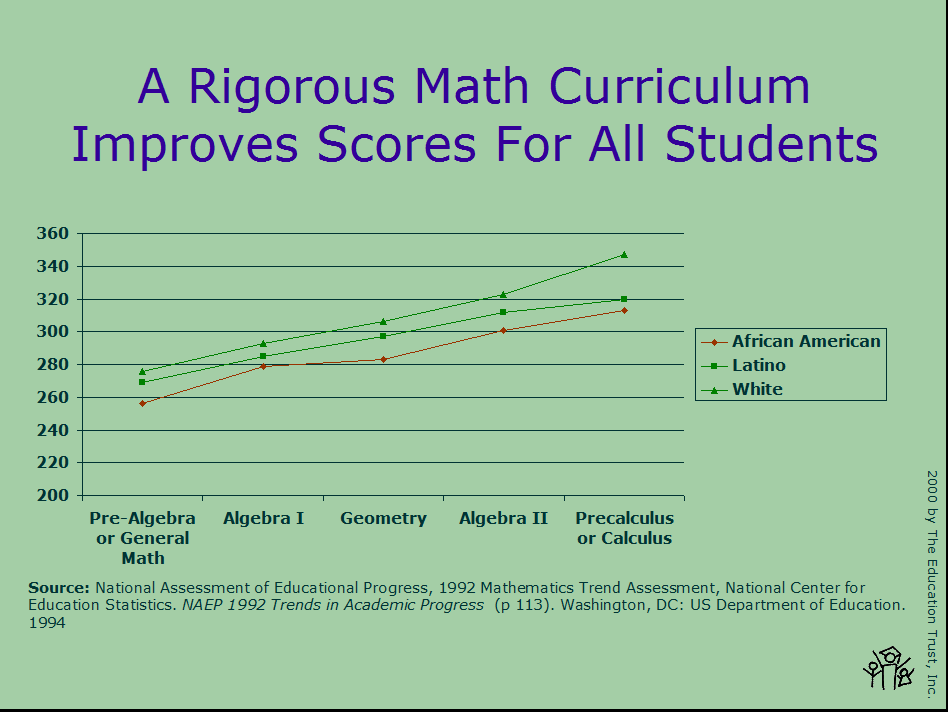
Unfortunate reality #2: Calculus kids do better on their SATs than Algebra I students. Selection bias. Duh.
What should we do?
Avoiding all EoC testing is silly. Pretending that some "3-week portfolio question is demonstrably superior" is the canard put forth by all those people who have never watched or judged a science fair. Individual teacher-written final exams are suspect because of quality-control issues and because of grading irregularities. Department-wide final exams are probably the best unless your state has Mr Honner holding your Regents exams to account, in which case, go with the Regents.
Unless your school just voted to eliminate all finals in light of the transition to Proficiency-Based Grading, but that's another post for another day.
I love the idea of End-of-Year testing in a purely hypothetical sense. Students should be able to demonstrate what they've learned. The teacher doesn't grade it or write it. The students can't weasel out of it. A group of math people decide what "Algebra I" should entail and write some questions to measure it.
The test is never perfect, as NY teachers will hurry to emphasize, but it is out of the hands of the teacher and that is good. We should not be afraid to let our students measure themselves against a common standard and we should be open to change if the unexpected happens. SATs serve this purpose as well.
Differences between what you expect them to get and what they get are the prime indicator. If your grades are all As and your kids can't succeed in appropriate tests, then you need to review what you are doing. If the majority of kids can't succeed on an EOY exam, then you the teacher needs to make a determination: is it the individuals, the exam, the curriculum, or me? If you are passing kids and the next teacher isn't, someone might need to adjust.
In theory, EOY exams should be perfect for this - it's just too bad that they'll be useless for it.
 |
| not linear. |
What will happen is that End of Year testing, like WilyECoyote, is going to run full-speed into the Cliffs of Reality. The "passing" score will be set to 60%, then too many kids fail so it's quietly lowered to 45%, or 35%, or lower. If enough people still can't pass the test, the cut-score will be lowered again. Or you wind up with the weird raw score conversion charts of the NY Regents (right).
So ... is it poor preparation and teaching or poor test-making?
 |
| The graph that's been misunderstood by admin everywhere. |
Unfortunate reality #1: If you raise the standard, more people will fail to reach it.
Unfortunate reality #2: Calculus kids do better on their SATs than Algebra I students. Selection bias. Duh.
What should we do?
Avoiding all EoC testing is silly. Pretending that some "3-week portfolio question is demonstrably superior" is the canard put forth by all those people who have never watched or judged a science fair. Individual teacher-written final exams are suspect because of quality-control issues and because of grading irregularities. Department-wide final exams are probably the best unless your state has Mr Honner holding your Regents exams to account, in which case, go with the Regents.
Unless your school just voted to eliminate all finals in light of the transition to Proficiency-Based Grading, but that's another post for another day.
Saturday, December 10, 2016
Deadlines
Labels:
21st Century Schooling
Does applying hard deadlines really make students learn to meet deadlines? 10 points off for each day late? Or does it just give an excuse to the procrastinator (or the kid who knows he's not that good at the task) that he is no longer responsible for the low grade?

Is our Calvinistic work ethic really a good thing here? Has anyone really considered its effect on the students and the climate of the school?
For all of those who so desperately want deadlines, let me propose one ... set yourself a deadline and then pay $10 per student per day late returning those essays.
end broadside ...
Here's what I feel works better:
Set a deadline if you have to, one that makes sense. Set it for Friday if you REALLY plan to grade over the weekend. If you're going to procrastinate, don't get on their case for it. Taking points off for lateness doesn't make your assessment of the work any more accurate. Grade the work and the lateness separately.
You can certainly set a deadline but be reasonable about it. Allow a kid to hand it to you as you walk out the door - the fumbling and muttering will make him feel bad enough - and you'll probably give him time to proofread and print it. Maybe he's just yanking your chain, but perhaps he's not.
"Here's how well you did" is far more powerful when you are discussing the work itself.
"Okay, give it to me tomorrow morning so I can look at it first period and get it back to you" may occasionally be taken as a sign of weakness and an excuse to persist in tardiness ... but far more often, it is a sign that you want good work rather than hasty work.
And it's a policy that fits much better with Proficiency-Based Grading.
Is our Calvinistic work ethic really a good thing here? Has anyone really considered its effect on the students and the climate of the school?
For all of those who so desperately want deadlines, let me propose one ... set yourself a deadline and then pay $10 per student per day late returning those essays.
end broadside ...
Here's what I feel works better:
Set a deadline if you have to, one that makes sense. Set it for Friday if you REALLY plan to grade over the weekend. If you're going to procrastinate, don't get on their case for it. Taking points off for lateness doesn't make your assessment of the work any more accurate. Grade the work and the lateness separately.
You can certainly set a deadline but be reasonable about it. Allow a kid to hand it to you as you walk out the door - the fumbling and muttering will make him feel bad enough - and you'll probably give him time to proofread and print it. Maybe he's just yanking your chain, but perhaps he's not.
"Here's how well you did" is far more powerful when you are discussing the work itself.
"Okay, give it to me tomorrow morning so I can look at it first period and get it back to you" may occasionally be taken as a sign of weakness and an excuse to persist in tardiness ... but far more often, it is a sign that you want good work rather than hasty work.
And it's a policy that fits much better with Proficiency-Based Grading.
Customer Service
Customer: “Excuse me.”
Me: “Can I help you?”
Customer: “I’m trying to return this orange juice.”
Me: “What seems to be the problem?”
Customer: “It’s brown.”
Me: “Oh, wow. When did you purchase it?”
Customer: “The 19th of this month.” *hands me her receipt*
Me: “Miss, this receipt says you purchased this orange juice on the 19th of last year. You bought this 367 days ago.”
Customer: “Yes, and it’s gone brown. I’d like a refund.”
Me: “Did it not occur to you that orange juice would expire over the course of the year?”
Customer: “I thought if I waited until the 19th of the month again, it would be okay.”
Me: “Can I help you?”
Customer: “I’m trying to return this orange juice.”
Me: “What seems to be the problem?”
Customer: “It’s brown.”
Me: “Oh, wow. When did you purchase it?”
Customer: “The 19th of this month.” *hands me her receipt*
Me: “Miss, this receipt says you purchased this orange juice on the 19th of last year. You bought this 367 days ago.”
Customer: “Yes, and it’s gone brown. I’d like a refund.”
Me: “Did it not occur to you that orange juice would expire over the course of the year?”
Customer: “I thought if I waited until the 19th of the month again, it would be okay.”
Subscribe to:
Posts (Atom)


 Posts
Posts


