Saturday, November 16, 2019

Ask the Narrator: Apps

Warning: The narrator of this blog is "going there".

Ask the Narrator: An App


What do you think about an app that helps parents to easily communicate with teachers towards the educational welfare of students both at school and at home?

Hoo-boy.


I’d have to look at it to be able to say. A few things about your question jump out, though.

“app” & “easily communicate” — you mean like email, texting, facebook clone, instagram, whatsapp, slack, messenger, facetime, …?

As a teacher, I don’t want this much communication with every one of my students parents because my job is teaching, not socializing. The biggest problem teachers have with parents is getting them to let go the reins, stop the constant hovering, … essentially to back off and let their children learn in peace.

Younger children need more oversight, but high school kids much less so. Juniors and seniors are nearly adults. HS is the time to learn self-control, self-motivation, learn from mistakes, break away from Momma and get out of bed on their own, take responsibility for their own education …. now, before it costs $30,000 per year.

“Educational welfare” — what does that even mean?

“at school and at home” — Children at school are my responsibility not the parents’. Children at home are their parents’ responsibility, not mine. Mixing these is where the most egregious problems happen.

Unless, of course, if you’d like me to express my opinions on your ability to cook a nutritious meal, refrain from attending that ridiculous church, comment on your parenting skills, criticize your gun control views, tell you that your kid should be studying rather than having a part-time job, question your support of Trump despite all the evidence, point out that being poor is your fault … and let’s not get into the fact that your divorce from the third man in your kid’s life is really messing her up and causing psychological problems.

Before you argue that all of that would never happen because teachers are just peachy-keen and awesome, supportive people, I have to mention that each one of those comments did happen in local districts or in my own district, and everyone wasn’t particularly happy. (Side note: being a union representative can be soooo interesting, sometimes)

I guess I’ve answered your question, after all.

I don’t want that app.

Fortunately for me, you don’t either.

Monday, November 11, 2019

Ask the Narrator: Taxes for Education

"I'm sick of paying for everyone else's kids to go to school. Why can't people without children pay smaller amounts of school tax than people with children?"

Ask The Narrator


Because you’re not paying for a child to go to school. You are paying taxes in a town, and that town is funding a school for any child who lives in the district. You aren’t driving on every road the town maintains, nor using all of the services available, or even paying all that much and you may have children in that district someday.

Mostly, you are living in a civilized society and that society believes that every child deserves an education.

Some numbers. I pay about $3000 per year on my property taxes for education. I will probably pay those taxes from age 24 - 64 (after that, education taxes are minimal or zero) - so a total contribution of $120,000, which sounds like a lot but it's over 40 years. However, the town guarantees an education to any child … all of mine, any step children, foster children, grandchildren if the kids get in trouble and can’t take care of them, children of relatives if we all want them to be in a better school system, immigrant children if we decide to sponsor them, … each one costing about $15,000 per year. And that’s just my household. Homeless or orphaned, single parent or two, black or white or something in between, disabled or genius or both or neither, athlete or nerd.

My lifetime taxes pay for one child, K-9th grade. Cheap at the price.

It’s just like buying home insurance that you never used because your house never burns down ... but you bought it anyway.

Then, we have the argument that "I don't want my kids to go to public school ... why can't I spend MY money the way I want to? Gimme a full-tuition voucher to a private school."

Because it isn't your money. You don't get to contribute $3000 per year and get a check for $30,000 to send your two kids to Catholic School. And, as above, that tax money is being used by the town to provide an inexpensive education for its citizens. If you don't want to take advantage of that offer, that's fine, but you don't then get to demand they pay for your whims.

If your local school sucks, perhaps you might consider helping to change it and fix it instead of selfishly trying to destroy it with no replacement.

Sunday, November 10, 2019

Ask The Narrator: Mandatory College For All


Recently, the Narrator was asked if college would ever be made mandatory like K12 is. The narrator says no.

Ask The Narrator


"Will college ever be mandatory?" 
No.

K-12 students, by and large, are not yet adults. You can’t require college for adults. 

Being the Narrator allows for extending the question.

"Should there be college for all?"
Nope. 

College isn’t for everyone in the first place, isn’t appropriate for many who do wind up going, and isn’t appropriate for everyone at the exact age they graduate high school.

No, the most you can do is put policies into place to encourage college for all, but you need to have some mechanisms to keep out those who don’t really want to be there.

"Should there be programs to offer aid (up to free tuition) to all?" 

Yes.

Four-year college is the pinnacle in the minds of most Americans, but that's ridiculous. Two-year degrees are just as worthwhile to many people because of differing aspirations, abilities, and life situations. So are tech programs, certifications programs and that sort of thing. 

If we can provide tuition for a four-year degree at a State School (which I think we can and should do), why not also help out with the retraining costs for someone who wants to be a long-haul trucker and help them get a CDL? Why not help the office worker who wants to retrain as an accountant?

Why should we wait for the plant to close and lay off all its workers before we help them get training in another field if they want to put in the considerable time and effort?


Monday, November 4, 2019

Ask the Narrator: SAT prep tactics

Ask the Narrator


Q: How do I prepare for the math SAT?

A: Hard work. There is no "Royal Road to Success."

Learn math every day.

Practice math every day.

Take your courses seriously every day.

See math problems as a challenge you can beat, not a chore you have to suffer through.

It takes deliberate practice, like the stuff you do to improve at soccer or chess, instead of half-assing your way through something just to finish it; that's the only way to succeed at anything, especially math.

Improve your arithmetic skills: mental math (for quick estimation), fractions, percents. Not having to worry about these will free your mind for more complicated parts of the questions.

Practice reading word problems and converting to algebra - there are plenty of questions like this on the SAT. You can find 8 sample tests on the collegeboard website - download them and take them.

Find out if anyone in your school has taken the SAT and requested (and paid for) the wrong answer report. If you can afford it, request it yourself when you take the test. Reviewing these questions helps a lot.

Finally, understand that the SAT is made up of the stuff you learned in:
  • Pre-Algebra (the statistics questions are at this level), 
  • Algebra 1 (especially word problems in systems of linear equations), 
  • Geometry, and a smidgeon of trig (mostly the right-triangle trig from ch8 in Geometry),
  • Algebra 2 (the raw, pure algebra of weird-looking expressions that factor nicely, etc.).

Saturday, November 2, 2019

Ask the Narrator: Class size

In the spirit of all of those movies with a Narrator voice-over ...

It's the Inaugural Episode of ...

Ask The Narrator

What is the optimal classroom size for creating the best quality learning environment?

I like my math classes between 10 and 18.

Fewer than 10 leads to too much of a tutoring situation. The student has to be “on” at all times, and misses out on being able to sit back and consider while someone else asks that same “dumb” question.

More than 18 allows students to hide and you can’t “check in” with them enough in a class period and they don’t learn as much or as well.

More than 24 kids in a class means that the kids on the edges are essentially taking a live-action but on-line class. They don’t ask questions, they don’t work very hard, they skate through and maybe learn something - or not; it’s as if you weren’t even there.

Friday, April 12, 2019

Let Math Fix Elections ...

(Note: I originally wrote this piece several years ago, but bumped it to the top when I read that the GOP is thinking of reconfiguring their primaries and convention.)


What if we really wanted to reform elections – How to do it?

The flaws in the current system are obvious to all – campaigns beginning right after the off-year elections, candidates who rarely stray from bullet-point sound-bites, massive amounts of money being raised and spent, and the all-too-common situation of one candidate's reaching a domination point before all of the states have had their say.

The desire for relevance has resulted in a furious jockeying for first primary. New Hampshire is pushing its primary as far back as it can to maintain its first-in-the-nation status, Iowa is following suit and California just moved its primary to February. It doesn't have to be this way and it shouldn't be this way.

I propose that there be 6 days of primary voting, arranged so that the delegate total doubles each time.

In order to simplify the numbers, I'll use Electoral college numbers as proxy for population or primary delegate numbers. It's not perfect, but it's a good start.

Primary Day I

Leave NH and Iowa first, voting at the end of February. They have been first for many years and are located in completely different parts of the country. They are also small. This small size gives all of the candidates an equal chance to get into a bus and criss-cross the two states meeting personally with as much of the electorate as possible. This sort of old-fashioned campaigning is essential at the beginning.

NH and IA are the first:
they winnow the candidates.
The media will, of course, follow and dutifully report on all of the wonderful stories, repeat all the sound bites and give valuable airtime to the candidates. Because only two states are in contention for the next three weeks or so, all of the candidate's attention is on a small number of voters and a small geographical area.
(Day 1: 2% of delegates committed)

After NH and Iowa have done their civic duties and winnowed the field somewhat, we have then three to four weeks before the next group of small states in mid-March.

Primary Day II

Wyoming, Vermont, South Dakota, North Dakota, Montana, Delaware, D.C., and Alaska.
(Day 2 cumulative total: 6% of delegates committed)

After this second day of voting, the candidates have been analyzed, interviewed, tested under fire, suffered through elections, and hopefully taken a closer look at themselves and their campaigns and made realistic projections about their futures. These small contests harden the serious candidates and eliminate any truly weak ones. Group II states are all "relevant" in that they are the first real test, the first crucible of cross-country campaigning.

Viable candidates who are late-comers to the party won't suffer, though. There have only been some small elections. A candidate could declare in March and still have a realistic shot.

Primary Day III

Now its time (1st week in April) for Rhode Island, Maine, Idaho, Hawaii, West Virginia, Utah, New Mexico, Nevada, Nebraska. Some are blue states, some are red, some are coastal, others are interior states.
(Day 3 cumulative total: 14% of delegates committed)

Our goal now is to force the candidates to campaign to wider audiences. TV ads and news interviews have given the candidates plenty of exposure by now. People in the coming elections are seeing the results of earlier elections and starting to mobilize their parties.

At every step of the way, anyone could take over the lead regardless of the current totals. We're doubling down at every turn - at every stage someone can decide to become a candidate and can come in and sweep up enough delegates to take the lead.

First Interlude

The race is in full gallop. The early debates can happen now. With 18 days or so before the next round, the country has a perfect opportunity to see these candidates in debates and forums. Jim Lehrer can put them through their paces.

Primary Day IV - Super Tuesday

In the 3rd or 4th week of April, we have the first Super-Tuesday. Mississippi, Kansas, Arkansas, Oregon, Oklahoma, Connecticut, South Carolina, Kentucky, Louisiana, Colorado, Alabama bring the delegate total from 14% to 29%.
(Day 4 cumulative total: 29% of delegates committed)

Primary Day V - Super Twosday

Two weeks later, the next Super Tuesday, somewhere near May 10th : Wisconsin, Minnesota, Maryland, Arizona, Washington, Tennessee, Missouri, Indiana, Massachusetts, and Virginia.
(Day 5 cumulative total: 50% of delegates committed)

Second Interlude

Candidates are now running around like crazy folk, but the primaries are coming with two-week "respites" that will allow everyone time to regroup and refocus on the next set of states.

Remember too, that even now only half of the delegates have been assigned – it's still anyone's race. Theoretically, a candidate could step in and sweep the next Super Tuesday and ride triumphantly to the party conventions in June.

Major candidates are now invited to the second round of debates. During these two weeks, the candidate debates can be held every four days or so. The League of Women Voters and other civic groups conduct debates, get-togethers, and candidate forums.

Primary Day VI

So here it is, the last Super Tuesday, in the week of May 24th … North Carolina, New Jersey, Georgia, Michigan, Ohio, Pennsylvania, Illinois, Florida, New York, Texas, California. These are the biggest states with the most voters, evenly split red state - blue state. Candidates still have the chance to "come from behind." They have been in the news for weeks and have had ample time to get out the vote in these big states, raise money, buy ads, and spend money.
(Day 6 cumulative total: 100% of delegates committed)


We've been doubling the totals every time to keep everyone relevant. We've kept the elections to six intense days, instead of scattershot across the five, six or seven months.

Every state matters because no candidate can get an insurmountable lead. Every vote counts because no one can be declared a winner until the end of May. Even the last set of states are relevant: without this group, no one can get over the top. Between Valentine's Day and Memorial Day, we've conducted our business, and can take the holiday weekend off.

We'll have earned it.

Monday, January 21, 2019

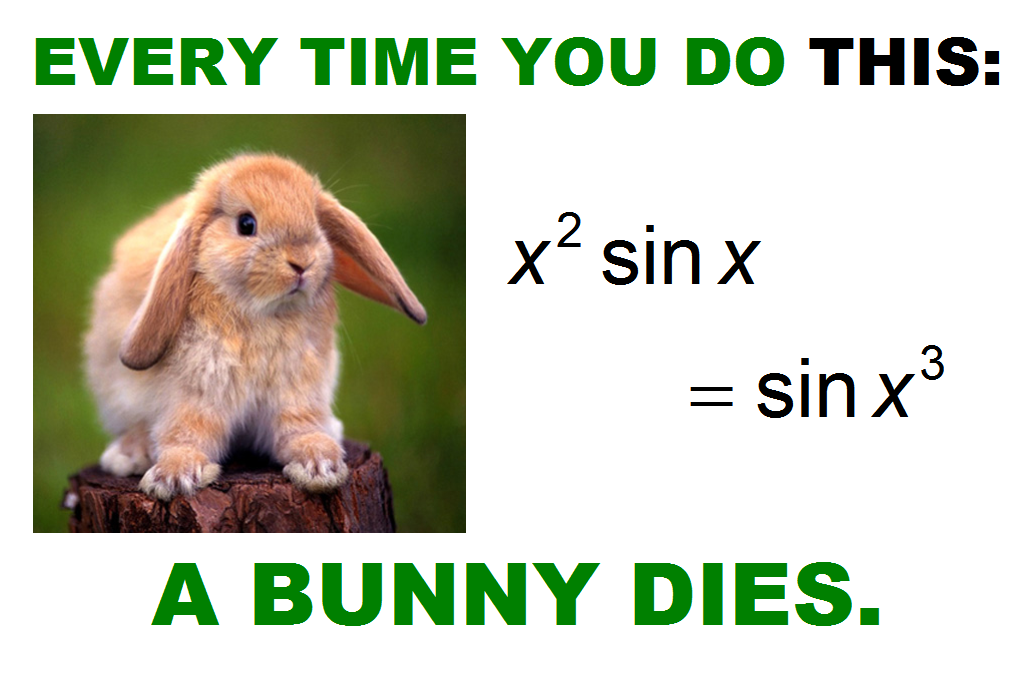
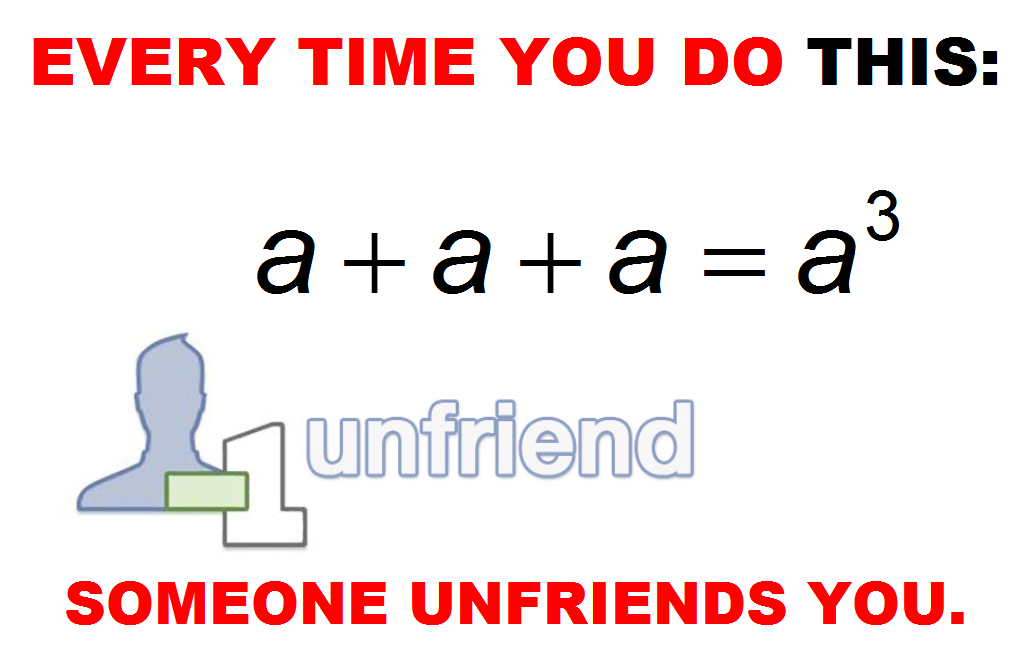
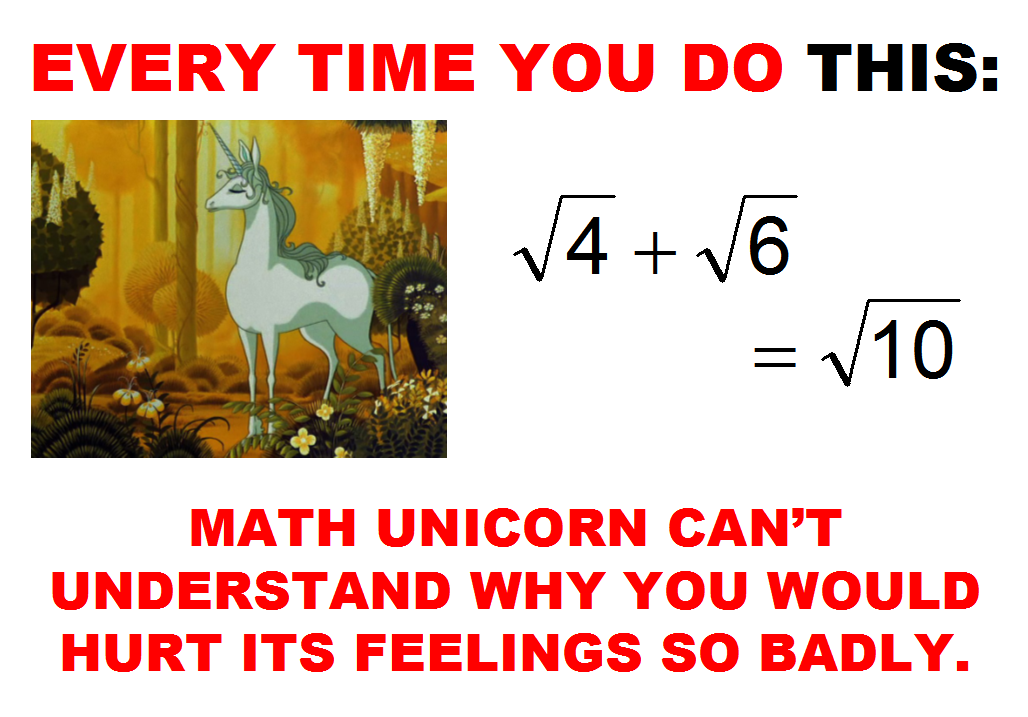
Do This and the Bunny Dies

By request Ms Cangialosi:


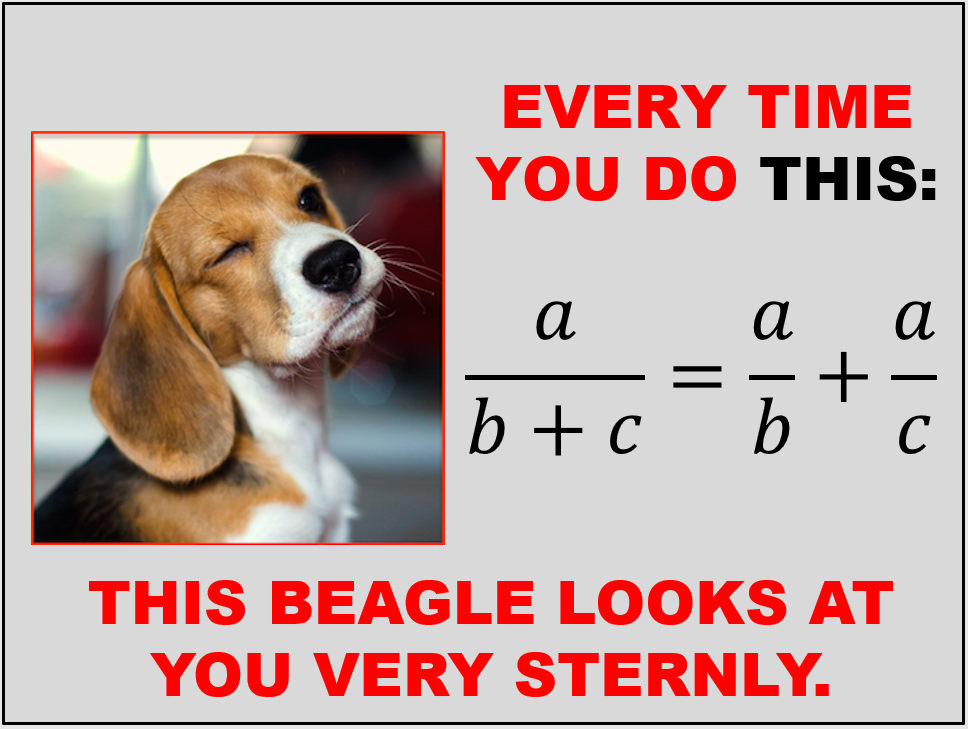
Because someone's beagles do this all the time ...


Fresh from today's test:


Nominated by @MathsPadJame,


Seriously? Nix The Tricks, Dammit!


I'm trying to hold it together, people ...


We've both had enough of that fraction mistake.


That's not even reasonable ....


One for the younger ones ...


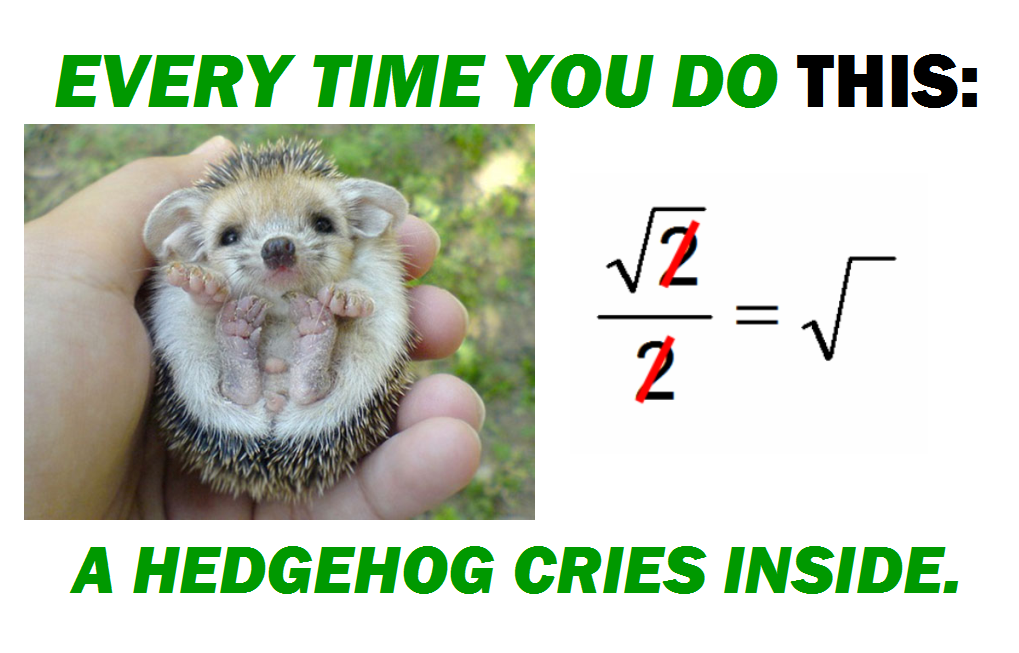
Can't remember where I saw this first. (edit: Finally found out the original ones with the handwritten math came from Bowman Dickson, @bowmanimal)

I cleaned up the original images a bit and tried to keep it sensible, but between the kids' and my evil senses of humor ... this project has grown out of control.

We might as well just enjoy it.
Save the Rabbit!


Finally found out these original ones with the handwritten math came from Bowman Dickson, @bowmanimal. You can blame him for starting all this. ;-)

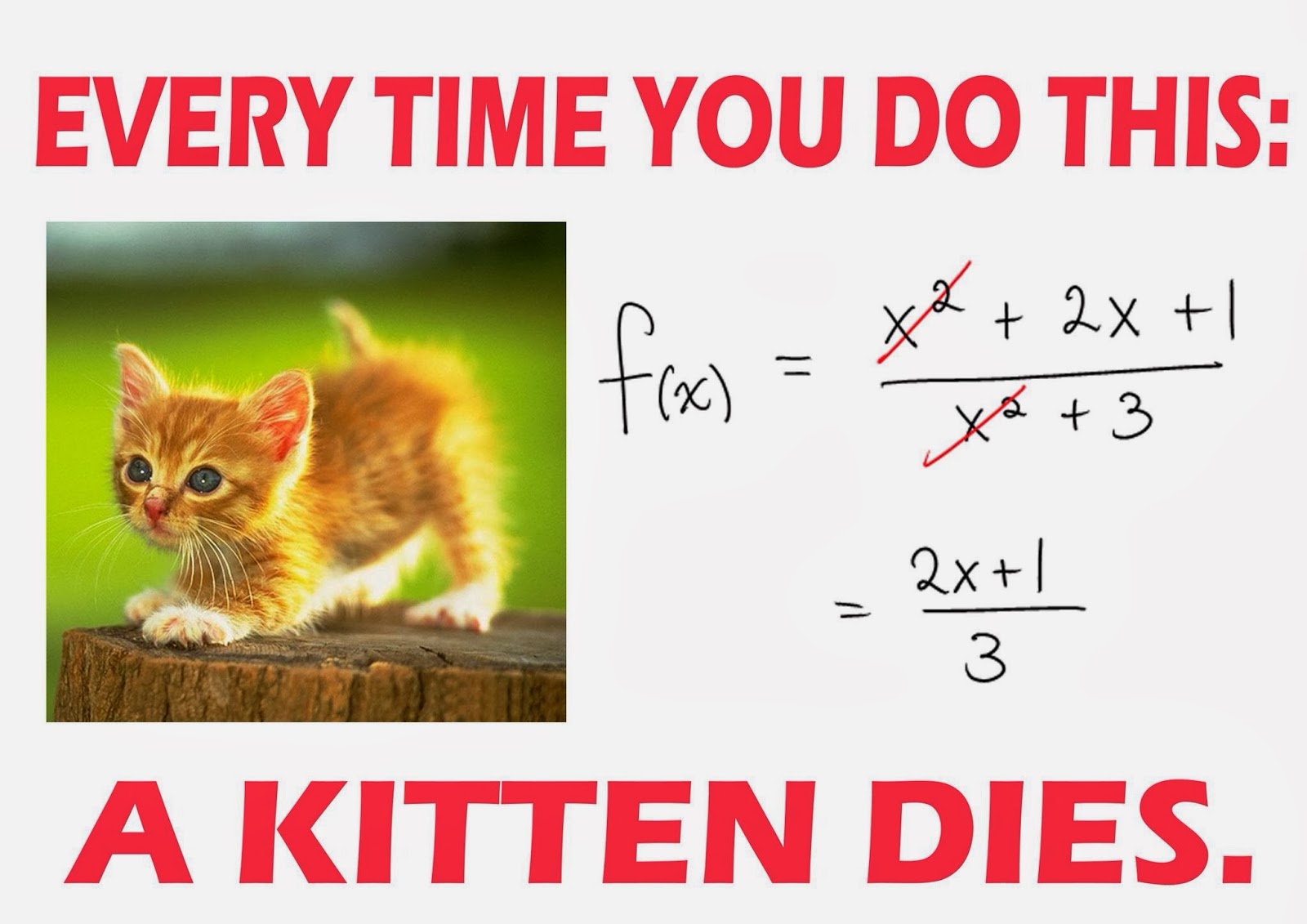
 Poor Kitten ... this happens all the time.


Such a shame how often that poor puppy gets it ...


Damn you, TI !


Because we all know a Fawn ...


Pandas are endangered, people. Cut that out!
from http://www.paulmcdonogh.com


Poor, poor Grumpy Cat.

Don't make him cry, people!

You heartless bastards.

I have nothing left to say.

Do You REALLY want him to win?

There's more!

Look at how sad he is ...


Don't you want friends ....


Poor bastard ...


SO very disappointed ...


It's just mean for you to do this ...


This just makes me sad ...


Wednesday, April 18, 2018

PBE part three - Death of the Average

Perhaps the most important aspect of PBE implementation and effectiveness is the death of the average. If you screw this up, the whole thing is worse than traditional methods.

Let's examine a typical Algebra 1 course. Here's the Intro page for Chapter One.

When m=4 and n=5, what is 3*n + m ?
and 34 - 3/11 = ?

This is fifth and sixth grade stuff. I expect all my students to be able to correctly evaluate these two expressions in a 9th grade algebra 1 class, but I know that there are always kids who mess up, need reminders, or who just don't realize that High School is different and paying attention to your work matters.

The point is that everyone gets an "A" here, or 100% if that's your school grading system.

Fast forward to chapter 6, linear systems. There are many ways to solve systems and we expect that each student learns them all. Invariably, there's a problem.

Johnny gets half of them wrong all the time. He gets a 50%. If you look closer, you see that he can only answer the most simplistic questions and then only occasionally. If you were pressed, you'd admit that he didn't understand at all. He can't explain what he's doing and didn't show any work, you suspect that he copied many of his answers from nearby papers, but you can't prove it so you give him a 50%.

No problem, he says, that's a 75% average. And, if you include his 100% homework grade and 95% class participation grade, that's easily a B+.

How does understanding one aspect of arithmetic average with not understanding algebra to get a "Good", almost "Excellent" grade?

Until we get out of this mindset, we're toast.

Hopefully, we can do that with PBE.

Each course is defined as a set of Big Ideas. In order to get credit for the course, each student must understand all of them.

That's a huge shift.

Think about it, though.

Thursday, November 23, 2017

PBE part two - The Gist of the Problem

For those whose states haven't yet been jumping on this bandwagon, what is PBE?  PBE is short for Proficiency-Based Education, sometimes called Standards-Based Education (SBE).

The gist of PBE is that education should be structured around knowing and understanding the Big Ideas, being able to do and perform those Important Skills, becoming students who learn and retain because they understand what the school was teaching.

There are several things that have pushed this initiative; most of the concerns are with the fact that so many kids seem to drift through high school (and especially HS math) without actually retaining anything. Of course, many students passed because they deserved to, because they understood the material and were ready for the next level. On the other hand, students have also "passed" by:
  1. being good at only a few topics but their average was above a 60.
  2. sitting like a lump and getting passed on. "It's all about Seat Time."
  3. bringing a pencil everyday, always handing in homework (even if they didn't actually learn anything from it) and having good attendance. "She's a GOOD kid."
  4. expending "Great Effort". "He really tries HARD."
What other problems were there with "traditional methods"?
  1. Courses are comprised of a few Big Ideas and a lot of filler that has gathered in the margins over the years. Reformers argue that we should focus on those Big Ideas instead of on the filler.
  2. What's so special about 120 hours of class-time? What if a kid needs 135 or only 80 to master the material? Reformers ask why every class goes for 180 days, 45 minutes a day.
  3. Teachers giving some kids a passing grade allowing them to move on to Algebra Two, just to get rid of him or to allow him to graduate.
  4. You don't measure understanding of a concept by simple repetition of a question. 
  5. Percentages are more precise than accurate. 
  6. Fine-grained reporting leads to a "Horse-Race" mentality in students and parents. "I'm better than you by a point." 
  7. Marking a question as 4 points out of 5 is less informative than a comment or some type of written feedback.
  8. Learning is a process that shouldn't be measured only once. Practice shouldn't be included in the grade, especially if the student had help.
Some of these claims are bogus, of course. Most are not.

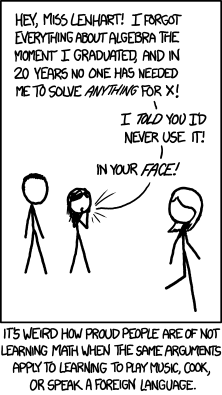
Let's be honest here. There are a lot of adults who walk into meetings who begin by saying "I was never very good at math." There are memes aplenty that laugh at us math teachers saying "I've never had to factor a trinomial in my career. Everything I've ever done was done with 7th grade math."

Students have their own version of this game, "When am I ever gonna have to use this?" and then they promptly shut down if the answer doesn't fit into their narrow view of their future life and career.

Reformers claim, "Clearly something isn't working."

Despite the fact that the most important problems that exist in traditional education won't be solved by switching to PBE, the switch is worthwhile in my view.

The most important problem is that someone has to subjectively measure the student's performance.
This has been the problem for centuries and it won't change. There are so many ways that this judgement can be altered, massaged, changed, or mangled.

Every teacher knows it.
  • "Why did you give that grade to my kid?"
  • "You can't fail a kid if you didn't contact the parents."
  • "She didn't deserve that grade. She worked so hard."
  • "Do you really want him back in your class for another year? He's taken this same course two times already."
  • "If I fail this class my parents are going to kill me."
  • "Did you tell his parents every week that he wasn't doing his work? I don't see any record of this in the contact log."
  • "What are you going to do to help him pass?"
  • "Why didn't you assign him to afterschool help?"
  • "My son was always the best in his class in math, until he had you."
  • "I looked at her test. She should have gotten full credit on this question, and that one isn't wrong. You have to give him a 90."
  • Sometimes it's less subtle: "I'm gonna break your fucking arms if you fail my son. He only needs this one fucking math credit to graduate. I know where you live. I'm going home to get my gun."
These problems remain, no matter the system.

Under PBE, however, we have an opportunity to reframe education. We're going to measure only what they know, and focus on the Big Ideas.
  • Random quizzes on the way to understanding don't count. Only understanding counts.
  • Homework that was done with other people's help doesn't count. Only understanding counts.
  • The "Gentleman's C" is no longer a thing.
  • "Pity points" is no longer a thing.
  • "Extra Credit" is meaningless.
  • A 90% on Order of Operations can't mask a 50% on linear functions.
  • No more marks of 89.5% being considered "better" than 89%.
  • No averages of 60.001% just to allow a student to pass.
Can we do it?

Maybe.

or maybe not.

Sunday, November 19, 2017

PBE part one - getting started

This is the first of several posts about PBE, Proficiency-Based Education. I am trying to set down my understandings and beliefs, give some advice from my (very) limited experience, and lay a groundwork for improving what we're doing in my school and in my state of Vermont.

I plan to discuss what I think my school is doing right, what I think they are doing wrong, and try to find the best answers that I can. Who we are is irrelevant; the entire state public school system is under mandate from the VT AOE to make the change to PBE in order for the class of 2020 to graduate having had four years of high school PBE.

Yep. We are a year behind. We, and almost every other school I know of, have been procrastinating badly. We've spent 4 years on this so far, and been required to write only four modules for our courses because teachers whine "We don't know what you are asking us to do" and, since the person in charge of PD doesn't really know what the end goals should be and what PBE looks like in practice, we waste lots of time making empathy maps, rating and watching videos that are demonstrably ridiculous, and other tasks that don't really advance the program.

The State A.O.E. reps have openly admitted that they have no idea about how this will work. When I ask for sample transcripts, I get "We don't know. This conference is for you teachers to tell us what a typical graduate should be able to do and be." Ask for sample curricula, or sample frameworks, or sample anything and you get "We can't tell you because we don't have any of that and you have local control." That law was passed four years ago and this conference was one month ago!

Much of the Vermont AOE website focuses on convincing people that this is a good idea, rather than on what this idea actually should look like in practice. Here, you can look for yourself.

The Supervisory Union has openly admitted that they have no real idea of how PBE is supposed to work. "We're not sure. Nobody has done this before. We're on the cutting edge. We don't know what the Graduation requirements should be -- you teachers have to decide. Write your modules to this template, but we're not going to look at them critically - you have to do that."

The principal and other school administration are just as much in the dark but, to their credit, are willing to let teachers do this exploration and possibly fail on our way to succeeding.

I'm going to focus at first on what I feel PBE should be and why I feel it's a good idea, then on some of the things that are really making this transition problematic and may end up destroying the initiative and ruining the educations of many students in the meanwhile.

Hopefully, this exploration will prove useful to both of us.

Another Problem with Computer-Based Learning

I am not a fan of computer-based courses except when the alternative is nothing. If the choice is Moodle or nothing, then Moodle wins, but it's not a great solution. Even a mediocre teacher is better than an online course. Charter schools who offload the majority of teaching onto computer programs are doing a real disservice to their students. Computer programs are far too often limited in what they accept as correct answers, too limited in their explanations, and not particularly well thought out.

Style and colors win out over physics.

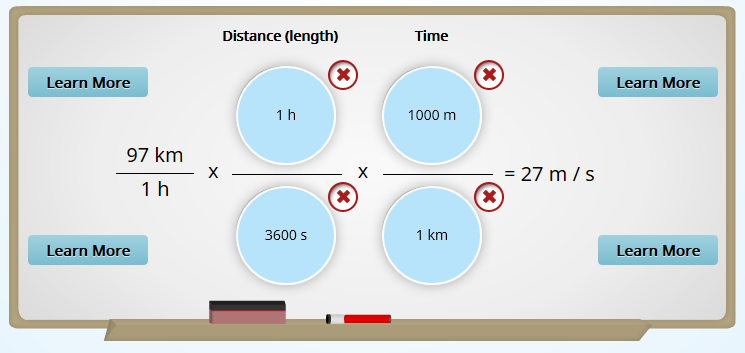
The example that prompted this note is below. In the exercises for an online edition of a physics textbook, there was this unit conversion problem that asked students to convert km/hr to m/s, a fairly simple but important task. The student had to drag and drop circles onto a fraction structure - the task was to replicate this pattern:


This is the only acceptable answer, however. Any different arrangement was deemed incorrect:


Those "Learn more" links simply repeated the advice to convert the length measurement first without ever giving any reasons why the fractions should be in that order.

It's programmed that way. No exceptions allowed, even if they are correct.

The worst part? It hasn't been fixed. I sent a note three months ago. This content was written and published at least four years ago. Why the holdup?

Friday, October 13, 2017

Consistency of Message

Short speech this afternoon included the following statement:
"We believe that all students should be able to take any or all AP courses at our school."

This was the concluding talk of a day-long conference on Proficiency-Based Education which has as one of its guiding tenets that
"Students should not progress to the next proficiency until they have mastered the first one and should not be allowed to move from course 1 to course 2 until they have reached proficiency in all of the predetermined areas in course 1."
These two statements seem to directly contradict each other, yet both were met with applause and approval from the assembled. How can you take AP Calculus if you haven't reached proficincy in the topics of precalculus, and before that in algebra 2, and before that in geometry, and before that in algebra 1?  (Granted that the geometry course is not strictly in that place across the country.)

What am I missing?

Wednesday, September 20, 2017

More PBE Idiocy

My school is implementing Proficiency - Based education this year. (Some people call it Standards-Based Grading)

We're behind the curve; the State of Vermont has decreed that ALL schools in Vermont will be using PBE so that the Class of 2020 will have had four years of PBE by the time they graduate. That's this year's sophomores.

Yes, that means we're a year behind. Our school's faculty made the decision last May to push forward with this initiative against the wishes of the SU -- we didn't want to wait two more years to begin, putting us three years late according to the directive from the State.

Our reasoning was that, if this is truly a Good Thing, then why should we wait to put it into place?

But our supervisory office and it's IT staff are hopelessly unready. Incompetent isn't a unfair characterization. They have no transcript format ready to go, no sense of how to ascertain academic ineligibility, etc.

So we faculty are doing it for them and fighting against their bad decisions the whole time.

Faculty: "Don't average proficiencies. In fact, don't even think of them as percentages."

"Hold my beer," they said.


Faculty: "Wait, you shouldn't do that ... and what's with the gaps between the levels? .... and what's with 'Not Attempted' being 0% to 15%?"

SU: "Uh, we don't know, and we don't know how to change it."
Faculty: "If you insist we keep percentages AND that they must average, would you at least fix the gaps?"

SU: "Uh, we don't know how to change it."
SU: "Uh, leadership team needs to make that decision."
SU: "Uh, it's your fault for moving too quickly."

Faculty: sigh.

SU: "Uh, you know there's two different scales, right?"

Faculty: "Wait, what? That's ridiculous, and wrong on so many levels. No one would do anything that stupid."

SU: "Yeah, check this out. Hold my beer."


Faculty: "Okay, so the percentages are the same but why is it called Approaching in this scale and 'Nearly' in the other?"

SU: "We thought it would be fun to change it two days before school starts, but not everywhere. You'll randomly see one or the other."

Faculty: "Whaaaat?"

Faculty: "By the way, if I enter a 3 out of 4, I get an NP. It should be Four Levels means One thru Four, but it isn't working that way. Please explain that."

SU: "Uh, we don't know what you're talking about and we don't know how to change it."
SU: "But, we just figured out that if you use a 5-point scale, and enter a 4 out of 5, then you'll get proficient. Think of it as a feature."

Faculty: "You went out of your way and insisting that it was four levels, not five. Would you please get it straight?"

SU: "BTW, did we mention there's a third scale? Check this out!"


Faculty: "WTF is with those percentages changes?"
Faculty: "If I enter a 3 out of 4, I get an NP again. Please explain that. While you're at it, why is 'Emerging' now 0%-50% instead of the 15%-45%?"

SU: "Uh, we don't know what you're talking about and we don't know how to change it, but all three are active in your gradebook at the same time."

Faculty" "Are you serious?" 

SU: "Yep. We're kinda proud of all the work we've done."

Faculty: "It's been all different, the kids and parents are fuming, and we're going back over everything and rescoring everything to make things consistent. THIS HAS NOT BEEN HELPFUL."

SU: "Don't be ungrateful ... BTW, you know how you asked that all of the Common Core State Standards for math be put into the gradebook?"

Faculty: "(Nervously) Um, yeah?"

SU: "We changed the names of each one of them."

Faculty: "Keep your goddamn beer."