Showing posts with label Prep. Show all posts

Tuesday, August 19, 2014

Drilling basic facts pays off.

"Practice makes perfect."

Okay, we do have to differentiate between mindless drill & kill and what really makes kids better at math - focused practice, error correction, and repetition of correct processes.  Just as hacking around on a soccer field doesn't help the team nearly as well as a directed practice, endless pages of addition problems aren't useful in developing math skills.

Do ten at a time until you get them right. Examine the work, identify errors and don't repeat them .... which sounds like what Common Core asks math teachers to do and what math teachers have been doing for a long time.

This all sounds like what you've been doing, unless you have Curriculum coordinators like mine who denigrate practice as "drill and Kill. We should have the kids do critical thinking", as if critical thinking and error analysis were two different things.
"Healthy children start making that switch between counting to what’s called fact retrieval when they’re 8 to 9 years old, when they’re still working on fundamental addition and subtraction. How well kids make that shift to memory-based problem-solving is known to predict their ultimate math achievement. Those who fall behind “are impairing or slowing down their math learning later on,” Mann Koepke said. 
So, those teachers who insist that the kids should have a calculator and an internet connection so they can look it all up are really doing a job on their kids.
It turns out that adults don’t use their memory-crunching hippocampus in the same way. Instead of using a lot of effort, retrieving six plus four equals 10 from long-term storage was almost automatic, Menon said. In other words, over time the brain became increasingly efficient at retrieving facts. Think of it like a bumpy, grassy field, NIH’s Mann Koepke explained. Walk over the same spot enough and a smooth, grass-free path forms, making it easier to get from start to end. If your brain doesn’t have to work as hard on simple math, it has more working memory free to process the teacher’s brand-new lesson on more complex math. source.
So the next time someone says that elementary students should have a calculator, that "you can look that up" and "all we need is to teach them information retrieval skills", remind them that the brain needs to have some basic facts to work with before it can handle more complex tasks.


Currently, the argument point brought up here is the Japanese education system, which has been moving away from drill and practice and turning to the higher-order thinking that reformers here in the States are always going on about.

Remember, however, that a typical Japanese high school teacher does NOT have to do as much of this preparatory drill and skills practice ... because of the ubiquitous "jukus" - after-school academies that nearly every Japanese student attends to make sure that he/she has a shot at higher education.What do the "jukus" do? Drill. Basic skills. Practice, practice, practice. Because it works.

Here's a description of one of these "cram schools":
"This school broadcasts lectures to its 800 satellite schools all over Japan and supports students via telephone, fax and the Internet. Students can take math training menu and other drills on the Internet through a service called Toshin Home Lesson. They can choose from one series of lectures to a whole package."

Thursday, March 20, 2014

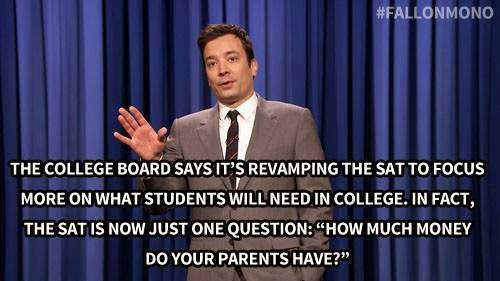
Leveling the Playing Field for the SAT.

I got the email the other day:
Exciting news: Khan Academy is partnering with the College Board so that all students who want to go to college can prepare for the SAT at their own pace, at no cost. The College Board just announced that they’re redesigning the SAT for 2016, and we’re partnering with them to make free, world-class prep materials. 
I'm underwhelmed. There are thousands of SAT practice sites around the Internet, some good and some not-so-good. There are thousands of SAT practice videos on YouTube, you just have to look. In my mind, the one thing that Khan is providing is a moderately well-organized list of boring-ass videos.

By spring 2015, you’ll have access to state-of-the-art, interactive learning tools that give you deep practice and help you diagnose your gaps. All of this will be created through a close collaboration with the College Board specifically for the redesigned SAT. 
So they will need at least 12 months to put this together. Seems like a lot of time spent on a test, but maybe it will be worth it. Screw you if you need anything before our planned roll-out date, of course, but Khan Academy isn't about the student.
Our goal is nothing short of leveling the playing field for every student taking the SAT, so please help us reach as many people as possible.
There's the rub. You can't level the playing field with a test-prep course. If test-prep could do that (and it doesn't), it would indicate that a few hours of knowledge-blitz is enough and would validate all those thousands of dollars spent on Kaplan and Princeton Review and everyone else in this test-prep sucker's game.

But test-prep helps, right? No, not really.  What 10 weeks of 4 hours a week test-prep will do is ease student tensions, help them focus, warn them of some of the obvious pitfalls, advise the students of "tricks" the test makers tend to play. This amounts to about 50 points "improvement" over untrained students ... which sounds like a lot, but it's well within one standard deviation, and about what happens when the student takes the test A SECOND TIME. That's right, test-prep eliminates some basic errors in test-taking, not in subject ability and knowledge.

"But the guarantee?" Yep, they have a guarantee. "Do 100 points better or we'll let you retake the course for free."  First off, 100 points better than what score if you haven't taken it? Second, if you don't improve by that amount, what kid is going to sit through another 10 weeks of this course, even if it is free?

I've convinced my school to allow me to offer SAT prep as an elective. Am I being hypocritical? Nope. What I do daily is work on math or English. I do the test-prep, too, but mostly I focus on filling all those little gaps in their knowledge and then we have time to practice them. It's a tutorial.

I'm looking to improve the math knowledge and understanding, not just talk about tricks. Sure, I'll focus on only certain parts of Algebra I, but they've already taken algebra I ... I'm filling many of the gaps. Not all, but it's an improvement.

I'm looking to improve vocabulary and grammar and I have the time to do it. It's often surprising to me how much students can appreciate grammar ... about five years after they've learned it. (Or after they've taken a language.)

I'm looking to have them write the stilted and boring essays that get scored well, while telling them all of the ways they can deviate from the stilted and boring pattern if they want to, for the English teacher or for their own personal writing.

Perfect Practice is not poison. Perfect Practice is not drill and kill. Perfect Practice leads to Automaticity, which allows the student time to think and gives her a knowledge base to work with.

Fallon is right, but I'll talk about why, next time.


Wednesday, May 18, 2011

Wrong on so many levels

They say that a little knowledge is a dangerous thing.
List of Fail
  • Archamendes
  • Carried a box of sand.
  • "I believe there is merit ..."
  • "Take your students outside to write in the mud."
  • This guy is teaching college students.
  • Who believes in himself and has his writings for sale.
  • Archamendes? Seriously? Google broken? Oh, yeah, I remember, you think that education should be "Just in Time instead of Just in Case."  How's that working out for you?
He scratched in sand because it was available, easy to use and cheap. Papyrus was harder to get and vastly too expensive to scribble on. Don't even consider parchment.  I love the intro ... "It is believed ..."  Sorry genius, it is known. Basically, the man did a lot of thinking in his head, aided by scratching in a sandtable or on the ground (the guy would have loved paper).  There is no "merit in his method" because the sand isn't what made him who he is and the sand won't make your college students any better than they are, though it will probably make them worse.


and his name is Archimedes.


Sheesh.


"Burn The Textbooks, Shred The Worksheets, Teach Math." Yeah right.

Saturday, March 26, 2011

Calculus Syllabus for the AP Audit.

This was enough to satisfy the review process wonks.  Feel free to use it verbatim as I can't claim to have made much up on my own. It is mostly a regurgitation of the table of contents.

I certainly don't feel that anyone should spend an iota of psychic energy on the syllabus - spend it making plans and working toward the best you can do for your students.

Case in point: "Definition by limit: epsilon-delta." was de-emphasized in AP years ago, is usually ignored by most college professors for MAT121 but emphasized by the Audit review process. I couldn't get the audit accomplished without lip service to it.

A change from this syllabus for me: I am changing from a school-hosted ePortfolio to a Moodle, blog and Wiki based on my personal server. There are several places to find free hosting for those. Additionally, I will be requiring certain homework to be done on WolframAlpha since no one can afford Mathematica.  I'd love to require an iPad but I'll have to win the lottery first!

Good luck in your setup.


Calculus Syllabus

Instructional Materials
  • Textbook: Calculus, 7th edition by Larson, Hostetler, Edwards; Houghton – Mifflin Publishing Company.
  • Technology: TI-83 / TI 84 graphing Calculator 
While materials can be borrowed from the school, it is highly recommended that students purchase both the book and the calculator. The book will be useful for many years and the utility and convenience of writing notes in the margins and highlighting passages cannot be minimized.
  • When appropriate, the class will make use of Geometer's Sketch Pad, excel, Google apps.
    • a gmail account would be most helpful.
  • E-Portfolios will be a part of the Course. See ____ for account and access information. Work will be done in groups, handed in separately (and included here). Typical Contents:
    • Your two sets of school-wide showcase materials
    • Chapter projects/labs assigned monthly.
    • Past years FRQ questions worked out and scored by each other.
    • Inter-curricular questions.

Introduction: What is Calculus About?

Functions Review
  • I. Sign Graph solutions
  • II. Coordinates, Slope
  • III. Linear Equations: [point slope, slope intercept, general]
    • A. Formulae [ distance, angle, perpendicular, bisectors]
  • IV. Polynomial functions – library of Functions
    • A. Domain, range, discontinuities, roots, synthetic division
    • B. Odd, even, Symmetry
    • C. composite functions g(f(x)), (g*f)(x), (gof)(x)
    • D. Slope = derivatives, differentiability,
    • E. "How to say it in Math." Introduction of proof techniques and format.
Limits
  • I. x =>a, one sided limits at discontinuity, peak, break in curve, inf. disc, etc.
  • II. [ graphically, algebraically, numerically]
  • III. definition of derivative as lim h =>0, delta, epsilon (refer back to "More or Less")
  • IV. Limits : add sub / mult / div
  • V. Infinite Limits
  • VI. Continuity, max-min theorem, Intermediate Value Theorem, Computer/calculator-aided exploration of situations in which lim f (x) x a D.N.E.
Derivatives of Polynomial Functions
  • I. Definition by limit: epsilon-delta.
  • II. Computer-aided exploration:
    • A. Using the definition of the derivative as a limit of slope
    • B. secants to plot f'(x)vs x. The relationship of the graph of f'(x)to f(x).
  • III. Power Rule, Constant Rule, Sum Rule, Product Rule, PowerRule2, Quotient Rule
  • IV. Implicit Differentiation
  • V. Chain Rule: composite functions
  • VI. "Explain" "Show that" "Why or Why Not" – how to justify an answer. Includes review of past free-response questions, and scoring methods, practice developing an appropriate answer with explanations. presentations by students
  • VII. Trigonometry
    • A. one-day review of basic functions, then Derivatives of trig functions
  • VIII. Linear
    • A. Tangents and Normals, Linear Approximations and Differentials – ZOOM and compare – analytic results vs. calc – relate back to epsilon/delta
    • B. Newton’s Method – writing a recursive program
    • C. Calculator computation of derivatives and graphs of derivatives.

Derivative Applications
  • I. Sign Graph analysis recap
  • II. Graphing
    • A. First derivative: increase, decrease,
    • B. Second derivative: concavity
  • III. Symmetry
  • IV. Asymptotes, limits, dominant terms, derivative of hyperbola vs parabola: behavior at extremes
  • V. Extrema Theory: Relative and Absolute Maxima and Minima;
    • A. 1st derivative test and the Extreme Value Theorem; Intervals,
    • B. Continuity;
      • 1. Why are the notions of continuity and limit crucial to the Calculus?
      • 2. Informal discussion of "function niceness."
      • 3. Definition of continuity theoretically compared to on the TI.
    • C. 2nd derivative test for maxima and minima
  • VI. Recap of "Explain" "Show that" "Why or Why Not" – justify an answer. "How does one know f(c) is minimum?" 1999 FRQ BC:4 Student Sample A and others.
  • VII. Maxima and minima: Problems
  • VIII. Related rates of change, physics, chemistry, Real Problems, dist-vel-acc-jerk, best solutions. Include here the instantaneous numerical calculations.
  • IX. Rolle's Theorem, Mean Value Theorem, Intermediate Value Theorem
  • X. Indeterminate forms and L'Hopital's Rule
  • XI. Fall School-wide Showcase: Presentations and Explanations (similar to typical portfolio except this is a chance for students to present some of their work to parents, faculty and members of the community.)
Indefinite Integrals
  • I. Indefinite Integrals - Primitives (antiderivatives) differential equations, Separation of variables, basic integration formulae, constant of integration.
  • II. Finding the constant of integration (C)
  • III. Substitution Method - U and dU
  • IV. Integrals of Trigonometric Functions
    • A. Basic Functions
    • B. Using Trig identities to solve integrals
  • V. The Area Under a Curve - Definite Integrals
    • A. Rectangles & Summation (Sigma notation)
    • B. Riemann Integral = Lim as number of rectangles incr. to infinity
  • VI. Calculating Areas by Summation
    • A. Rectangles
    • B. Trapezoids
  • VII. Fundamental Theorems of Calculus -
    • A. First F.T. of C. -- definition of Primitive F(x): derivative F(x) is f(x)
    • B. Second F.T. of C: definite integral is equal to F(b) - F(a)
  • VIII. Substitution
  • IX. Approximations of Definite Integrals
    • A. Trapezoidal Rule A=h/2 (1 2 2 2 2 ...... 2 1)
    • B. Simpson's Rule A= h/3 ( 1 4 2 4 .... 2 4 1 )
Integral Applications
  • I. Distance - velocity - acceleration - jerk
  • II. Areas: horizontal rectangles - dy, f(y), g(y); vertical rectangles - dx, f(x), g(x)
  • III. Volumes, by revolution
    • A. Creation: use potter’s wheel as example; zucchini-carving to show slicing; cardboard discs, wood tiles. Group–think: Given a lathe template for vase, find the volume
    • B. Volumes of revolution around x-axis and y-axis using Discs, Washers, Shells
  • IV. Known Cross Section
  • V. Average Value, average rate of change
  • VI. ** Optional extensions of integral theory
    • A. Length of Plane curves, Area of Surface of Revolution
    • B. Physics: Moment of Inertia, Center of mass, Centroids, Nonuniform mass distribution, Work done by variable forces (concurrent physics preferred)
Transcendental Functions
  • I. Inverse Functions and their derivatives
  • II. Inverse Trig functions
  • III. Derivatives of the Inverse trig functions and associated integrals
  • IV. Natural Log and Derivative
    • A. INT (1/cabin) d(cabin) = log (cabin) + C = houseboat
  • V. Exponential and logarithmic functions
    • A. derivatives and integrals
    • B. Applications [ rates of growth, decay, compound interest, Richter scale]
  • VI. Spring School-wide Showcase
Integration Methodology
  • I. Basic Forms
  • II. Integration by parts [Berger method]
  • III. Trig Functions, odd powers and even powers
  • IV. Trig Substitutions
  • V. Integrals involving .....
  • VI. Partial Fractions [Alfonso’s Method, Matrix solutions, Millitello cover]
  • VII. Numerical integration
** Post – Test Optional
  • I. Conic Sections – Definitions and uses of calculus – areas, etc.
  • II. Hyperbolic Functions –
    • A. Definitions, Derivatives and integrals
    • B. Cables, Catenaries (Gateway Arch and Power lines), and the suspension bridge.
    • C. Inverse Hyperbolics
  • III. Polar Coordinates
    • A. Graphing and common figures,
    • B. Derivatives and integrals in Polar coordinates
  • II. Infinite Sequences and series
    • A. e, sin, cos, pi expansions
    • B. Taylor, MacLaurin etc.