Monday, April 29, 2013

How much math do we use at Work?

Shawn Cornally writes about this piece in the Atlantic.
So the survey results are out ... no one uses complex math in RealLifetm, so we probably shouldn't be requiring it of all the students in high school.
These numbers alone aren’t an open and shut case against teaching complex math to most high school students. But they do suggest that what we teach today has little relationship to the broad demands of the job market, and that we should at least be conscious of the possibility that we’re putting educational road blocks in front of students without a practical application for them.
I have a few observations about this rather simplistic interpretation, including a rebuttal of those who, like Shawn Cornally, feel that the problem lies in the way math was taught.
Cornally: There’s a case against CRAPPILY teaching complex math to high schoolers. The adverb there is really important. What that graph really means is that the way people were taught math disables them from ever actually using it.
Okay, let's start there. Cornally is a SBG guy through and through and that's fine. It works for him. But to assume that what works for him is the only possible way to teach ignores that lots of teachers are very good but never bothered with SBG. This graph says that large percentages of people never use complex math in their daily jobs ... it does not say that they can't or didn't learn it.

As for that graph:

22% use any of the advanced math skills.  It did not say WHICH of the skills were used, how often, or whether the job required it but they didn't know ... so they answered "No."

Let's look at a breakdown (and no snarky comments about the color choice ... whoops, too late.)

Of the 14% who used geometry, there is no indication of which of the geometry skills each person used. Let's arbitrarily designate the broad topics of geometry as A,B,C,D,E, and F. This person uses A,B,and C. That person uses D,E, and F. Both respond that they use geometry. A third person uses the ideas but not in any formal way; he's a mechanic who needs to keep certain parts perpendicular to other parts, or needs to maintain a 5° camber on that steering linkage and uses the "Diagonals of a rectangle are equal in length." Is this "Using Geometry"? Not many mechanics would think of it that way and most would say "No." What are the locations of the bolt hole in a seven bolt pattern with a diameter of 11" inches? If you can't say that but you can program the CNC milling machine, does that count? Despite all that, 30% of high-skill blue collar jobs use geometry.

Second, is enough "No" answers a valid argument for eliminating Geometry, anyway? I don't think so. Just because you don't formally use it doesn't mean you don't use it.

Third, I am of the firm belief that students will learn many things while in school but forget a lot of that after graduation. Isn't it's better to require Alg1, Geometry and Alg2 and have students forget the hardest aspects of those three courses (unless they specifically use them) than to only teach them basic math and have them forget the hardest aspects of that?

Fourth. I debate the idea that most kids can't do Alg1, Geometry, and Algebra2. Most students can learn something and many who thought they couldn't realize that they actually could. I have students constantly tell me that they "hate math but they like my class" and then, in the middle of something, "Oh, I get it!" Regardless of whether they ever use that specific skill again in a formal setting, they have learned something; usually the calculation methods get lost in time but the concepts remain and that's good enough for me. If they every truly "need" it, the re-learning is far easier than starting fresh.

Is the small likelihood of total mastery a reason to deny students the chance to learn something of each topic? Shouldn't all kids have the chance? I think they should because it's the small spark that gets ignited into a flame of interest in a field they didn't even know existed. If you refuse to let them stretch, they'll stagnate and wither.

Both is better than just one.
Fifth. "Here's How Little Math Americans Actually Use at Work" is the title. What about in life? Shouldn't ALL students be required to take probability and statistics, if only to understand how incredibly stupid the anti-vaccination movement is and how utterly wrong Wakefield's work was? Shouldn't all students be taught how to recognize the true risks behind everyday behaviors so they can judge their responses appropriately? Why should "Work" be the only measuring stick for value of an education? Isn't a knowledge of Dante and Shakespeare worth the effort?

Sixth. Who the hell says that THIS kid isn't going to be one of those who uses trig every day of his life? How do you know that all these kids are going to fail at advanced math without giving them a shot at it?

"These numbers alone aren’t an open and shut case against teaching complex math to most high school students." You're including Algebra Freaking One in "Complex Math"? 95% of kids can learn and understand algebra 1 by the end of 10th grade, geometry by the end of 11th. 100% of anything is stupid, but throwing out several perfectly reasonable courses because McDonalds cashiers and administrative assistants "don't use math" is idiotic.

If you applied this same reasoning to every discipline, you wouldn't have any education above the 8th grade.
  • Certainly poetry would be out. Milton? Chaucer? Odyssey? Short Stories? Poe? Wharton? Dickenson? Useless to most American jobs. Research papers? Gone. Creative writing? Most Americans don't read or write anything nowadays so we shouldn't teach either?
  • History? Forget about it. It's in the past. Nobody uses that in their jobs.
  • Science? Just as useless for most American jobs as Math is. I mean, really. Chemistry? Unless you're building a bomb or something and we can certainly do without that. Biology is another useless field.
  • Languages? Spanish is the only language you'll ever possibly need and not the kind they teach in schools. You'll swear words and a lot of macho mixed in with your Spanglish. Grammar is only an impediment.
  • Art? Music? Nobody cares about any of that except artists and musicians and none of them has a job that makes any money ...
  • Logic? We don't need anything other than than "Reductio ad absurdum", "Ad Hominem", and "Gun Control is a Slippery Slope to Banning All Guns and That Just Leads to a Police State."
Fortunately for all of us, the opinions of The Atlantic isn't relevant. Leave education decisions to the people who are qualified to make them. The Sociology professor at Northeastern who performed the study isn't at fault here; he reported what he found. It's Jordan Weissmann, an associate editor at The Atlantic, who came up with this piece of brilliance.

Thursday, April 25, 2013

ANZAC Day


The Band Played Waltzing Matilda
When I was a young man I carried me pack
And I lived the free life of the rover
From the Murray's green basin to the dusty outback
I waltzed my Matilda all over
Then in 1915 my country said: Son,
It's time to stop rambling, there's work to be done
So they gave me a tin hat and they gave me a gun
And they sent me away to the war

And the band played Waltzing Matilda
When the ship pulled away from the quay
And amid all the tears, flag waving and cheers
We sailed off for Gallipoli

It well I remember that terrible day
When our blood stained the sand and the water
And how in that hell they call Suvla Bay
We were butchered like lambs at the slaughter
Johnny Turk, he was ready, he primed himself well
He rained us with bullets, and he showered us with shell
And in five minutes flat, we were all blown to hell
He nearly blew us back home to Australia

And the band played Waltzing Matilda
When we stopped to bury our slain
Well we buried ours and the Turks buried theirs
Then it started all over again

Oh those that were living just tried to survive
In that mad world of blood, death and fire
And for ten weary weeks I kept myself alive
While around me the corpses piled higher
Then a big Turkish shell knocked me arse over head
And when I awoke in me hospital bed
And saw what it had done, I wished I was dead
I never knew there was worse things than dying

Oh no more I'll go Waltzing Matilda
All around the green bush far and near
For to hump tent and pegs, a man needs both legs
No more waltzing Matilda for me

They collected the wounded, the crippled, the maimed
And they shipped us back home to Australia
The armless, the legless, the blind and the insane
Those proud wounded heroes of Suvla
And when the ship pulled into Circular Quay
I looked at the place where me legs used to be
And thank Christ there was no one there waiting for me
To grieve and to mourn and to pity

And the Band played Waltzing Matilda
When they carried us down the gangway
Oh nobody cheered, they just stood there and stared
Then they turned all their faces away

Now every April I sit on my porch
And I watch the parade pass before me
I see my old comrades, how proudly they march
Renewing their dreams of past glories
I see the old men all tired, stiff and worn
Those weary old heroes of a forgotten war
And the young people ask "What are they marching for?"
And I ask myself the same question

And the band plays Waltzing Matilda
And the old men still answer the call
But year after year, their numbers get fewer
Someday, no one will march there at all

Waltzing Matilda, Waltzing Matilda
Who'll come a-Waltzing Matilda with me?
And their ghosts may be heard as they march by the billabong
So who'll come a-Waltzing Matilda with me?

Sunday, April 21, 2013

Arrested Over a T-Shirt.

and the rules didn't specify that an image of a gun was "illegal", they just prohibit violence. In my mind this incident is wrong on many, many levels.

In a minor way (pun intended), the boy probably figured he was going to exploit a loophole and knew someone would react. In that very small sense, he takes a bit of the blame for initiating this incident.

The much, much bigger problem is the over-reaction by the teacher ("arguing"? Really?), the drastic over-reaction by the administration in calling the police.
Jared Marcum showed up at his West Virginia middle school Thursday wearing an NRA shirt with a picture of a hunting rifle on it, and ended up getting arrested over it. He and a teacher argued over the shirt, and the 8th grader was eventually suspended, arrested, and now finds himself facing charges of obstruction and disturbing the education process, WOWK-TV reports. The 14-year-old's dad says school policy doesn't forbid images of guns on T-shirts; the dress code does prohibit clothing displaying "violence," but gun images are not listed specifically.
Once called, the police have to put everything down on paper, but they should have toned this down instead of raising the stakes ("arrested?" "charged?"). And the judge should throw out the case entirely.

This is NOT the proper use of the criminal justice system.

The Irony? "Protect Your Rights"
I don't care how disruptive this kid may have gotten, or how much he argued. He is a 14 year old middle school student. Discipline is the job of the administration and the administration failed because this should not have even been an issue. This shirt does not depict violence.

And it's West Virginia, for crying out loud. If they're anything like us Vermonters, kids wear these shirts or camouflage or other hunting gear all the time. What's the big deal?

Highly Ineffective Principal: HIPster of the Month.

Wednesday, April 17, 2013

Education News is having trouble with numbers.

Education News ran this story:
The promise of technology in education has not been fulfilled — at least not in schools like Seminole Ridge High School, according to The Palm Beach Post. When the school spent millions to equip its labs with 25,000 new computers, little did the administrators or students expect that most of that machine time was going to be taken up by nothing else but testing.
Yeah, I get it. Evil testing. Bad, bad, bad. Using up computer time and such.

But then I noticed "25,000" and I wondered because that's a damn big number for a school.  I wondered if that was the entire district but that doesn't seem to be the case - the high school is specifically named several times. I googled it and found it had 2478 students.

Tell me again why I should trust their numbers?


Another student whining about School

From Dangerously Irrelevant comes this sad tale of woe and student repression that needs another point of view.

Here's the story. A student named Jack Hostager went to the "Coastal America Student Summit on the Oceans and Coasts. So far, I'm loving the sound of this.
[It] was indisputably the best learning experience I have ever had. I learned more than I could have ever learned in a classroom about how the planet works, ways in which humans depend on and impact the ocean, and efforts being undertaken to conserve them. 
This is awesome, though I have to point out that few classrooms will ever be the same as a Student Summit on the Oceans and Coasts because they are not designed to be so specific.  Rather, school curricula are usually designed to be an underlying foundation that provides the students with the knowledge and skills to appreciate and learn from something such as this.  
Equally important, I discovered how to work well with others, connect with people, be persuasive, speak in front of an audience, answer questions under pressure, juggle competing priorities, and follow through with a project.
Okay, but hardly new in the annals of education. Overall, he's still on a good theme here, though a bit misguided about what makes for effective education. Then he gets off track:
These all sound like skills that every student should have. Yet because I didn’t practice them in a classroom, I was punished by education’s systems of grading for this. 
Punished? Because you learned something while not being in school? Did you think somehow that school was the only place you could possibly learn?
When I got back to school, my grades had dropped (some considerably) since I missed a few assignments and a test. It was as if the whole experience meant nothing because I learned the wrong thing. But it would have been irrelevant even if it directly related to what I was studying because I still would have had to make up the work, listen to a lecture, and eventually take a test.

The main thing: You missed a test and some assignments. What did you expect your grade would be based on? Random behavior rubric? A report on "What I learned at the Conference"? If the teacher had said, "That sounds like a neat symposium, you get an A" he would be okay in your book? Instead, he said "That sounds like a neat symposium but irrelevant to our study of the Kreb Cycle and so you still have to take that test" and that makes him a bastard?

This symposium was irrelevant to the course and that is what you are graded on.

It may be relevant to your life (sounds like it will be and THAT's why you should have done it) but it was irrelevant to the course. 

Even if it were directly relevant, you can't expect a teacher to give you a grade based on self-reported and vaguely stated "learning" from a conference that the teacher did not attend. As much as possible, grades need to be based on objective standards not on participation rubrics and happy feelings.

Shut up and study hard.
But, please continue:
After returning inspired and ready to change the world only to be thrust back into the invariable cycle of desks, worksheets, textbooks, and lockers, education’s expectation for me hit me painfully hard. I realized that apparently my job is to shut up and study hard. If I’m so inclined, I can go out for a sport or join a club, but my schoolwork should trump all. 
Now THAT is funny. You went to a single conference and when you returned, you expect that the entire school would have changed to reflect and resemble a two-week student symposium. What did you expect, "Sure, you can skip all this material" or "Jack went to a conference, so we're changing the curriculum to match"?
I’m not supposed to contribute anything noteworthy to the world, but instead lay low and consume it until after I’ve graduated. Sure, adults applaud when we do something great outside of school. But ultimately school only cares if it meets some curriculum standard that can be measured. Oh, and it has to be the one we are studying right now, and it has to be part of an assignment that’s going in the gradebook. If not, I don’t get credit and therefore it’s a waste of my time.
No one is stopping you from contributing anything. Knock yourself out.

I certainly won't hold you back.

If I seem underwhelmed by your obvious brilliance, it is because that brilliance isn't so apparent. You aren't the first student to come back inspired from a summit and you won't be the last. What will set you apart from the rest is what you do from now on.

Will you spend your time whining about oppression by The Man or will you actually do something noteworthy?

Are you one of the crazy ones?

There's a big difference between being a rebel because you know something better or have done something important and being a rebel because you're immature.

Certainly, I wouldn't give you credit for something you haven't done. When I give grades, I do so based on things that I have direct knowledge of, like the tests that I write. I don't give credit for attending a conference I know nothing about, because that's what the students, parents, and school demand.

The grade is something you earn, not something I give. As best as possible, it reflects what you know and have learned.

I am required to address a certain number of curriculum standards, not because I have this random, indeligible list of checkboxes but because I know that students from this Algebra I class are going to be expected to know various things before going to Algebra II, before attending symposia, or before they can "contribute something noteworthy."

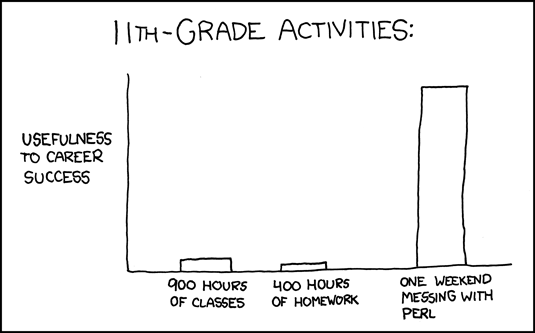
Was this symposium a waste of time? For you, it might have been. If the only thing that makes this type of experience worthwhile is a grade in the gradebook, I truly feel pity for you. If, on the other hand, you spent the summit "messing with perl" ...


Monday, April 15, 2013

Cops in school cause changes.

But not the changes everyone was hoping for.

Police are police. They've been trained in a certain way to do a job that is more often than not dealing with criminals, very often dangerous as hell, and involves the chance (remote though it may be) that the officer will have to use his weapon to kill someone. To keep checks and balances aligned, police operate under strict rules and the laws are written to protect the innocent, etc.

Students are not criminals. Students are not committing "assault" but rather are "horsing around".  Johnny didn't commit "assault and battery", he hit Jack because Jack said his mother was fat and neither boy was serious.

When the administration gives up its responsibility and hands over discipline to the police, then you have created a bad place. Putting a school under police patrol changes the attitude, mood and responses of the administration in the 99.995% of the day that doesn't involve actions serious to warrant police action. The rest of the time? That hired gun wouldn't do jack squat.

From NYTimes, via Joanne Jacobs:
Since the early 1990s, thousands of districts, often with federal subsidies, have paid local police agencies to provide armed “school resource officers” for high schools, middle schools and sometimes even elementary schools. Hundreds of additional districts, including those in Houston, Los Angeles and Philadelphia, have created police forces of their own, employing thousands of sworn officers.
. . . “There is no evidence that placing officers in the schools improves safety,” said Denise C. Gottfredson, a criminologist at the University of Maryland who is an expert in school violence. “And it increases the number of minor behavior problems that are referred to the police, pushing kids into the criminal system.”
Joanne:
In the wake of Newtown, many districts are hiring police officers to guard schools. But once they’re on campus, cops usually end up enforcing discipline. We are criminalizing our children for nonviolent offenses,” Wallace B. Jefferson, the chief justice of the Supreme Court of Texas, said in a speech to the Legislature in March.
And you wonder why the kids don't take the administration all that seriously. It has abdicated in favor of the guy with the gun.
When a 14-year-old boy “angrily” threw a football at another boy’s leg, middle school officials called the police, who arrested the boy for assault. The other boy was not injured. There was no real explanation as to why the incident was considered serious enough to involve police. The police report states that the unnamed juvenile suspect appeared “angry.”

Saturday, April 13, 2013

A did not cause B.

The fallacies are so obvious:
"Earlier this week a train carrying tar sands oil derailed in Minnesota, spilling tens of thousands of gallons of toxins. This is just days after an oil pipeline burst in Utah, spilling similar amounts of oil into a stream. SHARE this if you agree: there's no such thing as a safe tar sands.
Tar Sands Oil Spill After Train Derails
"
Look, people. I actually agree that there are a lot of things wrong with tar sands oil but you can't just spout illogical nonsense to try and make your point. 

Oh, and one other thing, if all you can do is SHARE, then you have lost the argument.

Friday, April 12, 2013

Seriously, wordpandit?

It makes me cry because it's not a typo.


Here's a sample of the quality of their proofreading.

 Seriously, http://wordpandit.com?

Sunday, March 17, 2013

Getting rich off schoolchildren

from Salon.com comes this excellent warning that "Nobody is really in it for the children"; to discover the real reasons, follow the money.

It all comes from taxes.
There is a lot of money in education.  Tech is not the cure-all and it's time that everyone starts to examine the basis for many of the claims. Bill Gates et. al. may be interested in improving education, but the constant drumbeat of "technology uber alles" does raise the eyebrow a bit.

The furious push to allow charter schools is another venue for profit in education - if the KIPP or other charter school can't make a profit, they're not staying open. Even the "non-profit" private or charter school is still in things for the money, though these profits tend to get funneled to the administration and administrative costs instead of being used to repay the public school that "donated" the building, for instance. But, I digress.

At my school, we are currently in the interesting position of trying to reduce the librarian to 50% FTE while at the same time adding in 20 computers to the library to make a "media center" because the computers already there don't apparently count; and we absolutely no idea, no vision, of what those additional computers are supposed to accomplish or be.

We'll purchase a Chromebook for every student but cut the language department and cut the computer science classes.

We've increased the number of seats in virtual classes because the desired courses are unavailable to the students instead of simply scheduling classes better.

The IT department can, at whim, increase costs by $40,000 on wifi and network gear (he originally priced the equipment at $20k but it's now $60k) but we can't spend any money on protective cases for the Chromebooks.

It's a strange world we live in, with priorities all askew.

I have to give the billionaires credit for moving with a purpose, though. If we could run our schools with that same single-minded focus on a goal and furious drive to achieve that goal, we'd probably be a lot better off.

Getting rich off of schoolchildren

Stop pretending wealthy CEOs pushing for charter schools are altruistic "reformers." They're raking in billions. By David Sirota
Getting rich off of schoolchildren
News Corporation Chairman/CEO Rupert Murdoch
(AP Photo/Cliff Owen)

Last week, Los Angeles provided yet another example of a cadre of anti-public-school millionaires swooping in to try (and in this case, fail) to buy a big-city school-board election. And once again, that sparked a round of Orwellian newspeak that distorts what’s really happening in education politics.

You know how it goes: The pervasive media mythology tells us that the fight over the schoolhouse is supposedly a battle between greedy self-interested teachers who don’t care about children and benevolent billionaire “reformers” whose political activism is solely focused on the welfare of kids. Epitomizing the media narrative, the Wall Street Journal casts the latter in sanitized terms, reimagining the billionaires as philanthropic altruists “pushing for big changes they say will improve public schools.”

The first reason to scoff at this mythology should be obvious: It simply strains credulity to insist that pedagogues who get paid middling wages but nonetheless devote their lives to educating kids care less about those kids than do the Wall Street hedge funders and billionaire CEOs who finance the so-called reform movement. Indeed, to state that pervasive assumption out loud is to reveal how utterly idiotic it really is, and yet it is baked into almost all of today’s coverage of education politics.
That, of course, is not all that shocking; after all, plenty of inane narratives are regularly depicted as assumed fact in the political press. What’s shocking is that the other reason to scoff at the Greedy Teachers versus Altruistic Billionaire tale is also ignored. It is ignored even though it involves the most hard-to-ignore facts of all — the ones involving vested financial interests.

Yes, though it is rarely mentioned, the truth is that the largest funders of the “reform” movement are the opposite of disinterested altruists. They are cutthroat businesspeople making shrewd financial investments in a movement that is less about educating children than about helping “reform” funders hit paydirt. In that sense, they are the equivalent of any industry leaders funding a front group in hopes of achieving profitable political ends (think: defense contractors funding a front group that advocates for a bigger defense budget). The only difference is that when it comes to education “reform,” most of the political press doesn’t mention the potential financial motives of the funders in question.

While I’ve written about this reality before, recent news perfectly exemplifies how the “reform” movement is really just a sophisticated business strategy.

First, there was the Washington state ballot initiative expanding publicly subsidized, privately run charter schools. As the Seattle P-I reported at the time, the initiative was effectively underwritten by Amazon and Microsoft. This was part of the latter’s larger education “reform” push through the massive foundation of company founder Bill Gates.

Yet, in most of the coverage of that ballot measure, just like in most of the coverage of Gates’ foundation work, there is no mention of the fact that both Amazon and Microsoft just so happen to be technology companies — that is, for-profit entities with their eyes on lucrative education technology contracts.

Those contracts are much easier to land in privately run charter schools because such schools are often uninhibited by public schools’ procurement rules and standards requiring a demonstrable educational need for technology. That reality, no doubt, is part of why charter schools often spend so much more on “administration” and “business services” than do their public school counterparts. Though it is rarely mentioned in the political coverage of education, that spending promises to benefit tech companies like Amazon and Microsoft. (Ready for proposals to give every kid an Amazon Kindle or Windows laptop, paid for by public money?)

Then, as mentioned before, there was last week’s high-profile Los Angeles school board race. The anti-public-school “reform” slate was bolstered by a $1 million contribution from billionaire Michael Bloomberg, who has been making similar contributions to other education “reform” campaigns across the country. As he pours money into buying these local elections, he is loyally portrayed in the press as a high-minded humanitarian using his perch as New York mayor to earnestly raise issues. Somehow, few bother to mention that he is the founder of a massive information technology company that seems well positioned to break into the burgeoning education business and profit off “reformers”‘ technology triumphalism (seriously, does anyone think we won’t soon see a Bloomberg School Terminal sometime soon?).

In that same Los Angeles race, the Los Angeles Times reported that News America Inc. donated $250,000 to the “reform” slate. That’s the same News America that is the for-profit education technology arm of Rupert Murdoch’s News Corp. It is the same News America that was recently trumpeted in the New York Times for rolling out an expensive “tablet (that) will be targeted at middle-school children” — that is, if the company can convince the school board candidates it underwrites to divert money away from hiring teachers and into News America’s coffers.

National Public Radio was one of the few media outlets to even mention this profit motive as driving education politics. Setting an example for how education journalism should be conducted (but largely isn’t), it reported that Murdoch’s education technology push is about delivering “future revenues from his educational branch to help shore up the finances of his newspaper and publishing division.”
Of course, if the tech industry’s attempts to make money by technologizing the classroom was also a proven way to improve education, then the education “reform” movement’s for-profit scheme might seem a bit less odious. It might seem like an example of a laudable public-private partnership whereby an industry does well for itself by doing right for the greater good.

But that’s not the case in education so far. As the New York Times exhaustively documented, “reformers” have convinced schools to spend “billions on technology, even as they cut budgets and lay off teachers, with little proof that this approach is improving basic learning.” As just one glaring example of that lack of proof, the Times points out that “a division of the Education Department that rates classroom curriculums has found that much educational software is not an improvement over textbooks” (this why Idahoans recently voted overwhelmingly to reject a plan in the Legislature that would have diverted money for teachers into classroom computers).

Education results, however, don’t matter to the moneyed interests behind the “reform” movement. Profits do — and the potential profits are enormous.

Citing a fact sheet from the for-profit education industry itself, the Washington Post recently reported that “the education sector now represents nearly 9 percent of the country’s gross domestic product” while the “for-profit education is valued at $1.3 trillion, and is one of the largest U.S. investment markets.” Likewise, NPR reports that as he’s launched an education technology division, Rupert Murdoch “has described education as a market worth hundreds of billions of dollars.” This is why the tech site Geekwire predicts another full-scale tech industry bubble, thanks to “K-12 and other education segments now being chased by a mob of investment capitalists.”

Give “reformers” credit; they have successfully hidden a venal investment strategy in the veneer of idealistic political activism. Appropriating the poll-tested argot of change and mass movement, the Wall Streeters and tech moguls who finance the “reform” efforts have somehow convinced the political press to ignore one of the most powerful motivators of human action: the almighty dollar.

 David Sirota is a nationally syndicated newspaper columnist, magazine journalist and the best-selling author of the books "Hostile Takeover," "The Uprising" and "Back to Our Future." E-mail him at ds@davidsirota.com, follow him on Twitter @davidsirota or visit his website

Sunday, February 24, 2013

Statistics, Textbook Bias and Robo-Calling Pollsters

Electoral-vote.com has this piece about Rasmussen polls:
Silver analyzed 105 polls released by Rasmussen Reports and its subsidiary, Pulse Opinion Research, for Senate and gubernatorial races in numerous states across the country. The bottom line is that on average, Rasmussen's polls were off by 5.8% with a bias of 3.9% in favor of the Republican candidates.
It's a methodology thing - robo-call households and you'll be more likely to get older, more often Republican voters who have a landline instead of the younger, cell-phone only types on the DoNotCall list. This is an issue but you can account for it. It's more problematic when you are talking about schools. Darren links to a Rasmussen report that says
Extremism in the defense of my virtue is no vice.
Voters continue to believe that political correctness trumps accuracy in most school textbooks. A new Rasmussen Reports national telephone survey finds that just 16% of Likely U.S. Voters think most school textbooks are more concerned about accurately providing information. That's down from 27% in March 2010. Fifty-nine percent (59%) think most textbooks are chiefly concerned with presenting information in a politically correct manner, consistent with attitudes for the past three years. Twenty-five percent (25%) are not sure. (To see survey question wording, click here.)
Here's the question: "Are most school textbooks more concerned about accurately providing information or about presenting information in a politically correct manner?"

The choice of Yes or No is too limiting for a question like this one. How is anyone supposed to answer this and why would any teacher or school district care about the result?

Sure, everyone's got a right to an opinion but these opinions are based on flimsy evidence and zero first-hand experience.
  • How many adults have read or even skimmed an actual school textbook in the last few years? 
  • On what are these people basing their answer and which textbooks are they considering? 
  • How do they know that the "bias" they see isn't simply the book having a lack of bias towards their favorite religion or social cause? "I don't have an accent; I sound normal."
When you pose a question like this in a robo-call, it's obvious what kind of answers are being pushed for so I'm frankly not at all surprised that they got the answers they did.

My guess is that, if respondents have heard of this issue at all, they've heard from FoxNews or Ann Coulter going on about a history book called People's History of the US, by Howard Zinn, (which few schools use anymore) or about a California textbook that didn't deal harshly enough with Islam (i.e., treating all Islamics as responsible for acts of the Sunni extremist splinter group, Al Queda) which is akin to demanding that the all Christians must be responsible for the actions of the lunatics at the Westboro Baptist Church.

Of course, it could also be that the poll respondents have been listening to any one of the mentally confused pro-Intelligent Design reformers who are trying to change the science curriculum into something that won't contradict orthodoxy. There are no other hot-button issues since Indiana tried to make pi = 3.


As regards to the need for actual reform of the school textbook industry, this survey is merely a "confirm your current opinion" instrument. The industry has many problems; free digital books are going to make this whole discussion explode in brave new ways. Most people will drop the issue.

Except for Fox.  They'll continue to harp on it. In my opinion, of course.

Monday, February 18, 2013

How To Ask for a Recommendation


Ricochet spoke of a parent asking for a recommendation and mentioned this article detailing the tips for getting one from any teacher.  Here's what works for me:

Why ask me?

Ask me for a recommendation if you've taken a complete course from me and you tried your best in that class. It's even better if you've had me more than once. Writing a recommendation for someone I had in the fall semester three years ago is tough. I have no idea of growth or current ability. If you've only been in my class for a couple of weeks/months, I'm not the person to ask. If you skipped a lot or didn't do any work, ask a teacher for whom you DID work hard.

... poor behavior in class, frequent absences/tardies, chronic late assignments or incidents of academic dishonesty are reasons for declining ... Poor choices made at athletic and co-curricular events or crass behavior in non-classroom environments ...
Yeah, it matters. Childish or stupid behavior stays in my mind. Stealing someone's candy and throwing at another student, shooting spitballs in class ... really? Got caught drinking ... it depends. Did you admit the mistake and learn from it? I see you in lots of places and I remember both the good and the bad. If the bad outweighs the good, ask someone else.

Being an "A" student is not a requirement because I could talk about your willingness to work hard and persevere even though math isn't your strong point. Colleges want to know that you'll fit it to their programs and those immeasurable qualities are important ... that's what the recommendation is for ... those things not on the transcript.

I won't lie
TO you
and I won't lie
FOR you.
We also need to define the difference between an evaluation and a recommendation:

If I agree to write a recommendation, I will say good things. In my mind, there can be no bad recommendation - the meaning of recommend includes the idea that I believe you are a good fit for the program or school. If I can't write positive things, I won't lie to you and I won't lie for you. An evaluation, on the other hand, is an honest assessment of the good and bad and may include wording that suggests against the placement.

These are totally different animals and you must be clear on that difference. Some applications ask for one or the other specifically. Don't mess that up.


So, you've decided to ask me for a recommendation.


Ask personally and early. 

This is critical for me. If you can't come and see me personally to ask for the recommendation, then you have no business moving on to college. If your mother emails me instead, the answer will be "I don't think that I can write a recommendation for your child." If guidance has to email me and the words "deadline is next week" appear anywhere in the conversation, then you have failed.

Time: I can whip up a recommendation fairly quickly, but I'd like some lead time. Three to four weeks minimum is a good length of time.  That is, I'd like 3-4 weeks before you plan on sending the rest of the application, not 3-4 weeks before the drop-dead deadline for admissions. If you know that you will be asking in five or six months, tell me now. What possible reason could there be to wait? Planning ahead is the mark of an adult.

Bottom Line: This is YOUR future. You need to be planning for it and be responsible enough to get  it going. Everyone is here to help you by doing our part but not by doing your part for you.

Minimize the clerical work as much as possible.
 
This is just being polite. Fill out your name and all of the information that you know. If you are applying to ten schools, with ten different forms, then it is imperative that you do this. If we are using an online form with a 120 character URL, I need the exact URL sent in an email.

If the recommendation is something I can type, I will. I will send a copy of everything to the office in case we are out of session and they need another copy and I will give you a copy of everything I write.

Envelopes should be stamped, addressed, return addressed, and so on. It sounds picky, but it makes a difference. Splurge on the self-adhesive mailing envelopes - I appreciate not having to lick ten of the cheaper ones.

Be neat. 

If you can type it, then type it.  If your handwriting sucks, then you need to improve it. If it's barely legible, that reflects badly on you. Everything you put on the application will be looked at. If you can manage it, run the envelopes through the printer as well.

Follow Instructions

If the form says "Student will fill out the top of this form," then you should do that before handing it to me. If you can't do that simple task properly, it tells me you aren't serious about your plans. If the header says "Evaluation" then don't ask for a recommendation (and vice versa). If the instructions say for me to mail the recommendation separately, then have all the envelopes and such ready for me.

Many of the admissions decisions are, unfortunately, handled long before the admissions people read and consider applications. Your folder at College begins with a checklist. If anything is incomplete or missing, the folder is put aside and ignored until everything is complete or the deadline has passed. If you can't read and follow simple instructions, then why would the college waste its time on you? They have plenty of applications to pick through; any easy rejections are dealt with first. Of course, the check will be cashed before the folder is thrown away. This happens distressingly often. Don't let it happen to you.

Give me the list of your experiences.

Guidance has that form for you to tell me about yourself. Mention things that will help me make your case for you and allow me to be specific. List the awards you've earned, the volunteer work you've done, NHS and other societies you're a member of, History Day, Governor's Institute, Odyssey of the Mind, and son on. If you were student council, mention that.  If you ran a significant portion of Winter Carnival, definitely mention that.

The reason is two-fold; you'll be reminding me of things you've done which will help me even if I don't write about them specifically and this will be the source for your applications.

With regards to math classes you taken with me, include things that you enjoyed or that were meaningful to you or that you found directly useful in tech, for instance. I might never mention it, but it will help me in writing about you.

That's it.

Now it's my turn. If I tell you to check back with me in 3 weeks, then I am giving you permission to "check back with me in 3 weeks." Don't nag. Don't remind me every day or even every other day. It'll be done.

That's my responsibility.

Further reading: 

Read the article I linked to for other insights that apply at bigger schools or for other teachers.  I know most of the students at my school and I've had almost all of you in class at some time or other so "Practice your pitch", for instance, isn't as big a deal for me as it might be for other teachers.

Saturday, February 16, 2013

Cause of Death Statistics

Click to See Full-Size.

from: http://www.economist.com/blogs/graphicdetail/2013/02/daily-chart-7

Some thoughts on guns and 2nd Amendment.

I responded to a friend the other day on Facebook.
The NBC link is about a murder in Texas with a chainsaw. So now in theory because they look evil and are dangerous they should be banned right. According to how politician’s look at things they should. Let’s not look at the human factor, just the tool that was used. I never said we don’t need some form of gun control, we do. What I am saying with this is that with tool no matter what its designed to do, whether it’s a car, chainsaw, hammer, screwdriver, gun, power tool, it can be and has been used to injure and or kill another human being. The gentleman in China that killed multiple people used a knife. So accordingly too the arguments over gun control, guns are dangerous in untrained hands or in the hands of the criminal, that being said this is true for all other tools out there .So it could be argued that all tools are dangerous and should be controlled. The hammer was the cause of many deaths here in the US, so we should ban them or how about cars. This is not about apples or oranges, a tool is tool no matter what its designed to do, but in the hands of HUMAN a tool can be used, whether they are untrained, a criminal, mentally incapable, to hurt other living beings. The main point being no matter the tool It takes a HUMAN to the do the deed, so why aren't we working on that instead. Why aren't they working on the human?


"They" are, but it's a tough row to hoe.

Meanwhile, various groups and hospitals are working on domestic abuse (and trying to help women out of bad situations in which they are threatened with guns daily), and police and ATF are trying to get the ability to track guns back to the store and close down the TINY % of stores that seem to be providing the 99% of guns in crime, and the background check legislation is to prevent those "flawed" humans from acquiring more guns easily, and the legislators are trying to identify the "bad" ones and pass laws to prevent them from owning a gun.

While some of these tactics may not suit you, remember that almost all of them (with the exception of the magazine limit - which is silly) were proposed by the NRA in the first place because they stood a very good chance of working to lower the gun violence, take guns out of the hands of idiots and crazies, and take some heat out of the situation and let us all breathe easier.

Back to the chainsaw - I don't care about the weapon: this man should be stripped of all rights to ever own a gun or any kind of dangerous tool. and be in Jail. Using him as a strawman doesn't help either side of the argument.

And for all of the 2nd amendment absolutists: the "original intent" was that Protestant white men were citizens, Catholic white men were tolerated, and pretty much everyone else: women, Blacks, children, Asians, Original-Americans (Indians), etc., were expected to follow orders, shut up, and be servile.

Over the last few centuries, we have interpreted, altered and re-configured the Constitution many times. If we can pass Prohibition and then come to our senses a few years later, then we have to agree that nothing is certain in this country. If we can pretend that a corporation has personal free-speech rights instead of simply being the owner's free speech rights, then we are very far from "original intent".

We have spent the last 230 years trying to improve this country and sometimes need to fix our improvements ... so what fix do you propose? What method do you have for identifying the idiots and crazies who are the "real problem"? What process do you propose to use for removing the guns of those the courts (for it will have to be they) determine shouldn't be allowed to have guns? What checks and balances will we install to make sure that no one who ISN'T on the banned list ever loses a gun?