Showing posts with label 21st Century Schooling. Show all posts

Monday, July 20, 2020

Ask The Blogger: Do We Stick to the Curriculum?

Sure. We are always editing the curricula for our classes because we all have different experiences and we have different priorities.

I’ve got an engineering degree. I used math for practical reasons, doing hands-on problems. I want my students to understand why it’s necessary by doing the same kinds of things with the math that I did and that they will need to do in their futures.

To a math major, that’s a pentagon. It’s got an apothem, a radius, and a side length. To me, that’s a five-bolt pattern that needs to be milled into a block of aluminum for a wheel, and you measure it “this way, between the top bolt and the center of the third bolt”.

VT doesn’t mandate any curriculum, but our school has basically adopted the CCSS. It has some limited technology requirements, but I have kids use spreadsheets, DESMOS, wolframalpha, geogebra, laser transits, etc., whenever I can.

The statistics book and the SAT use examples that contain 12 data points. I like to give them ones that have at least 1000. Is spreadsheet facility a part of the standards? No, but my students come back and tell me how useful and helpful that knowledge is.

We’ve all got our strengths; we’ve got our preferences and dislikes for which courses we teach. We are always changing up what we teach if we think we can give our kids an edge.


Narrator: The curriculum is a minimum.

Saturday, January 4, 2020

Teaching Grammar

I was wasting time the other day, reading an article that my browser labeled "5 Administrative Tasks that Waste Teachers' Time" even though the actual title at the top of the article itself was "5 Things Teachers Do Every Day That Are a Complete Waste of Time."

Irony? I think that qualifies as irony. But, I digress.

The article listed the following:
  1. Write the standard on the board. 
  2. Teach grammar. 
  3. Grade daily work. 
  4. Collect data. 
  5. Enforce the dress code. 
Wait, what?  One item at a time, shall we?

Enforce the dress code - that's a tough one. Dress codes are usually so one-sidedly sexist that I want to reject them outright and as a man (he/him/Mr.), I will always be over-cautious when it comes to enforcing dress code violations. Yeah, this can an administrator's job. I've got better things to worry about.

Collect data - data is good, as long as it is collected without extra effort on anyone's part. I see no reason to fill out paper forms, hand out paper exit tickets, or collect paper that only services data collection. If you tell me I have time to transcribe data, then I would have far more time if you understood that I can distill that raw data into more meaningful information.

I can ask for a show of hands. Clicker cards. Exit tickets and homework checks with Google Forms. That raw data is useless to anyone but me and instantly obsolete. My interpretation of that data is useful - we call that interpretation "Grades". That's what you pay me for. If you demand the detail, then I'll send you a blizzard of it and then pester you often for your interpretation of it, until you admit that it's not working for you.

I read further; that isn't what they meant:
It seems there’s always some kid who desperately needs an IEP but doesn’t have one, which means we have to go through the process to get the kid services. Yes, it’s incredibly important to provide kids with the accommodations they need. But spending 20 minutes twice a week using some “intervention” one-on-one just to prove that it doesn’t work, then giving a “probe” that’s completely unrelated to my curriculum or the skills the kid needs? That’s meaningless paperwork, and it takes away from my students’ learning.
The author is an ass.

The IEP has the power of a legal contract. It says what the school agrees to do, and by extension, me. They're important. If it says "20 minutes, twice a week" then it has to happen. To be fair, the author (Captain Awesome, apparently) teaches in the UK, so maybe things are different. In my school, the teacher is part of the team that decides what the school can guarantee to do, and we are expected to object if an intervention is truly impossible to fulfill; a school resource professional takes up the slack.

Grade Daily Work - no argument there. If we're using a normal 100-pt scale, tests are 100-150pts.  That means homework or classwork is 0pts or 5pts, depending on "an honest attempt". In the current SBG, this stuff is "formative" and carries no value to the grade. Either way, I'll tell you how you are doing, but I won't grade it.

Write the Standard on the Board. Yep, waste of time. Especially for us. Our administration has declared that each course has one "Power Standard" each term (8 terms). The same words are posted for a month; it's not particularly useful. If you mean "Daily Learning Target" should be posted, then that's different. I doubt that posting it has much purpose or improves the teaching in any way, but I'll do it if my paycheck depends on it.

Teach Grammar. WTF? Grammar is vital. (I'm assuming that Captain Awesome is an English teacher). Grammar to an English teacher is analogous to arithmetic and mental mathematics to a math teacher - it's basic, vital, and perilous if overlooked.

Take the line: y = (3/7)x + 2

What numbers would you substitute for x to get three points that you can graph? Why? If they aren't saying "-7, 0, and 7 because fractions", then you have a problem. You really shouldn't be moving on without this conversation because they can save so much pointless mental anguish trying to graph (3, 12/7) or (3,1&5/7) -- this takes up all their abilities and they miss this new idea of a linear function.  A slope of 100/250 can be reduced to 2/5 or 0.2, but can also be thought of as 100 up and 250 over, or 100 hits in 250 at-bats.

Grammar is similar. If it's understood, then your students can use it and communicate clearly and easily. If they don't "get" it, then you need to stop what you're doing and dive in.

I teach SAT prep. Most of the math I do is review. Let's look at this again, now that you basically know what to do but perhaps have forgotten "why?". Show me you can write the equations that model "$500 pays for 14 bags and 200 pounds overweight, or "kilometers are roughly five-eighths of a mile, so 55mph is equal to how many kph?".

Funny enough, I also have to review for the Verbal Test.

"The students' knowledge of grammar (is/are) laughable."
They can't identify the subject, so how are they supposed to know subject-verb agreement? "Clause" only has meaning at Christmas and adverbs are much the same as proverbs, apparently. "Past tense" is an easy concept as long as you know the meaning of "tense" in this context, and most students don't.

In fact, the only kids who understand English grammar are the ones who are in at least their second year of a foreign language.

Bah, Humbug.

I've got to get back to work.

Sunday, November 10, 2019

Ask The Narrator: Mandatory College For All


Recently, the Narrator was asked if college would ever be made mandatory like K12 is. The narrator says no.

Ask The Narrator


"Will college ever be mandatory?" 
No.

K-12 students, by and large, are not yet adults. You can’t require college for adults. 

Being the Narrator allows for extending the question.

"Should there be college for all?"
Nope. 

College isn’t for everyone in the first place, isn’t appropriate for many who do wind up going, and isn’t appropriate for everyone at the exact age they graduate high school.

No, the most you can do is put policies into place to encourage college for all, but you need to have some mechanisms to keep out those who don’t really want to be there.

"Should there be programs to offer aid (up to free tuition) to all?" 

Yes.

Four-year college is the pinnacle in the minds of most Americans, but that's ridiculous. Two-year degrees are just as worthwhile to many people because of differing aspirations, abilities, and life situations. So are tech programs, certifications programs and that sort of thing. 

If we can provide tuition for a four-year degree at a State School (which I think we can and should do), why not also help out with the retraining costs for someone who wants to be a long-haul trucker and help them get a CDL? Why not help the office worker who wants to retrain as an accountant?

Why should we wait for the plant to close and lay off all its workers before we help them get training in another field if they want to put in the considerable time and effort?


Friday, October 13, 2017

Consistency of Message

Short speech this afternoon included the following statement:
"We believe that all students should be able to take any or all AP courses at our school."

This was the concluding talk of a day-long conference on Proficiency-Based Education which has as one of its guiding tenets that
"Students should not progress to the next proficiency until they have mastered the first one and should not be allowed to move from course 1 to course 2 until they have reached proficiency in all of the predetermined areas in course 1."
These two statements seem to directly contradict each other, yet both were met with applause and approval from the assembled. How can you take AP Calculus if you haven't reached proficincy in the topics of precalculus, and before that in algebra 2, and before that in geometry, and before that in algebra 1?  (Granted that the geometry course is not strictly in that place across the country.)

What am I missing?

Monday, December 26, 2016

New Year, Same as the Old year

From Poor Elijah:
We raise academic standards on paper even as we’re compelled by policies and pressured by politics to lower them in reality. We crow about “standards-based” grading, as if teachers will miraculously agree about what “proficient” means more than we now agree about what a B means. Our “objective” scoring rubrics rest on the distinction between sentences that “wander” and those that “meander.” Advanced placement is less advanced, and everybody takes algebra, even if it isn’t really algebra anymore.

Sunday, December 11, 2016

End-of-Year Testing

(I started this article several years ago. Just getting around to editing and publishing these drafts.)

I love the idea of End-of-Year testing in a purely hypothetical sense. Students should be able to demonstrate what they've learned. The teacher doesn't grade it or write it. The students can't weasel out of it. A group of math people decide what "Algebra I" should entail and write some questions to measure it.

The test is never perfect, as NY teachers will hurry to emphasize, but it is out of the hands of the teacher and that is good. We should not be afraid to let our students measure themselves against a common standard and we should be open to change if the unexpected happens. SATs serve this purpose as well.

Differences between what you expect them to get and what they get are the prime indicator. If your grades are all As and your kids can't succeed in appropriate tests, then you need to review what you are doing. If the majority of kids can't succeed on an EOY exam, then you the teacher needs to make a determination: is it the individuals, the exam, the curriculum, or me? If you are passing kids and the next teacher isn't, someone might need to adjust.

In theory, EOY exams should be perfect for this - it's just too bad that they'll be useless for it.

not linear.
The State of Oklahoma requires these tests and they will *attempt* to write them to be an honest assessment of the skills that should have been acquired in any particular course. Just like Texas, just like New York Regents.

What will happen is that End of Year testing, like WilyECoyote, is going to run full-speed into the Cliffs of Reality. The "passing" score will be set to 60%, then too many kids fail so it's quietly lowered to 45%, or 35%, or lower. If enough people still can't pass the test, the cut-score will be lowered again. Or you wind up with the weird raw score conversion charts of the NY Regents (right).

So ... is it poor preparation and teaching or poor test-making?

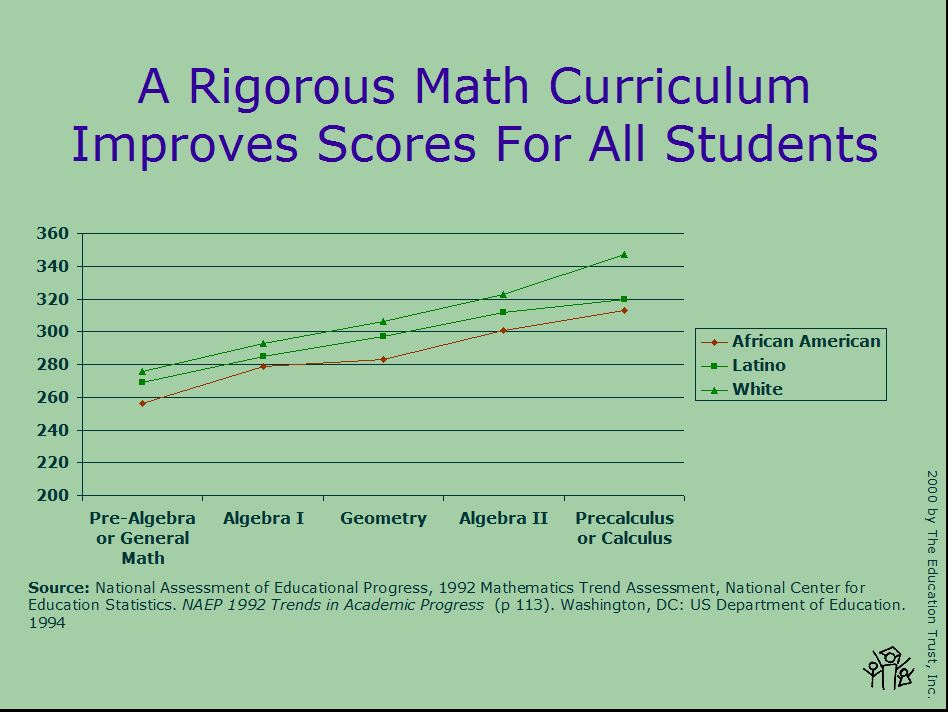
The graph that's been misunderstood
by admin everywhere.
Or could it be that the test is trying to apply the "Higher Standards" that everyone is crowing about? You know the trope: "Raising the Bar improves performance."

Unfortunate reality #1: If you raise the standard, more people will fail to reach it.
Unfortunate reality #2: Calculus kids do better on their SATs than Algebra I students. Selection bias. Duh.


What should we do?

Avoiding all EoC testing is silly. Pretending that some "3-week portfolio question is demonstrably superior" is the canard put forth by all those people who have never watched or judged a science fair. Individual teacher-written final exams are suspect because of quality-control issues and because of grading irregularities. Department-wide final exams are probably the best unless your state has Mr Honner holding your Regents exams to account, in which case, go with the Regents.

Unless your school just voted to eliminate all finals in light of the transition to Proficiency-Based Grading, but that's another post for another day.


Saturday, December 10, 2016

Deadlines

Does applying hard deadlines really make students learn to meet deadlines? 10 points off for each day late? Or does it just give an excuse to the procrastinator (or the kid who knows he's not that good at the task) that he is no longer responsible for the low grade?


Is our Calvinistic work ethic really a good thing here? Has anyone really considered its effect on the students and the climate of the school?

For all of those who so desperately want deadlines, let me propose one ... set yourself a deadline and then pay $10 per student per day late returning those essays.


end broadside ...

Here's what I feel works better:

Set a deadline if you have to, one that makes sense. Set it for Friday if you REALLY plan to grade over the weekend. If you're going to procrastinate, don't get on their case for it. Taking points off for lateness doesn't make your assessment of the work any more accurate. Grade the work and the lateness separately.

You can certainly set a deadline but be reasonable about it. Allow a kid to hand it to you as you walk out the door - the fumbling and muttering will make him feel bad enough - and you'll probably give him time to proofread and print it.  Maybe he's just yanking your chain, but perhaps he's not.


"Here's how well you did" is far more powerful when you are discussing the work itself. 

"Okay, give it to me tomorrow morning so I can look at it first period and get it back to you" may occasionally be taken as a sign of weakness and an excuse to persist in tardiness ... but far more often, it is a sign that you want good work rather than hasty work.

And it's a policy that fits much better with Proficiency-Based Grading.

Monday, May 16, 2016

No Bells - part two. Focus

I ran across an article: School Bells Interfere With Learning but unfortunately it has some points backwards. It misinterprets much of the what and why of bells and classes. Let me explain.
"... because we partition students into neat packages called subjects, they are implicitly taught that learning is something we do in compartments."
Actually, this is called focus (or uni-tasking) and we aren't partitioning the students at all. We're separating the subjects for three reasons: so the students can concentrate on one thing at a time, so that the most competent teachers for each subject can teach them and so the students don't have to have the exact same schedule of learning - each is able to specialize in his or her own way.

It's a NEW IDEA called differentiating.

Since students aren't going through the day in lockstep with all of their classmates, we must keep to a schedule so that everyone's time and preparation can be utilized most effectively.
If you try and introduce a little bit of another subject in your subject, students object, saying "This isn't English, Mr. Wees. Teach us Mathematics." (I've actually had students tell me that). Where in the real world is learning sectioned off like this?
Frankly, everywhere. Learning is always focused on one topic. When was the last time you attended a college class called "College Algebra and British Lit as used in Cobol programming?" Teaching at the elementary grades is cross-curricular by nature. The higher you rise, the more likely you're going to specialize. Not only is each student's course mix different but the levels are, too. One freshman may take Honors Algebra2, Spanish 3 and H.English but the other takes CP English, CPAlgebra1 and Spanish1.

Then, there's competence. I can teach Physics and any level of math, but I'd be fooling myself if I thought I could do Biology, History or Latin. I hate it when some other teachers try to teach math because they invariably screw up and I'm sure the English teachers would complain about my writing style. Even within a certification area, teachers have strengths and weaknesses. Some teachers are great with Geometry and others aren't.  Calculus is beyond many and some don't have the patience for pre-algebra or consumer math.
"Mathematics do English (and other languages) when they explain their discoveries to other people. Biologists use geography to decide where to start their research. All of what we learn is interconnected, and more of these connections need to made obvious to the students. This is not easy to do in a school with nine 45 minute separate blocks."
Ignoring the grammatical weirdness, this is the crux of his problem. Just because we are dealing with a vast interconnected world doesn't mean that the best way to learn is by studying the whole thing all at once. The connections cannot be made clear to students until the students understand the two (or more) things that are being connected.

There is also a huge difference between "learn" and "use." I use English to explain my thoughts on math but that doesn't mean I can teach English and it doesn't mean that mixing math and English will improve the learning of either. (Educational pundits went to school but that doesn't mean they know how to fix it, either, but I digress.)

The argument that connections can't be made in 45 minute blocks is precisely the reason many schools went to 90 blocks. Not that it helped anything.
"Maybe we should even rethink how we schedule kids, and consider other instructional models. There are schools where there are no bells, no classes like what you would see in a traditional school, just kids (and adults) learning."
I want a school with no classes.
Cliche alert! 

When will otherwise well-meaning people realize that the vast bulk of their students are not "natural students" who, "unlike themselves", have greater interest outside of the classroom than in?

There's a reason that these schools are few ... they don't work for most kids.

The "no bells, no classes" scenario ... there's also no learning. These schools are filled with the spoiled rotten children of money. In return for the kid's chance to pretend to learn, the schools pretend to give them an education, whitewashing over the fact that the kids have little interest in anything and school is below "nothing" on their lists.

The teachers think they're being "cutting edge" and "understanding" and the school is "so 21st century" that your head might burst from the fuzzy good feelings. I've seen this kind of school go straight into the tank. Fortunately for the kids, their parents have plenty of money because that education isn't cutting the mustard.

Those kids who can do the "unschooling" kind of thing are the ones who could pick up a "Perl for Dummies" book and teach themselves programming over the weekend. They also tend to have parents who take the place of the school.

Those aren't your kids. Or my students.

Work is Not the Enemy

Doesn’t it seem strange that we can have a shortage of skilled labor, a crumbling infrastructure, and 6% unemployment? How did we get into this fix? Are we lazy?

All around us, society has slowly redefined what it means to have a “good job.” The portrayals in Hollywood, and the messages from Madison Avenue have been unmistakable. “Work less and be happy!” For the last thirty years, we’ve been celebrating a different kind of work. We’ve been aspiring to other opportunities. We’ve stopped making things.

We’ve convinced ourselves that “good jobs” are the result of a four year degree. That’s bunk. Not all knowledge comes from college. Skill is back in demand. Steel toed boots are back in fashion. And Work is Not the Enemy.

(channeling Mike Rowe.)

Saturday, May 14, 2016

What's high school for?

In May of 2011, Seth Godin asked: What's high school for?

"Perhaps we could endeavor to teach our future the following:
  1. How to focus intently on a problem until it's solved.
  2. The benefit of postponing short-term satisfaction in exchange for long-term success.
  3. How to read critically.
  4. The power of being able to lead groups of peers without receiving clear delegated authority.
  5. An understanding of the extraordinary power of the scientific method, in just about any situation or endeavor.
  6. How to persuasively present ideas in multiple forms, especially in writing and before a group.
  7. Project management. Self-management and the management of ideas, projects and people.
  8. Personal finance. Understanding the truth about money and debt and leverage.
  9. An insatiable desire (and the ability) to learn more. Forever.
  10. Most of all, the self-reliance that comes from understanding that relentless hard work can be applied to solve problems worth solving.

Not a bad list, I suppose.  Goals, if you will. They're good goals, obviously, but if the Internet is any evidence, very little of this seems to be necessary to survive in America as an adult. To thrive is another matter.

You can make the case for each of these being necessary in the RealWorldtm, but how many am I responsible for and can they be taught? How many should a high school graduate be proficient at before setting off and can we as educators stop them if they haven't demonstrated each one?

The first one. "Focus intently".  Exactly how do I teach that except by setting consequences for not focusing intently enough, or for not solving a problem quickly enough? That seems wrong. Too many kids will quit under the pressure. We can talk "grit" all we want. We can add this into our ever-expanding list of "Transferable Skills" and demand proficiency. We can bluster and pontificate but the student who falls short through ADHD or a conflict with a teacher ...

Postponing short-term satisfaction for long-term gain is a laudable trait. Pretending to teach it and measure it is unworkable. This will be a "Yeah, check that box and move on" situation. I can see the rubric now:
Proficient with distinction: "Held off eating the marshmallow for thirty minutes before succumbing."
"Reading critically" is a phrase that sounds intelligent but falls short in practice. You cannot teach students how to read critically. You can tell them of tricks to reading but that stops being productive quickly. High school kids CAN read; what they need is the background knowledge and worldly experience to be able to tell which parts of that text are bullshit.  They need extensive science courses to refute the VERY compelling counter-arguments. It's difficult to counter anti-vaxxers, for example, if you don't understand biology, chemistry, and probability and statistics. It's difficult to convince them if you haven't got a good handle on psychology, too. Fools are so damned good at being fools.

Being able to "lead". I like that one. Expecting every teenager to lead, or even work collaboratively with peers, is a fool's mission though.  Few kids are competent at what they do - that's why they are learning. As I've said before, learning is not the time for collaboration. Working with already learned information is the time collaboration can happen. Beyond collaboration, leading, is not for every kid.

Understanding the scientific method is why we have them take science. Not my fault if Organized Religion seems to be actively fighting that every step of the way.

Understanding this leads to
understanding self-management.
Multiple-form presentation - definitely. First, though, the kid needs to know those various methods and know all the things he wants to talk about. That's why we teach them Foreign Languages, English, Science, History, Technology, Engineering, Arts, Mathematics (FLESH TEAMS).

Project management - how much of this should we leave until after the foundation work is done? Science Fair is a great example of this. Give them the background, then have them experiment. I'm totally for doing science fair -- I think the parents do a wonderful job with those boards.

The expectation of universal self-management is a pipe dream for teenagers. There's a reason they're not allowed to rent a car, smoke cigarettes, take a pill without supervision, ... the works. They're learning self-management. College kids don't even have it yet. Hell, many adults don't have it yet. How much of society do you expect me to solve here?

Ah, yes. Consumer skills. Personal finance. The "Truth" about money. Kids know how many things work - and don't care about the rest yet. They get the idea of "I earn money. I save money. I spend it on rebuilding that 1959 Studebaker." Whenever my admin talks about "Consumer Skills", it's usually a stupid reaction to "Kids can't write a check" or "Look at the College Debt Crisis -- We need to teach them how to avoid that!"  I'm here to tell you they aren't that stupid ... and nobody understands how to make a amortization schedule, not even the bankers. 

"Life-long learner." What a meaningless cliché. All that aside, how exactly does one tell if a student is a life-long learner if he's only just beginning his life? Is that diploma retractable? Do we call him up in 30 years and send a repo squad for it if he hasn't learned something in the last ten weeks?


"Most of all, the self-reliance that comes from understanding that relentless hard work can be applied to solve problems worth solving."  Bottom line, looking at every graduate I've shaken hands with as they walked back down the aisle,
If you give them a problem they NEED to solve, they'll be just fine.
I look at this list, and many like it, and I shudder when I think of the teachers who will be pushed into focusing on this at the expense of teaching content. You can't think critically without knowing something to think about. You can't teach many of these non-measurable skills (which doesn't make them unimportant) but unless you stop expecting teachers to measure the unmeasurable in order to provide accountability to those who have no idea what schools are supposed to do, you're only perpetuating the problems we face.


End of Rant. Thanks for reading.

I've got to get back to work.

Sunday, July 5, 2015

Considering Google Classroom - part1

So you're considering Google Classroom?  Great!

What it is: The best way to explain this thing is that it's an organizing system for GMail communication in a classroom setting. It has tools that make the process of sending out assignments and collecting assignments, from all of the students, multiple classes, multiple artifacts per student, much easier. 

It is NOT an online classroom where each student gets to work at his/her own pace. That would be Moodle ... if you want a totally differentiated system that does the teaching and each kid is at a different place, then Classroom isn't going to work well for you.

Type of class it's best for:
My colleagues in the English and History departments are the most satisfied with Classroom because their myriad assignments are typically written paragraphs that could easily overwhelm your in-box if you were to try and have the students just send them to you ... to the tune of 1000 emails a week, or more.

(update: "Ducks to Water - Google Classroom" details the experience of a New Zealand English teacher's use of Classroom)

It's tough for math, however.  Symbols are limited. There is Greek Delta for triangle, but you have to use < for angle. Complex notes are impossible - handwritten still works best for taking notes, then scan and send from the school copier.  Algebra is possible for me since I'm writing one equation for a problem but the students can't show their work easily. Pre-Caclulus and Calculus are basically a no-go in GDocs.  There's easy integration of Desmos and Geogebra, but you have to let go of the need to show work or steps.

The exceptions: Probability and Statistics, and portfolio/explanation/extended answer questions. P/S using Sheets works great. You can send out data ("Make a copy for each student") and the kids each create a presentation with graphs from it.  Similarly, "portfolio" problems or the new Common Core explanation-required problems work fairly well because there's more writing and verbiage than math equations.

Bottom line: If your students are using Google Docs to do their work, then Classroom is perfect. I gave the Stats class work that they generated spreadsheets and graphics for: Sheets and Slides came back, sorted, tagged with name, a nice little interface that collects all of the artifacts that are submitted with the assignment (also renames them with assignment name and student name, e.g., "6.2 Histogram - John Smitty 2018").

Bonus: If your students have more than one class using Classroom, then they get a dashboard with assignments and such. They LIKE having everything there.

Advantages:
  • Ease of use.
  • Every assignment goes to every kid at the same time. Email notification and bright red "Assignment Due" in the interface.
  • The assignments that are submitted are definitely submitted.
  • Kids appreciate it when multiple teachers use it.
  • You can grade right in the list of students' submissions. Open the kid's submitted files, add comments right in the margins, "Return" it if you want improvements, choose a grade.


Problems:
  • Typing Algebra. 
  • Drawing graphs. (Desmos and Geogebra integrate well, but DRAWING is cumbersome)
  • Every assignment goes to every kid at the same time. Email notification and bright red "Assignment Due" in the interface. No differentiation.
  • No quizzes (yet. They claim to be working on it)
  • You can't have a class prepped too far out, certainly not a full course. 
  • Gradebook is limited and does not integrate with your gradebook program.

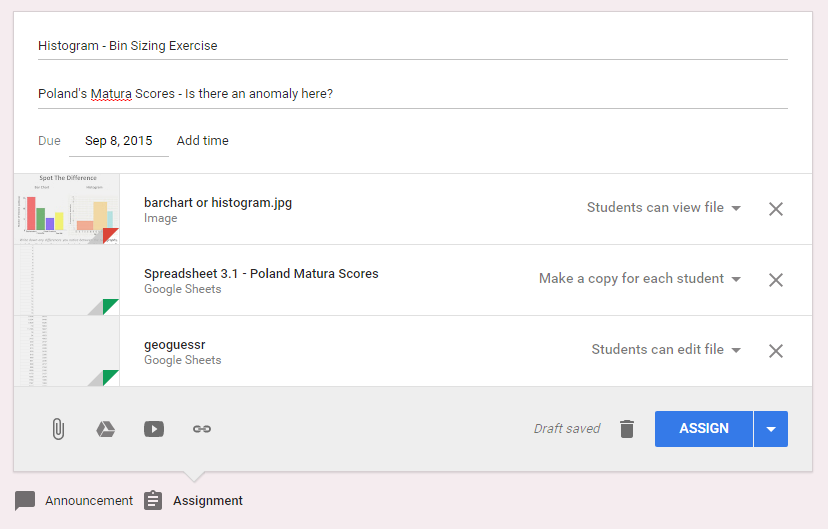
Here's a sample assignment:


It's got a title and a due date. I included a picture for them to look at (student can view), a spreadsheet will the data that each student will work on and submit later (Make a copy for each student) and an another spreadsheet that all students can edit together. The "Make a copy for each" option allows each student to have their own to work on while the "Students can edit" option lets us all contribute data to the same file. It could be raw data, a GDoc that you're using for class notes, etc.

The paperclip icons at the bottom allow you to attach a file from your computer (uploaded), attach a google doc (doc, sheets, drawing, etc.), a YouTube video link, and a general link.

When you student has completed his work, he goes back to this page and hits the SUBMIT button.  Any file that was "Make a copy for Each" is automatically attached, but the student can attach other files, evidence, artifacts, and then submit.

It all gets neatly organized in your GDrive, in a folder creatively called "Classroom", but you will never need to look in there for them.
Nope, don't care.
What you'll do is look in your assignment "stream":


Note: The blue rectangles are just to obscure the students' names for publishing here. The green one covers a student's name as part of the new automatically created filename. Each student's entry can be expanded as I did here to see and open any submitted files. Everything is in my Drive, but I can get to it all here.

Also, to answer the other question asked on Twitter, I feel it's not that difficult to create the same assignment more than once for different sections and this gives me the flexibility of having classes at different points during the year. Not only that, but announcements can be posted to more than one group and can contain PDFs, links, images, etc.

Note: I don't grade them here because I don't want dual-gradebook confusion. I do write comments (ctrl-alt-M) in the documents themselves.


If this works for you, you owe me a beer someday.

There will be a part 2.

Thursday, May 28, 2015

Why do Teachers Get the Summer Off?

Funny you should ask. We don't actually get the summer off ... the students do. Our time off is the logical consequence.

The reasons why are more interesting than the "It's a farmer thing" line of reasoning.
If Education Secretary Arne Duncan has his way, kids would be spending a lot more time at school — and a three-month summer would be a thing of the past. He continued by explaining that the American school calendar is antiquated and must be modified so that American students can compete at the highest levels internationally. “Most people realize that our current day is based on the agrarian economy, and we don’t have too many kids working out in the fields nowadays,” Duncan said. 

Most people realize, huh? Then most people would be wrong. And so is Arne.

The summer months are hot. The temperatures throughout the Northeast rise regularly into the 80s and 90s, the humidity is choking, and closed-in spaces like classrooms are no fun when you've got 25 kids sweating and fidgeting. It's bad enough in late May and mid-June.

In the late 1800s and early 1900s, when a lot of school policies were first considered, it was easier to heat buildings in the winter than to cool them in the summer because, you know, duh, there wasn't any air conditioning. Factories closed. Schools closed. Offices closed. Congress closed. Everything closed. People with the wherewithal escaped the cities and went to the Adirondacks or Vermont or the Catskills, with all their servants and entourage.  People who didn't have money went to Coney Island. That's why everyone traditionally gets two weeks in August ... because it's the worst damn time to be in NY and Boston and Washington D.C. and since that was where the decision-makers were, that was the decision. Time off for major holidays and the occasional week or two here and there - Thanksgiving, Christmas and Easter - and the rest is school ... and everyone escapes in summer.

Sorry to all you "It's all based on the agrarian calender" believers - it's obvious you were never on a farm.

Think about it ... if the whole thing was done for farmers benefit, wouldn't it make more sense to have the time off when the real heavy work was done on a farm? Like planting and harvest?

You don't see vacations in October, do you? You know, when the harvest occurs for most of the major crops in the northeast. Halloween and all the corn stalks and pumpkins -- ringing a bell?  Thanksgiving is in November - the only time you get is for the feast, not the work that leads up to it.

The summer months are busy (the definition of farmer is 'a busy man') but nowhere near as busy as other times of the year. About the only farm work done around here in the summer is haying, watching the corn grow and fixing stuff. 

I'm going to go out on a limb a bit here ...

... Kids need a break from school; we have to let them do things OTHER than school. You know that old saying, "Most of what I know, I learned outside of school"? That's a big part of what summer is about. Parents, by and large want their kids to have summer break, want their kids to be able to get a part-time job and learn to be responsible adults, be able to hike the Appalachian Trail, laze about or go swimming, etc.

And why should kids be in school for every week of the year? Shouldn't we let the parents raise them for a while?

There are some schools that have installed a full air-conditioning system and choose to go year-round ... but they still tend to stick to the same 180 days. The only difference is that they have more one-month vacations or they do a four-on, one week-off schedule.

If my school system ever decides to change to that, I'll adapt but I have confidence the students and their parents won't let that happen.

Monday, October 13, 2014

Stop Common Core (and replace it with what?)

Enough.

What utter dreck.

10. Your child is unique? Yeah, no two snowflakes are exactly alike, but they are all basically the same. After 30 years of teaching, I think I can lay this ego-driven, touchy-feely garbage to rest. Your child is special to you but he isn't different enough from the rest of the crowd to warrant special teaching.

9. Yup, CCSS was created by special interests. No, it's not perfect. No, I don't endorse all of it and I probably won't hold my breath and teach every part of it. I'm a math teacher. I have the intelligence to modify it when necessary. It is, however, better than that mess of garbage that it replaced.

8. I really don't want the legislature voting on math standards. They have zero experience in education. I don't want them to ask my opinion on the intricacies of healthcare for the same reason.

7. Does it matter that this is false? Does it matter that districts are spending that money on testing regardless?

6. The CCSS do not collect information.

5. The lack of attention for gifted learners is not the fault of the CCSS. And your child isn't gifted.

4. Again, not by CCSS. And again, this is false in many states. Mine for instance wrote definitively that test scores have not, are not and will not be used to rate teachers because it is inappropriate and wrong to do so.

3. Yup, this is the only thing you got right. We are not forcing them to read as much of the classics. Instead the English teachers are using SOME different works, such as essays and non-fiction. Unfortunately for your rather uninformed little screed, Shakespeare and Edith Hamilton Mythology are still very much in evidence.

2. No one changed who was in control. School Boards are still the only controlling bodies. Homeschoolers are not in any way, shape or form, under the control of any CCSS.

1. You have the power to stop common core but in #2 you didn't have any power? Come on, at least be consistent in your paranoid ramblings. The last people who should be exercising control over their kids schooling are people who can't even make a coherent argument.  Fortunately for me and my job, deluded paranoiacs like you are keeping me employed -- although usually I don't get your kid until after you've messed up his education and nearly ruined his chances at living a good and successful life.

But don't let me stop you. The Internet is free to use.


Tuesday, September 9, 2014

Reason #438 why kids have trouble.

During the passing time, Student is telling a story of how she had $20 in her backpack and then couldn't find it.

Thinks maybe her father took it when he drove her to her friend's house.

Another kid chimes in, "Yeah, my father always takes money out of my purse to go buy beer."

Kind of a shame when they trust their math teacher more than their parent.

Tuesday, August 19, 2014

Drilling basic facts pays off.

"Practice makes perfect."

Okay, we do have to differentiate between mindless drill & kill and what really makes kids better at math - focused practice, error correction, and repetition of correct processes.  Just as hacking around on a soccer field doesn't help the team nearly as well as a directed practice, endless pages of addition problems aren't useful in developing math skills.

Do ten at a time until you get them right. Examine the work, identify errors and don't repeat them .... which sounds like what Common Core asks math teachers to do and what math teachers have been doing for a long time.

This all sounds like what you've been doing, unless you have Curriculum coordinators like mine who denigrate practice as "drill and Kill. We should have the kids do critical thinking", as if critical thinking and error analysis were two different things.
"Healthy children start making that switch between counting to what’s called fact retrieval when they’re 8 to 9 years old, when they’re still working on fundamental addition and subtraction. How well kids make that shift to memory-based problem-solving is known to predict their ultimate math achievement. Those who fall behind “are impairing or slowing down their math learning later on,” Mann Koepke said. 
So, those teachers who insist that the kids should have a calculator and an internet connection so they can look it all up are really doing a job on their kids.
It turns out that adults don’t use their memory-crunching hippocampus in the same way. Instead of using a lot of effort, retrieving six plus four equals 10 from long-term storage was almost automatic, Menon said. In other words, over time the brain became increasingly efficient at retrieving facts. Think of it like a bumpy, grassy field, NIH’s Mann Koepke explained. Walk over the same spot enough and a smooth, grass-free path forms, making it easier to get from start to end. If your brain doesn’t have to work as hard on simple math, it has more working memory free to process the teacher’s brand-new lesson on more complex math. source.
So the next time someone says that elementary students should have a calculator, that "you can look that up" and "all we need is to teach them information retrieval skills", remind them that the brain needs to have some basic facts to work with before it can handle more complex tasks.


Currently, the argument point brought up here is the Japanese education system, which has been moving away from drill and practice and turning to the higher-order thinking that reformers here in the States are always going on about.

Remember, however, that a typical Japanese high school teacher does NOT have to do as much of this preparatory drill and skills practice ... because of the ubiquitous "jukus" - after-school academies that nearly every Japanese student attends to make sure that he/she has a shot at higher education.What do the "jukus" do? Drill. Basic skills. Practice, practice, practice. Because it works.

Here's a description of one of these "cram schools":
"This school broadcasts lectures to its 800 satellite schools all over Japan and supports students via telephone, fax and the Internet. Students can take math training menu and other drills on the Internet through a service called Toshin Home Lesson. They can choose from one series of lectures to a whole package."

Wednesday, April 16, 2014

Doing Things the Hard and Expensive Way

So this school had an election. Desperate to justify their purchase of enough TI-Inspire Navigator calculators for the whole school, they used them for voting for StC, because apparently:
  • the cellphone that every kid carries around were ... IDK ... banned, 
  • the free Socrative.com website was shut down undergoing maintenance at that exact moment, as were all of the similar, related websites, also free. .. like SurveyMonkey.
  • Google Forms was suspiciously locked and inaccessible ... 
  • the supplies budget didn't allow for 100ct note card pack at $0.39 per ...

but did allow for the Inspires:


For this misuse of funding, we hereby award them the US Armed Forces Monetary Memorial Medal, emblazoned with the image of Our Rich Uncle Pennybags.


Sunday, April 13, 2014

Snap Judgements

I love the kinds of conclusions people make on Twitter.


"Which looks more like a 21st century classroom?"

Neither. They're booths at a conference. I understand that the snap judgement goes against the top booth because the 21st century classroom isn't supposed to be about one person "lecturing" and 30 students quietly absorbing new information without "collaboration"; it's also missing a lot of misunderstood 21st Century Learning New-Age Idealistic Pedagogical Folderol.tm

But I digress.

In the Upper portion of the composite photo, we see a booth set up to present a lot of information. The people are encouraged by the layout to be seated, which means that they can all see because they out of each others way; no one is standing in front of the screen.

Think about this for a second. TI has a mission: sell calculators, at $150 each, with crappy screens and SLOOOOOOOW processors. They need to get you in a seat and show you the WOW factor. They need to get you past the basics fast and sell you on the tech because that $4500 classroom start-up fee is huge.  "Those regression functions don't come cheap, and aren't in any other package."

This is crying out for exactly what they've got here: a booth with a presenter who knows the machine inside and out, delivering information to as many people as they can, as efficiently as they can, in as little time as possible.

You put them in a seat where they can set down their stuff, see the big screen, write something down if they want to, hold the Inspire, swap out the faceplate, photograph it with their phones, set it down and tweet about it ... tables and chairs arranged in an efficient pattern, making best use of the space. Additionally, once seated, it's tough to leave politely before the end of the spiel and it's easy to control the technology and prevent theft.

Over on the side, some tall tables (which don't force you to lean over) for people who are browsing and don't want the whole presentation, or who want to stand and watch from the side.

BOOTH SCORE: 8 out of 10. Great for information transfer and for sales promotion. This booth is designed to have you linger and explore, try out and figure out, and to convince to you agitate for a major purchase back at your school.
CLASSROOM SCORE:  7 out of 10. "Boring" if you are looking for new-age learning styles, but effective as an organized setting for 30.


In the lower one, there is a guy on the left, holding a laptop in an awkward stance. One of the people he's talking to can see the screen. The other one can see the keyboard and be part of the conversation but unless he leans in and gets in the way of the other listener, he can't see much.

In the lower right, three people are crowded around a computer that desperately needs to be on a higher platform because all the people who want to look at it are standing -- it should be at eye height or, if not eye height, at least not "lean over and peer through the top part of your bifocals and then crane your neck back so you can see through the lower half of your bifocals" height - as the guy in white shorts is being forced to do.

In summary, a badly designed booth for this function, unless that function was "quick information shot and move on." This booth is designed to NOT allow you to linger and deeply explore the product.

There is no marketing director here trying to maximize anything, because there doesn't need to be. They only need to let you convince yourself that Desmos is cool - it is its own selling point. The website is free and doesn't have a large initial classroom purchase required, as TI does.

As a classroom, this booth is crap, too. There's nowhere for people to get comfortable. There's a giant graphic with some expression art. The displays / workstations are placed too low without any chairs so students have to type at weird angles. If the intent was for people standing, there should be some podiums so they can set down their devices and use both hands. If the intent was for people to sit, then the tables are at the right height, but there are no chairs.

This would be a horrible "classroom" for teacher/guide or for students.

BOOTH SCORE: 3 out of 10. (or 8 out of 10, depending on intent)
CLASSROOM SCORE:  1 out of 10.

But I guess I don't see things in the same way as other people do.

Sunday, March 30, 2014

Common Core math thing, round two ... a mathematician.

I was floating around the Internet and came across The Mindful Mathematician's A Letter to Frustrated Parents
I was never taught to make sense of numbers, I was taught one way to solve every problem, every problem had ONE way, memorize these steps and you will be able to solve this problem.  Sorry if you can't remember the steps.  This is how we do it.  I was robbed.  I was not taught to persevere and try to make sense of the problem... who cares what it means, here's how you do it, just do this.  
I would feel sorry for you, but I cannot accept that this is truly what happened to you in school. As much as I get irritated by some of what I hear about elementary school teachers, I cannot believe that anyone took this approach.

You are flat-out misrepresenting what the "traditional" approach was in order to bolster support for the New way of doing things - to the exclusion of the algorithm. "I call Shenanigans."
Hold on, why am I crossing out this number and changing that one? 
Because you don't have enough to take away.  Just do it!  
But wait, I have 453 and I'm just trying to take away 17. I think there is more than enough to take away.  
No you can't take 7 away from 3... Just cross out the 5. Just do it!
But wouldn't 3 take away 7 be negative...
NO! You can't take a bigger number from a smaller number, sit down, JUST DO IT MY WAY!
Bullshit. Or, to put it more kindly, IF this is a true and accurate transcript of the conversation, this teacher is not very good and probably would teach everything in the same tyrannical fashion. Rather, it sounds like the kid with a poor understanding and this is the "excuse" for why.
"Hold on, why do I have to have common denominators? "Because you can't add apples and oranges! Just do it"
"I was wondering... why do I have to flip the fraction upside down if I'm dividing?" "It's not your place to reason why, just invert and multiply!  JUST DO IT!"
Elementary teachers have enough problems teaching math, without your strawman argument and fairly obvious projection.

Second, isn't it interesting that you claim this fictional teaching method is the reason that all of our students hate math, yet you are the first counterexample among many ... most math teachers included. If you are looking for a cause-effect relationship, you've disproved it.

The probable causes for the lowered "love of mathematics" are the lack of enjoyment of the subject by those teachers, the nervousness and trepidation with which they approach math, and the over-reliance on discovery methods of teaching and the "Guide on the Side, not a Sage on the Stage."
The "new" methods you're seeing are not being taught.  They are methods that students naturally invent.  Just the way that mathematicians invented them before our formal mathematics system existed.  
That is the crux of the problem. Too much of teaching now is centered around letting the kids "discover" a way of their own. Having the kids to "discover" their own way does not create "better understanding", it merely forces them to re-invent the wheel ... and then go through the trouble of learning. (I guess this is the next post.)

But I digress.

Students find comfort in tried and true methods that work without major thinking. They'll accept the  struggle with any method at first, because it is new. Once learned, there is a sense of pride of ownership, of knowing that they've got something to call their own, something that eliminates the need to count by ones on their fingers. They could subtract 37 from 63 by counting but it's slow, so we give them new methods. One in which you count up like a shopkeeper making change and the other, the "algorithm."

The algorithm, originally developed for simplicity, required the student subtracting 37 from 63 to "borrow 1 ten from the tens place to make 13, and 13-7 is 6. Then 5-3 is 2. Ah, 26." That requires understanding of place-value. That's very important.

The "new method" takes a different kind of thinking. "Add 3 to get to 40. Add 23 to get to 63. Ah, 26." This thinking is also very important.

These two methods are not mutually exclusive in a student.

For 63-37, method 2 works better. For 8569 - 6325, the first one is superior because there's no cancelling and because the numbers are larger.
When people say that "borrowing" is unnatural, I present the addition to the right. Go.

Did anyone add 3 to one of the 27s to get to 30, then add 24 to get to 54? Probably not. That's the method for subtraction, done in reverse.

Did you add the twenties and then add the sevens? 20+20 = 40 and 7+7=14. Ah, 54." Maybe. Depends on how old you are. For 27+27, it's the most efficient.

More likely, you added 7+7 = 14, carry the 1; 1+2+2 = 5; Ah, 54.

If we're okay with "carry the one" why are we so all-fired-up about "borrow a 1" when subtracting?
Should kids be able to do it all three ways? Yes. It's math, and math is fun.

I'll leave you with this final example, from our intrepid mathematician -- right at the top of the page -- that exemplifies the best time to use the old algorithm.

Students must be able to do both. (or all three, or four).
Which they choose is up to them.

Why do we have so much trouble with that?

Friday, March 21, 2014

CK-12 Stealing Images Again

NPR.org's Planet Money ran "74,476 Reasons You Should Always Get The Larger Pizza" and graphed things out pretty nicely.


Then CK-12 took it, converted the format to a lossy jpg, branded it with their own logo and has been reposting it as if they had done the work and owned it:


If you're going to use an image on a webpage, very few people will mind. If you go to the trouble of taking the picture and changing it and then claiming it as your own ... that's not cool.

Wednesday, March 5, 2014

SAT scores are linked to Family income. So what?

Bumped to the top from 2009


Just a warning ... I'm going there.

Flypaper, the edExcellence Blog, has commentary on the SAT scores that refuse to go up.
"Gaps widening a bit by race, income, parental education. Indeed, the tidiest relationships and smoothest curves are those that continue—as they have for as long as anyone can remember—to show the steady upward progression of average SAT scores (pdf) as family incomes and parents’ education rise."
Chester then goes on to show some details and to say,
What does this say about 26 years of education reforming since A Nation at Risk? For starters, it says the reform efforts haven’t seriously penetrated our high schools. Then it says that current moves (e.g., the “Common Core” national standards project of the governors and chiefs) to align high-school exit expectations to college and workforce readiness are urgently needed, indeed long overdue.
That's an interesting take. If you can't get results in 26 years of trying reform after reform, let's try another reform! (Insert sound of Bells and Whistles). Then there is the sentiment that "Reforms are obviously urgently needed."

It's true. The only correlated data that ETS has with an R-value greater than 0.1 or so is between scores and family income. The NYTimes has this:
Everyone, of course, dismisses that income-scores correlation as silly, saying "You can't just give the family more money and raise the scores, ha, ha." That's right, but I don't think that money causes good scores, although there is a lot to be said for SAT prep courses, which are really a total review of math and basic grammar and that's good no matter what.

I think the problem is an incorrect correlation, a confounding factor. It's not that A (money) causes B (scores). It's that C causes D which affects B. Simultaneously D causes A.

Parents are the confounding factor.

As I see it, smart parents are likely to have smart children. More importantly, motivated, dedicated, educated and intelligent parents are likely to have M, D, E, and I children. They are also more likely to have money because they work harder for it and are more capable of holding the job and moving up the ladder to the big bucks and higher family income. Simultaneously, their M,D,I, and E children are more likely to have better scores.

Children whose parents were poor because of misfortune or some other external factor don't tend to fit this pattern. They're the Horatio Algers of the world, the kid who worked his way up from the mailroom to CEO. There's no reason to assume the black or Hispanic kid can't be doctor, lawyer, etc. In fact, the kids of those successful (and higher income) blacks and Hispanics are likewise high-scoring and successful. The single mother who instills dedication, motivation, and a healthy respect for education into her kids might not have money but her kids will.

Children whose parents were not motivated, etc., always fit the income-score correlation. Race has rarely been a factor in determining motivation and dedication (simply look at KIPP schools to see that), but it has been an indicator of income due to longstanding segregation and migration patterns. Money doesn't seem to drive scores, but it does correlate.

The constant desire for improvement and reform and reform and change and reform again is doomed to repeat its cycle of failure.

Are reforms necessary? Sure, if you can point to a definitive improvement that will result. I'd appreciate it if you'd define "improvement," first. Improve what and by how much? Student satisfaction, tech-toys, test scores, athletic titles, graduation rates, future wages? Fundamentally, is "success" as defined by "average scores increasing yearly" or "adequate yearly progress" possible? I don't believe so.

I think we should stop looking for the perfect reform because it doesn't exist. We should instead focus our attention on doing the best we can each year with those we have in front of us.

Just sayin'.