EDITORIAL WRITERS: Any time someone calls the presidential race a
"marathon" is a chance to point out a Kenyan will likely win it.
Tuesday, August 28, 2012


Saturday, August 25, 2012
It's just an arbitrary rule ...
Labels:
21st Century Student,
Basic Algebra

But that's too easy, you say?
Well, following the break (Sorry to those reading in Google Reader) is a small portion of the Facebook feed. This is 100 or so of 254,542 ! According to the poster, only 30% got it right.
Thursday, August 23, 2012
Brain-Dead Teenager to be Euthanized
Labels:
21st Century Student,
Humor,
Technology
Naturally, the Onion was on the case first.
Wednesday, August 22, 2012
Algebra for all in the 8th grade is disastrous
Labels:
8th Grade Algebra,
9 Kinds of Stupid
from Joanne:
Stop teaching dumbed-down algebra to unprepared eighth graders and we can solve America’s math problem argues Jacob Vigdor in an American Enterprise Institute report. Unprepared students don’t benefit from Algebra Lite and prepared students are turned off to math, he argues.
Charlotte-Mecklenburg schools pushed most eighth graders into algebra classes, he writes. Students scored much lower on the end-of-course exam than those allowed to take algebra in ninth grade — and accelerated students did worse in geometry. The district abandoned the experiment after two years.
Our math problems are largely “self-inflicted,” Vigdor writes. In order to bring low performers up to the standard, schools have lowered standards.
I have an idea. Let's try this everywhere.
Stop teaching dumbed-down algebra to unprepared eighth graders and we can solve America’s math problem argues Jacob Vigdor in an American Enterprise Institute report. Unprepared students don’t benefit from Algebra Lite and prepared students are turned off to math, he argues.
Charlotte-Mecklenburg schools pushed most eighth graders into algebra classes, he writes. Students scored much lower on the end-of-course exam than those allowed to take algebra in ninth grade — and accelerated students did worse in geometry. The district abandoned the experiment after two years.
Our math problems are largely “self-inflicted,” Vigdor writes. In order to bring low performers up to the standard, schools have lowered standards.
Closing the achievement gap by improving the performance of struggling students is hard; closing the gap by reducing the quality of education offered to high performers—for example, by eliminating tracking and promoting universal access to “rigorous” courses while reducing the definition of rigor—is easy.The first step to improving math performance is to concede that students differ in abilities, he concludes.
I have an idea. Let's try this everywhere.
When you don't score a goal for 6 games ...
your fans do this:
 |
| The big white thing. Aim for the guy in the middle of it. |
Wednesday, August 15, 2012
Back from Pennsic - Bridge Battle video
A friend uploaded his helmet cam video already.
I was shooting the ballistae over his head at the enemy shield wall (especially Black Talon - those guys with dark red shield with white circle and a black raptor talon), so I'm not in these scenes. Enjoy!
I was shooting the ballistae over his head at the enemy shield wall (especially Black Talon - those guys with dark red shield with white circle and a black raptor talon), so I'm not in these scenes. Enjoy!
Tuesday, August 14, 2012
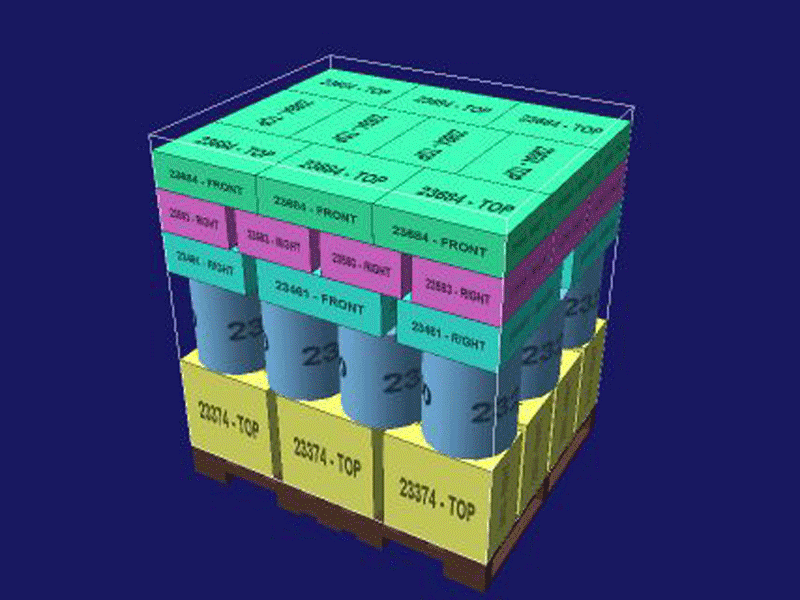
Pallet Load configurations
Found this interesting ... a pallet manufacturer's images of various loading schema:






Algebra is worthless - to a PolySci professor.
Labels:
8th Grade Algebra,
Math Reform
So Andrew Hacker got on the NYTimes and asked "Is Algebra Necessary?"
States such as California who make Algebra I a requirement for 8th grade are forgetting that not everyone will be a STEM major and that there are plenty of adults in the world who can't "do math" yet who are doing just fine and consider themselves successful. Mandatory 8th grade algebra is bad policy. I have never been a proponent of 8th grade algebra except for the 15% or so who are ready for it. Making it a requirement for all 8th grade students is educational abuse in my book.
There are certainly students who will never do well in a strictly abstract, mathematically intense field ... but that's okay. The world needs artists, too. And property management, and construction, and politicians, and entrepreneurs, and salesmen, and fast food, and so on. Where Hacker goes astray is in taking the previous paragraph and then running out of the algebra classroom, Pied-Piper-style, taking the students with him.
Why? All high school students should climb the mathematical ladder to the greatest height they can manage. 9th graders are not in much of a position to know their strengths and weaknesses and should be pushed, cajoled, tutored, helped, or cheered as necessary. It's not until the summer jobs between 10th and 11th grade that students start getting a sense of "this is necessary" or "this is useful" and decide to apply themselves a little more.
Why not let them
experience algebra first? Many students just don't realize what
they are good at. Many parents and elementary school teachers (the two biggest influences in students' lives so far) are rarely good at math and pass on that limitation to the kids. Give me some time to reverse that before you write off this generation as math losers.
If students fail in the abstract path, they should be diverted to a parallel ladder of courses that are less abstract (more vo-tech, perhaps) while still teaching them math.
Hacker is also fairly sloppy about mixing in topics from pre-calculus and calculus and using somewhat obscure terminology to scare the reader ... "vectorial angles and discontinuous functions," two topics that wouldn't be a graduation requirement anywhere and I wouldn't expect very many of the NYT readers to know (I'm not sure Hacker knows either - I think he just picked up a math book).
I'll throw in my favorite, "But there’s no evidence that being able to prove (x² + y²)² = (x² - y²)² + (2xy)² leads to more credible political opinions or social analysis." Well, Andrew, no one ever claimed that it would.
I'll end with this:
Go ahead and deny the algebra classes to anyone who seems unlikely to use the skills. Tell them that they aren't going to take algebra, geometry, calculus. Remove them from all the purely theoretical classes you want.
If you aren't sued for discrimination and neglect, keep on doing it. My students will continue to return and thank me for what we did in class and have an easier time of it because your students won't even be in their rear-view mirror.
"This debate matters. Making mathematics mandatory prevents us from discovering and developing young talent. In the interest of maintaining rigor, we’re actually depleting our pool of brainpower."From a cognitive sense, brain-power depletion is a myth and he's barking up the wrong tree to start with it. His points get worse as he continues.
"The toll mathematics takes begins early. To our nation’s shame, one in four ninth graders fail to finish high school. Most of the educators I’ve talked with cite algebra as the major academic reason."Really? Every school I know of has some program in place for those who cannot pass algebra - consumer math, business math, basic algebra - they can get their three math credits and move on. Then, too, the educators who responded to this man's anecdotal survey probably had no idea of the real reasons kids dropped out - math was just the convenient scapegoat to help make his argument.
States such as California who make Algebra I a requirement for 8th grade are forgetting that not everyone will be a STEM major and that there are plenty of adults in the world who can't "do math" yet who are doing just fine and consider themselves successful. Mandatory 8th grade algebra is bad policy. I have never been a proponent of 8th grade algebra except for the 15% or so who are ready for it. Making it a requirement for all 8th grade students is educational abuse in my book.
There are certainly students who will never do well in a strictly abstract, mathematically intense field ... but that's okay. The world needs artists, too. And property management, and construction, and politicians, and entrepreneurs, and salesmen, and fast food, and so on. Where Hacker goes astray is in taking the previous paragraph and then running out of the algebra classroom, Pied-Piper-style, taking the students with him.
Why? All high school students should climb the mathematical ladder to the greatest height they can manage. 9th graders are not in much of a position to know their strengths and weaknesses and should be pushed, cajoled, tutored, helped, or cheered as necessary. It's not until the summer jobs between 10th and 11th grade that students start getting a sense of "this is necessary" or "this is useful" and decide to apply themselves a little more.
 |
| "If you can't swim the first time you get in the water, you should never try to learn." seems to be his message. |
The depressing conclusion of a faculty report: “failing math at all levels affects retention more than any other academic factor.” A national sample of transcripts found mathematics had twice as many F’s and D’s compared as other subjects. (Which means that math teachers are grading for knowledge and other disciplines for development? Hardly an argument for changing the curriculum. C.)
If students fail in the abstract path, they should be diverted to a parallel ladder of courses that are less abstract (more vo-tech, perhaps) while still teaching them math.
Hacker is also fairly sloppy about mixing in topics from pre-calculus and calculus and using somewhat obscure terminology to scare the reader ... "vectorial angles and discontinuous functions," two topics that wouldn't be a graduation requirement anywhere and I wouldn't expect very many of the NYT readers to know (I'm not sure Hacker knows either - I think he just picked up a math book).
I'll throw in my favorite, "But there’s no evidence that being able to prove (x² + y²)² = (x² - y²)² + (2xy)² leads to more credible political opinions or social analysis." Well, Andrew, no one ever claimed that it would.
Actually, it's their perseverance that helps them score better on the tests. It's that same perseverance that dictates whether they will succeed in college and in life. Removing algebra doesn't change that.It’s true that students in Finland, South Korea and Canada score better on mathematics tests. But it’s their perseverance, not their classroom algebra, that fits them for demanding jobs.

But a definitive analysis by the Georgetown Center on Education and the Workforce forecasts that in the decade ahead a mere 5 percent of entry-level workers will need to be proficient in algebra or above.Not to press the point, but entry-level jobs rarely require much of anything. They won't ask the entry-level intern to write a report, but grammar and writing skills are necessary. An entry-level construction worker isn't interpreting designs, and the entry-level brewery go-fer isn't using his biology knowledge. It's at the next levels, where the decisions are made, that companies require the writing, programming, algebra, science, and tech skills.
I'll end with this:
Go ahead and deny the algebra classes to anyone who seems unlikely to use the skills. Tell them that they aren't going to take algebra, geometry, calculus. Remove them from all the purely theoretical classes you want.
If you aren't sued for discrimination and neglect, keep on doing it. My students will continue to return and thank me for what we did in class and have an easier time of it because your students won't even be in their rear-view mirror.
I’ll grant that with an outpouring of resources, we could reclaim many dropouts and help them get through quadratic equations. But that would misuse teaching talent and student effort. It would be far better to reduce, not expand, the mathematics we ask young people to imbibe.Works for me.
Tuesday, July 24, 2012
Super-Duper Teacher Mentors
Labels:
PDev
Just what we need ... more teachers with slightly above-average ability getting $20,000 to do less teaching and more "mentoring".
These subjective, holistic-sounding pieces of evidence will then be analyzed by three panels of master educators using an objective-sounding yet surprisingly sloppy RUBRIC to whittle down the candidate pool to those who are the "top talent", a euphemism for "someone willing to put a family life on hold while cranking out endless reams of drivel in exactly the proper format required."
Amazingly, the winners of this particular lottery will be those who are tallest, prettiest and who are the same skin color as the examiners. And then they'll throw in some others so they aren't accused of being racist or anything. Ethnicity will not be a factor until it has to be one to keep the list of "top talent" from seeming too monotonic.
After the candidates spend the requisite 200 hours putting together the 40 hours of video and another few hundred typing the portfolio into proper format, while grading endless term papers, reading and analyzing daily stacks of exit cards, preparing for and analyzing more standardized test data than the DOE ... then the Board will eliminate 90% of them.
The ones left won't be the best teachers; they won't be the best mentors; they probably won't even be well-educated. They certainly won't have the personality to mentor their peers without being annoying little know-it-alls.
They'll be great at the trappings of education and lousy at doing the job that they're "paid" for.
President Obama wants to create a “master teacher corps,” starting with 50 math and science teachers who’d earn an additional $20,000 a year to act as mentors, plan curriculum and lead school turnarounds. The administration proposes spending $100 million this year and $1 billion next year to increase the corps to 10,000 teachers, reports National Journal.And how will we choose these Masters of the Classroom? I figure that we'll use standardized test scores to select them for inclusion in the program, require them to submit 50-page portfolios of their teaching, including evidence of effectiveness as witnessed by superiors, a minimum of 40 hours of video recordings of the best lessons in their "toolbox".
 |
| What does "awesome" look like? It looks like me, of course. |
Amazingly, the winners of this particular lottery will be those who are tallest, prettiest and who are the same skin color as the examiners. And then they'll throw in some others so they aren't accused of being racist or anything. Ethnicity will not be a factor until it has to be one to keep the list of "top talent" from seeming too monotonic.
After the candidates spend the requisite 200 hours putting together the 40 hours of video and another few hundred typing the portfolio into proper format, while grading endless term papers, reading and analyzing daily stacks of exit cards, preparing for and analyzing more standardized test data than the DOE ... then the Board will eliminate 90% of them.
The ones left won't be the best teachers; they won't be the best mentors; they probably won't even be well-educated. They certainly won't have the personality to mentor their peers without being annoying little know-it-alls.
They'll be great at the trappings of education and lousy at doing the job that they're "paid" for.
The Crisis that is Khan
Labels:
21st Century Schooling,
Khan,
School Reform
Karim Kai Ani via Washingtonpost.com.
teachers aren’t “pissed off” because Sal Khan is the world’s teacher. They’re concerned that he’s a bad teacher who people think is great; that the guy who’s delivered over 170 million lessons to students around the world openly brags about being unprepared and considers the precise explanation of mathematical concepts to be mere “nitpicking.”
Experienced educators are concerned that when bad teaching happens in the classroom, it’s a crisis; but that when it happens on YouTube, it’s a “revolution.”
Monday, July 16, 2012
Preparation ...
Labels:
SCA
Almost time for the highlight of my summer ... Battle of Hastings re-enactment and seven days of other battles and fighting. Total blast.

Me and 12,000 of my closest friends:

I'm here somewhere.

Me and 12,000 of my closest friends:

I'm here somewhere.
Friday, July 13, 2012
Fill the Pail, then Light the Fire.
Labels:
Fallacy,
Ideas for New Teachers
If you don't know some of the facts, your opinions and viewpoints are worthless.
It's the same in math. If you can't factor trinomials, then there are scads of things that you can't do much thinking about. If you spend three minutes to do a fraction addition that the rest of the class does in seconds, then your understanding of probability is delayed, if not severely impacted. If you reach for a calculator to add ½ and ⅔, it makes it difficult for you to focus on what you really wanted to accomplish.
Imagine a class of Korean and Japanese kids (like one I had some years ago). All had limited English skills. They were always looking up words in the dictionary instead of memorizing, always working out the meaning word by word, and always resisting when we said "Just use English ... We know it's hard but it will pay off." One day, we finished our math work early and one asked me about a Reading homework (instantly, the rest chimed in). They were having trouble understanding what was going on.

None of the students got it. They were so wrapped up in the definitions of words, in the structure of the sentences, and meaning of sentences that they couldn't put it all together at once and understand the whole. They didn't have enough facts and basic understanding to do any critical thinking. The "can't see the forest for the trees" analogy.
As an experiment, I grabbed a couple of weaker American students, dyslexics and generally slow readers ... they all got it instantly ... "Ewwww." I grabbed some European kids who had more years in country ... they all got it instantly ... "That's gross." The Asian kids were still stymied, even while other kids tried to explain without giving it all away.
Lighting that fire should be your goal, but the facts and knowledge are the only things you have for fuel.
And the original wasn't Yeats, it was Plutarch:
For the mind does not require filling like a bottle, but rather, like wood, it only requires kindling to create in it an impulse to think independently and an ardent desire for the truth. Plutarch , page 259Not that the Internet has a clue:
 |
 |
 |
You can vote it up on Joanne Jacobs for least favorite edu-homily.
Thursday, July 12, 2012
Cheating on Tests Again
Labels:
Cheating,
Teacher Education
Joanne Jacobs has:
After taking the test and passing it, they can take their place in the new-hires whirlwind.
The Math PRAXIS 2 is pre-calculus. If you can't pass that, you shouldn't be teaching math ... and a case could be made for middle and elementary school, too. Teachers shouldn't be the stupidest ones in the school.
Really? The PRAXIS test is really easy. The English one has simple grammar and a writing test that a chipmunk couldn't pass but only because the chipmunk can't type. The math test has decimal place-value questions and fractions. Every one of those teachers should be immediately fired.Aspiring teachers paid a Memphis school official to find substitutes to take a teacher certification exam, prosecutors charge. Clarence Mumford, 58, is accused of charging $1,500 to $3,000 per test. The scam involved at least 50 teachers and would-be teachers required to pass the PRAXIS in Tennessee, Mississippi, and Arkansas from 1995 to 2010, according to the indictment.

After taking the test and passing it, they can take their place in the new-hires whirlwind.
The Math PRAXIS 2 is pre-calculus. If you can't pass that, you shouldn't be teaching math ... and a case could be made for middle and elementary school, too. Teachers shouldn't be the stupidest ones in the school.
Subscribe to:
Posts (Atom)


 Posts
Posts


